Time is not possessed, it is passed through. And Laila Al Habash talks about it as a living organism, which expands and contracts depending on how much we learn to stay inside it.
“Tempo” is the new album by the Roman singer-songwriter of Palestinian origins, a record born from a dream and an urgency: to understand how to live in an era that runs at the speed of light.
After Mystic Motel Laila returns with a work written in solitude, during a summer suspended in an empty city, to observe her anxieties and the sensation of being “old and precocious at the same time”.
He mixes languages and worlds – Italian, English, Arabic – building a pop full of colour, but crossed by profound questions about time, love and society. Inside there are the luminous ghosts of Raffaella Carrà, Bruno Lauzi and Califano, the taste for popular melody and the lucidity of the present. Time it's a record that invites you to slow down, to breathe, to return to the center.
We met her to talk about models, musical eras and what it means to make art today, in a world that seems on the verge of collapsing but still needs – desperately – beauty.
THE INTERVIEW
“Tempo” is your new album. What is your time? What is your dimension of time?
It's a huge question, but that's actually where it all comes from. The title was literally suggested to me in a dream, a few years ago, while I was finishing my first album. I remember saying to myself: “The next one will be called Tempo”. I still didn't know why, but I had written a sentence on my phone: it's something that everyone has and no one ever has it, it's free but no one knows how to spend it.
That name has become a compass. Over time I understood that this album spoke precisely of my relationship with time, with age, with growth.
I have always been “out of phase”: as a child they told me I looked older, but no one took me seriously; Now that I'm 26, I still feel on the edge, always running to get somewhere. Making this record was an exercise in observation: more than finding answers, I was interested in understanding the journey. I learned, slowly, that the present is a very difficult place to be.
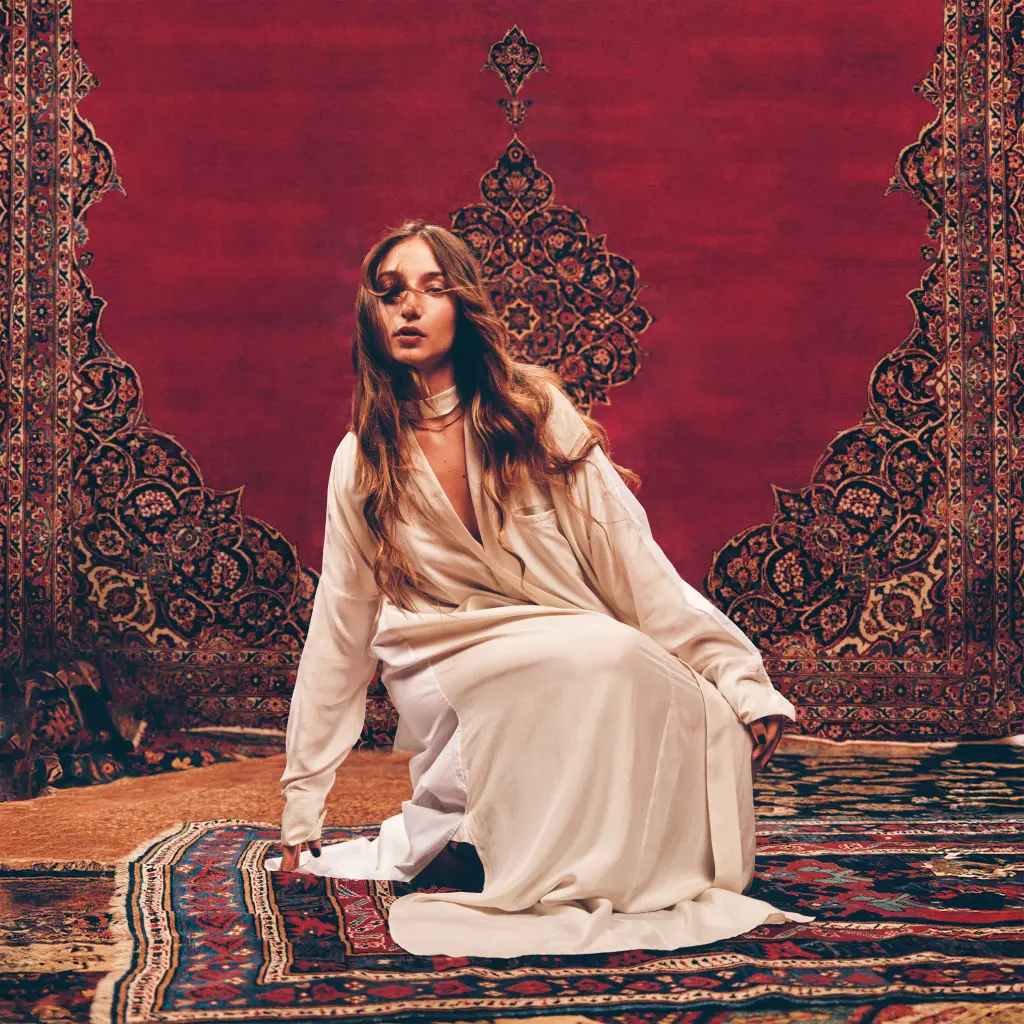
It's your second album after “Mystic Motel”, and the second album is always the most difficult. How was “Tempo” born and how did you choose the cover with the carpets?
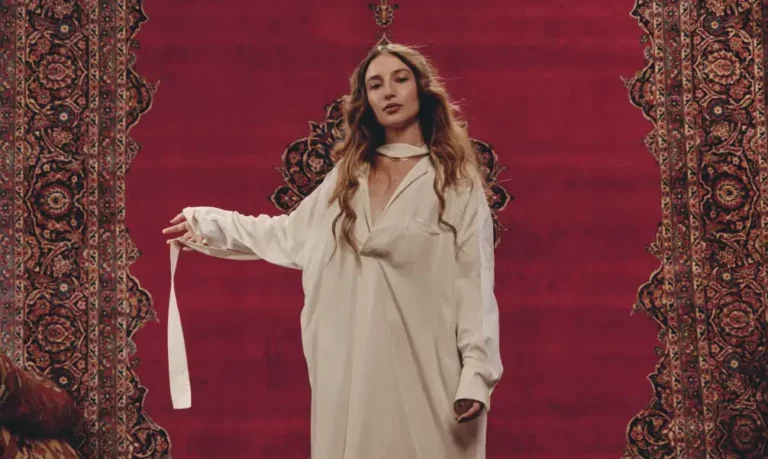
Look, in reality “Tempo” was born long before the songs. I already had the title and cover in mind, but not a note. I have always had a very strong connection with fabrics: my first EP was called Moquette, then “Mystic Motel” had that imagery of rooms, tapestries, carpets… and I grew up in a house full of Arabic carpets.
I can't imagine a place I call “home” without a large rug on the floor.
In 2021 I met Mehran Farmand, son of the owner of the Farmand Gallery, an antique carpet gallery in Rome.
He was the one who said to me: “Why don't you do the cover here?”. And it was like a light bulb turned on for me: it all made sense. We shot there, just me and a carpet. It is an image that perfectly encapsulates the meaning of the record: something ancient, experienced, which however accompanies you in the present.
“Tempo” is also a profoundly generational album. We live in the anxiety of doing everything, of always being productive. It's like we have less and less time. Do you think there once was more?
I don't know, but I think every era has thought they were experiencing the end of the world. Maybe only the boomers didn't (laughs), they still had faith in the future.
Today we certainly live in a society that praises you if you are super-performing, if you already have ten goals at twenty years old.
We are constantly compared to others: sales, streaming, results… and you end up no longer having your own internal rhythm. I for one live it with anxiety.
I believe we should relearn how to “waste time”, to do things that are useless. The moments of inaction, those in which you produce nothing, are the most precious.
When I'm still, when I travel on the train, when I'm doing “nothing”, I actually understand everything. That's where I really make things happen.
We live in a society that links personal value to productivity. I myself had to remind myself that if I don't do anything… I'm still worth something.
Another strong theme also emerges in the album: desire. How does it fit in with time? Is it still possible to desire, in an era that seems to no longer have any?
Desire is my favorite word on the album, perhaps also the most mysterious. I don't think it's gone, but it's definitely changed. We live in a society that forces you to continuously desire material things, goals, goals. In my songs I talk about a greater, more existential desire: what is something that only exists when you don't have it?
Desire lives by hunger, it does not die of hunger. It's the drive that keeps you alive, creative. This is why in the song Wish I wanted to leave it free, without structure. It's a piece that is on the record because it talks about the very hunger of making music, without any apparent purpose.
In Shy instead you tell a journey, perhaps inspired by Brazil.
Exact. I was on tour in Brazil and I noticed something absurd: I, who have always considered myself an outgoing person, seemed shy there! (laughs) Everyone there is cheerful, spontaneous, open. And I asked myself: “So who am I, really?”.
The song was born from that feeling. Timido is a piece with a lighter rhythm, almost bossa, which plays with the idea of questioning oneself again.
In general, travel has always been fundamental to me. I spend almost all my money on travel, although in recent years I have had a more critical relationship with tourism. You don't need to go to the other side of the world to change perspective: sometimes you just need to take the ring road. I wrote my first songs right there, in the car. That too was a journey.
What was your last trip?
Wait… the last real trip was to Greece, in September. A remote island in the Cyclades. Then yes, I always travel Rome-Milan twice a month, but that doesn't count.
That trip, however, yes: it helped me stop for a moment, to breathe.
In the album you mention Bruno Lauzi and Iva Zanicchi. Who are your models, your references?
I have always been viscerally attracted to Italian songs written between the 50s and 70s. I'm fascinated by finding hidden gems, the B-sides of records that no one knows about.
My mother is my first source: she is the one who put me in contact with that world, my benchmark.
If she says “I don't know this one”, I win. She was the one who made me listen How I would like you by Iva Zanicchi, a song I heard as a child.I believe very much in the relationship between time and music. Every era has told about love and life in its own way. I think of Califano, who wrote with disarming sincerity, or of Max Pezzali, who thirty years later spoke of the same things but within the Po Valley. It's the same human gaze, just with different landscapes.
In Wants there's just that: it's an ideal response to And say hello to her for me by Raffaella Carrà. I've always been struck by that song where she tells this man “don't tell lies, I already know what you're doing… say hello to her for me”. A very strong, almost revolutionary way of speaking as a woman in the Seventies.
I wanted to write a song that had the same directness, even if it tells a story about a friend.
My influences are always hybrid: Bruno Lauzi for writing, Enzo Carella for sensitivity, that whole world that continues to nourish me.
In your opinion, are you in the right musical era? Or would you have liked to live in another time of music?
I think anyone would tell you that they wish they lived in a time when records were sold, when people actually stopped to listen to them. Today, sixty albums are released a day, not sixty a year. But at the same time, it's our present, and that's okay.
Of course, I would have liked to live in a time with more space for attention, for concentration. But I don't idealize the past: even the Beatles complained that they had no money! Every era has its struggles. Maybe in twenty years I will say: “how cool it was when we were 15 and the Dark Polo Gang was there”. It's easy to be nostalgic for times you didn't experience.
I don't know the right recipe, but I think that being in the moment — being truly present to yourself — is already a lot.
Earlier you mentioned the constant sense of apocalypse that accompanies us today. In such a complex moment, what is the point of making music and culture?
Making art is a form of breathing. It's inevitable. Even if you do it alone, in your home, it is a human, natural gesture. This is why I feel sorry when art is treated as a hobby, or as something “useless”.
It should be the opposite: it is what has always defined us as a species. Before we even spoke, we started singing, drawing, dancing. Italy experiences a paradox: we are a country that owes everything to culture, but treats it as if it were not important.
During the pandemic we understood it: without concerts, cinema or books we were going crazy. Art is essential.
And precisely because we live in difficult times, there is a need to express what we feel. Not necessarily explicitly, but letting the emotions find a channel. It's inevitable.And then, on a practical level, we also need to raise our heads: demonstrate, take to the streets, say when something is wrong. Italy doesn't do it often, but when it happens – like in the demonstrations for Palestine – you feel that culture can still unite and give voice.
Will you find the “Time” to bring the album live?
Absolutely yes! The album is designed to be played live, the dimension I love most. The whole time I had the impression that we were writing each song, imagining it as a function of a live concert.”
THE TRACKLIST
1. I'll try again
2. Fumantina
3.UFO
4.What work do you do
5. Desire
6.You serve me
7.There is time
8. Desire
9.Shy
10.Sahbi
11.Dream86
12.Tuareg
ABOUT
Laila Al Habash is a pop singer-songwriter born in Rome and of Palestinian origin. His icons are Raffaella Carrà and Mina. The artist has an album and two EPs and collaborations with Coez, Studio Murena, Stabber and Maria Antonietta. He opened Coldplay's live shows at the Maradona in Naples and at Lana Del Rey's Lido di Camaiore. With her music, she has always had an outlook outside Italy: in recent years she has toured Brazil, Germany, the United Arab Emirates and Morocco.
Laila Al Habash is one of the new voices of Italian music, chosen by “Radar Italia” for Spotify and by “Breakthrough Italia” for Amazon Music. In 2021 she was ambassador of the Spotify playlist EQUAL, with the billboard in Times Square in New York dedicated to her.
WEB & SOCIAL
https://www.instagram.com/lailaalabastro