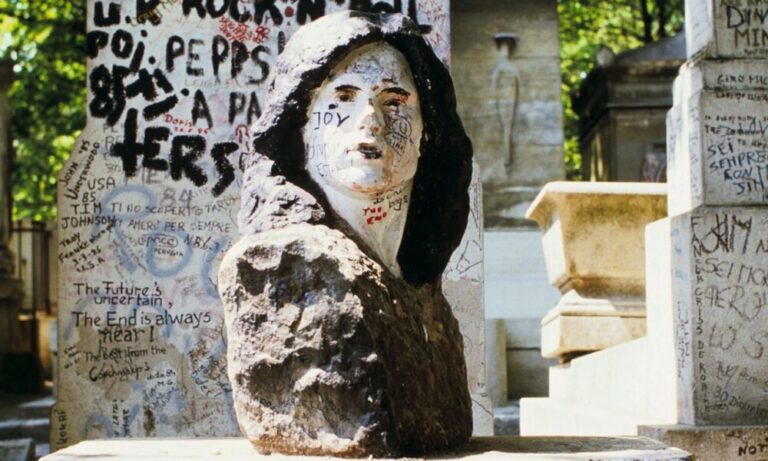
Stolen in 1988 from the Père-Lachaise cemetery, the famous bust of Jim Morrison was found last May by the Paris police. But behind this rediscovery lies a still unsolved enigma: who stole it, and why? WECB looks back at the story of this mystery
On July 3, 1971, at dawn, Pamela Courson discovered Jim Morrison inanimate in the bathtub of their Parisian apartment. Officially, the Doors singer dies of cardiac arrest. But the absence of an autopsy immediately fueled the rumors: overdose? asthma attack? staging?
Buried in secrecy at Père-Lachaise, out of sight, Morrison became in a few years a mythical figure – and his tomb, a place of global pilgrimage.
A rock sanctuary turned battlefield
Installed in 1981, a white Macedonian marble bust, sculpted by the young Yugoslav artist Mladen Mikulin, became the focal point of the tomb. The work, representing Morrison as an ancient Dionysus, attracts fans and curious people. Bottles of wine, wilted flowers, and half-smoked joints are placed there. Patti Smith would later describe in Just Kids “an improvised altar” where they pile up “broken rosaries, half-full bottles and strange charms”.
But this fervor turns into chaos. Neighboring families complain, cemetery guards become exasperated, and Paris town hall fears seeing Père-Lachaise transformed into a psychedelic squat.
For the Morrison family, the situation is unbearable: “It had become a shame”confides Anne Chewning, sister of the singer. “Jim would have liked the fans to come, but not in this state. »
The day the head of “Lizard King” disappeared
One morning in May 1988, photographer Antoine Le Grand received a strange call. Two young men claim to be the perpetrators of an incredible theft: they stole the bust of Jim Morrison. An appointment is made in a plush apartment on the left bank.
They claim to have “saved” the vandals' monument. In reality, their version is not convincing. How could two young guys and a scooter have transported such a massive block of marble across Paris?
A theft more mysterious than it seems
No arrests will follow. The investigation bogs down, theories flourish. Some speak of a sponsored theft, others of an act of conceptual art. For 37 years, the bust remained undiscovered — until May 16, 2025.
That day, the Regional Directorate of the Paris Judicial Police published an unexpected Instagram post:
The photo shows the marble sculpture, wrapped in cords, labeled as evidence in a warehouse. No details are given, other than that the discovery was made “by chance” during a search.
The Paris town hall is just as laconic. “Unfortunately we have little information at this stage”declares its spokesperson, Margot Dubertrand.
A case that spans the decades
Fascinated by this affair since my first visit to Père-Lachaise in 1988, I wanted to understand what really happened to the missing bust. My investigation, carried out between the Morrison family, the municipal archives and witnesses of the time, reveals a much more complex story – between a forgotten sculptor, a family feud and the gray areas of the Parisian administration. Because the Morrison family has never validated the presence of the bust. Jim wasn't even supposed to be laid to rest under a monument. The right to the concession belonged to Pamela Courson, his partner, who died three years after him. It is therefore to his parents that the grave belongs.
Despite this, Mikulin obtains authorization “exceptional” of the mayor of Paris in 1981. The 21-year-old artist created the bust “in gratitude for what Jim left behind”. On July 3, the tenth anniversary of the singer's death, the work was inaugurated in the presence of the three surviving Doors. “It was moving”remembers guitarist Robby Krieger. “I didn’t see any ghosts, but lots of smiles. »
When the family wanted to move the grave
Over the years, the situation deteriorated. Père-Lachaise employees complain of nocturnal crowds, broken bottles, loving couples on neighboring graves. “If we could get rid of him, we would”let go of a manager in 2004.
In a family file entitled “We Want to Move Jim”the singer's sister and niece keep an unpublished letter dated 1986: Jim's mother officially requests the transfer of the grave to a more discreet location – or even its repatriation to the United States. The request is refused. “The cemetery said no, without explanation,” said Tristin Dillon, Morrison’s niece.
His grandmother, exasperated, then joked: “Ask a friend in Paris to steal the bust and throw it in the Seine. »
Two years later, he disappeared for good.
The trail of the forgotten witness
The mystery could have ended there. But a direct witness, Andrew Sarnow, emerges from the shadows today. In March 1988 — two months before the alleged theft — this young American traveling in Paris photographed the bust removed from its base, placed behind the tomb.
His photos, published for the first time, show a fragile fixation: a simple piece of iron connecting the head to the pedestal.
However, a letter from the funeral services attests that the theft occurred not in May, but in the night of March. The history of “two Xs on a moped” would therefore be an illusion.
A return without a happy ending
Thirty-seven years later, the sculpture reappears, without explanation. For the Morrison family, there is no question of putting her back in the grave.
“My parents never loved her, because they didn’t choose her”explains Chewning.
They now want the bust to be exhibited in a contemporary art museum in Paris, “where fans can admire it without damaging the tomb”.
And maybe that's how Jim would have wanted things to end: in the beauty of mystery.