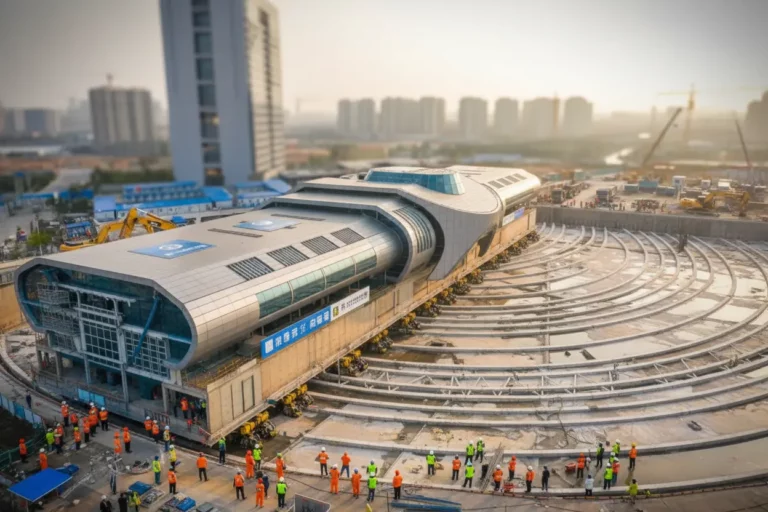
This isn’t the latest sci-fi blockbuster but the astonishing real-life tale of a construction project that took place in 2019 in the southeastern Chinese city of Xiamen.
A High-Speed Roadblock
The authorities in Fujian Province had a problem: to make way for a new high-speed rail line, something had to move. In the way stood the brand-new Houxi Long Distance Bus Station—a hulking beast of a building, far too massive for traditional relocation methods.
How massive? We’re talking 30,000 metric tons. That’s about the weight of a full-sized aircraft carrier, or if you’d rather, the equivalent of lining up 170 Boeing 737s nose-to-tail. Destroying the building wasn’t an option. Instead, they decided to swivel the entire station on its base, then slide it nearly 300 meters (about 985 feet) to its new home—without removing a single brick!
Sliding a Skyscraper, Brick by Brick… Literally
Accomplishing this required some serious engineering wizardry:
- Engineers developed a system of mobile rails placed beneath the structure.
- Five-hundred and thirty-two hydraulic jacks were distributed under the station.
- A computer system synchronized every move, step by tiny step.
- Half the jacks lifted the building, while the other half gently nudged it forward, and so on in relay.
This strange and mesmerizing ballet played out over 40 days, with the building inching forward at roughly 20 meters (about 66 feet) per day, setting a new world record officially recognized by the Guinness Book. To the naked eye, nothing dramatic seemed to happen, but in timelapse, it looked eerily like a mechanical creature: moving in steady, almost organic, pulses.
On social media, the technical term was “assisted structural translation,” but the rest of the world just called it mind-blowing. A timelapse video posted on Weibo quickly clocked up millions of views, showing the building gliding serenely across the city—no dust clouds, no commotion, just effortless motion as if the whole structure was riding on giant skates.
The Cost: Cheaper Than a Do-Over
Why not just rebuild? Good question! The Houxi Bus Station had opened its doors in 2015, built for about €36 million (roughly $39 million USD at current rates). Constructing a replica would have been even pricier and—more importantly—far more time-consuming. Not to mention, demolition and reconstruction would have been an environmental mess.
Sliding the station to its new plot cost around €7 million (roughly $7.6 million USD). Not super cheap, admittedly. But for a feat of such precision—preserving the existing infrastructure and sparing a whole neighborhood months of disruption—it was actually quite economical.
Inspiring the World’s Engineers and… Sparking Debate
Today, this one-of-a-kind relocation job is being studied in engineering schools across the globe. It’s proof that with courage, technology, and a dash of imagination, even the rules of civil engineering can be rewritten.
“Very smart… this country is going to compete with the USA, whatever anyone says! Asian countries could pull ahead of us just thanks to their intelligence!”
But some have put China’s record-breaking move in perspective:
“In the 1960s, the French company Sainrapt and Brice moved an 800-ton Egyptian temple 2.6 kilometers (1.6 miles) for the construction of the Aswan Dam. Admittedly, it was lighter, but the distance, fragility, and historical value made it a much more delicate task… The principle was the same: prestressed beams for support and rail movement using heavy-duty jacks.”
“True, and with only the technology of that era! But today’s journalists prefer to highlight other countries’ achievements… Even for comparisons, they’d rather mention Boeing than Airbus. Mental colonialism, anyone?”
Whatever your take, there’s no denying that the world watched, stunned—and just maybe, a little inspired—by Xiamen’s moving miracle.