In a move that has stirred debate across academic and political circles, Florida Governor Ron DeSantis has ordered state universities to stop hiring foreign workers on H-1B visas, a program long used to recruit highly skilled international talent. The decision, announced in late October, signals a shift toward a more protectionist hiring philosophy—one that many educators warn could reshape the state’s higher-education landscape.
A Political Push to Prioritize American Workers
Standing at the University of South Florida, DeSantis framed his directive as a matter of national loyalty. He cited examples—an assistant swimming coach from Spain, a public-policy professor from China, a graphic designer from Canada—as illustrations of roles he believes should be filled by U.S. citizens.
“Are you kidding me?” he asked. “We can’t train an assistant swim coach in this country?”
His stance mirrors a broader campaign by former President Donald Trump, whose administration drastically raised the cost of obtaining an H-1B visa—from roughly $2,000 to $100,000 per applicant—in an effort to discourage employers from hiring abroad. Trump officials argued that American companies should “train American graduates” instead of relying on overseas talent.
Experts Warn of Serious Academic Consequences
Higher-education leaders, however, have raised alarms. Lynn Pasquerella, president of the American Association of Colleges and Universities, says limiting H-1B visas threatens the core mission of public universities:
“It would undermine Florida’s ability to recruit and retain top professors, researchers, and international students.”
Charles Lee Isbell Jr., chancellor of the University of Illinois at Urbana-Champaign, echoed the concern, noting that forced hiring of less-qualified candidates would inevitably erode academic excellence and compromise merit-based selection.
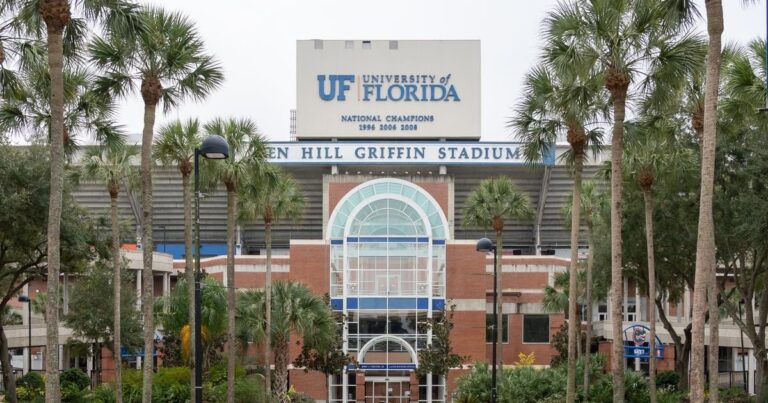
Florida’s own numbers highlight the stakes: between January and June, the state’s 12-university system received about 400 approved H-1B petitions—including 156 for the University of Florida. For comparison, Washington University in St. Louis reports over 700 H-1B employees, many of whom contribute to advanced research and patient care.
A State Power With Federal Limits
Despite his bold rhetoric, DeSantis cannot revoke or block H-1B visas outright—they are issued exclusively by the federal government. What he can do is instruct state universities to stop sponsoring applicants, a policy shift that would disproportionately affect positions requiring specialized expertise.
Pasquerella notes that such a directive would almost certainly face legal challenges, given the potential conflict with federal immigration authority and university governance structures.
A Clash Between Politics and Higher Education
Florida’s new direction highlights a growing tension between nationalist hiring policies and the global nature of modern academia. Universities rely heavily on international scholars for scientific innovation, language programs, medical research, and tech development. Critics fear that curbing foreign recruitment will weaken Florida’s competitiveness and diminish its research output.
As the debate continues, one question looms large: can a state protect domestic workers without compromising the very academic excellence its public universities depend on?
For now, Florida’s campuses—and the foreign scholars who once saw them as a gateway to opportunity—remain in a state of uncertainty.