When it comes to cutting energy bills or reducing our reliance on the grid, most of us think about swapping to LED bulbs or turning appliances off at the wall. But every now and then, someone takes a wonderfully inventive leap that makes the rest of us feel almost embarrassingly conventional. One such tinkerer has been running his entire home on nothing more than sunlight and hundreds of reused laptop batteries – and he’s been doing it successfully for nearly a decade.
How the project all began
Back in late 2016, armed with curiosity and an ever growing pile of discarded laptop batteries, this dedicated DIY enthusiast set out to build his own off grid energy system. The idea was simple enough: if each laptop cell still held a bit of life, why not combine them into something much bigger and more useful?
He installed the setup in a shed about 50 metres from his house, which became the heart of the operation. There, the salvaged batteries were connected to solar panels, creating a constant stream of renewable power. What surprises many is just how smoothly the system has run. Despite sceptics warning about fire hazards or battery swelling, he reports none of these issues – a fact that speaks volumes about careful design and a fair bit of technical know how.
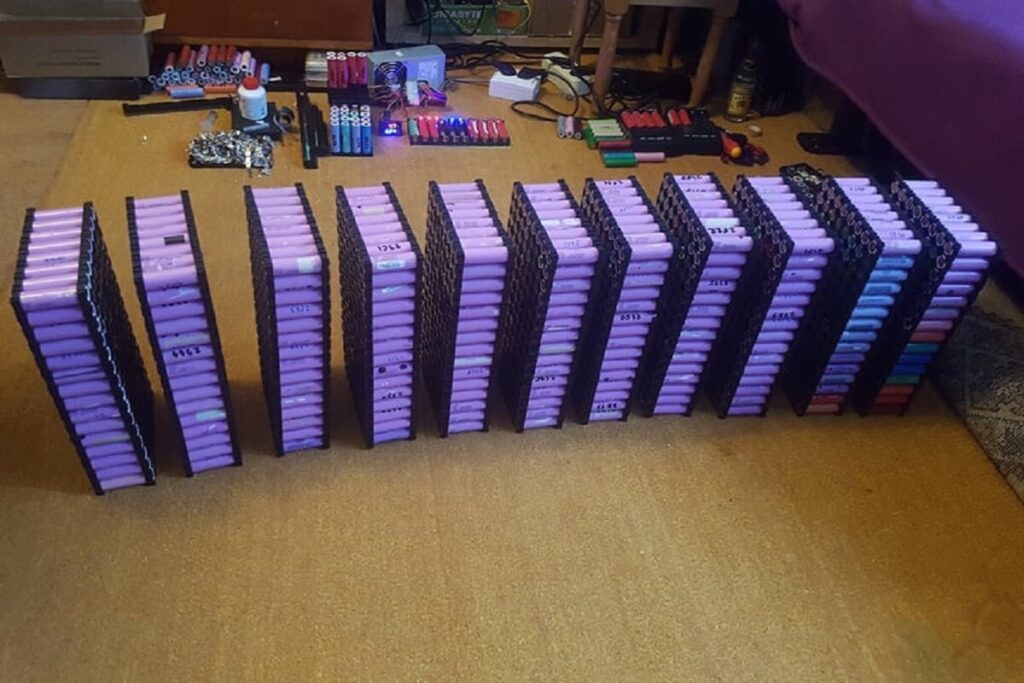
In the early days, he assembled around 650 laptop batteries into packs of roughly 100 Ah each. To ensure durability, he relied on copper cabling rather than cheaper alternatives – a choice that likely contributed to the system’s longevity.
Overcoming technical challenges
Of course, no ambitious project comes without its hiccups. Uneven discharge between old cells turned out to be one of the first big challenges. Instead of abandoning the idea, he dissected the batteries into individual cells and rebuilt them into custom racks. This allowed him to balance the system more precisely and get the most out of every salvaged piece.
Over the years, the setup has continued to evolve. It now includes 24 solar panels, each capable of 440 W, giving the system a serious power boost. Yet perhaps the most remarkable detail is this: since 2016, not a single battery pack has needed replacing. It is a rare example of electronic waste not only being reused, but thriving far beyond its expected lifespan.
According to the International Energy Agency, electronic waste is one of the world’s fastest growing waste streams. His project demonstrates, on a small but meaningful scale, how much potential still lies inside components that usually end up in landfills.
A broader look at energy independence
Beyond the technical victory, this story taps into something larger. With rising energy costs and increasing concern about climate change, more people are looking for ways to become less dependent on traditional power grids. From home solar systems to battery banks and heat pumps, the appetite for energy independence is growing.
What makes this project stand out is its simplicity. It doesn’t rely on cutting edge technology or expensive proprietary systems. Instead, it uses items many consider useless – leftover laptop cells – and turns them into a long lasting power source. It’s a reminder that innovation isn’t always about the newest invention; sometimes it’s about seeing value where others don’t.
His success might even inspire a new wave of community based experiments, especially in places where power cuts or high energy prices are part of daily life.
A vision for a more sustainable future
This long running experiment is more than a quirky engineering project. It’s a testament to what happens when creativity, determination and concern for sustainability meet. He has proven that a home can run reliably on reclaimed technology for years, all while reducing waste and easing pressure on the environment.
As the world moves toward greener solutions, stories like his offer a glimpse of what might be possible when we think beyond the bin. With some imagination – and a healthy respect for safety – even a pile of old laptop batteries can become the backbone of a resilient, eco friendly energy system.
In a time when many are wondering how to navigate the future of power, this project stands as a quiet, brilliant example: the answers might already be sitting in our drawers, waiting to be reimagined.