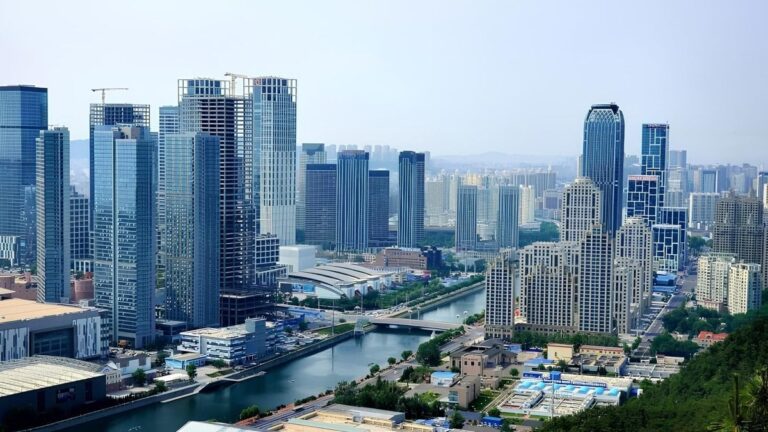
Shenzhen’s skyline is a testament to ambition – glass towers that stretch into the clouds and glow long after sunset. But life inside these vertical giants brings its own peculiar challenges, some so unexpected that entirely new mini-jobs have appeared almost overnight. One of the strangest? People who climb skyscrapers not for thrills, but to deliver takeaway orders the last few dozen floors.
A gig economy within the gig economy
Shenzhen, a tech powerhouse of more than 18 million residents, has grown at breathtaking speed. But with that growth come everyday frictions no one quite predicted. In some of the city’s tallest buildings, such as the 70 storey SEG Plaza, simply catching a lift at peak hours can take up to 30 minutes. For traditional delivery riders, that wait is a financial disaster. Every minute stuck in a lobby means fewer deliveries and lower earnings.
So a spontaneous system emerged: delivery climbers. These aren’t athletes or professionals – they’re teenagers, retired workers or anyone struggling to scrape together a bit of income. Their role is straightforward. They wait at the entrance of skyscrapers, take food from regular couriers and complete the exhausting final ascent themselves, floor by floor, in exchange for a tiny commission.
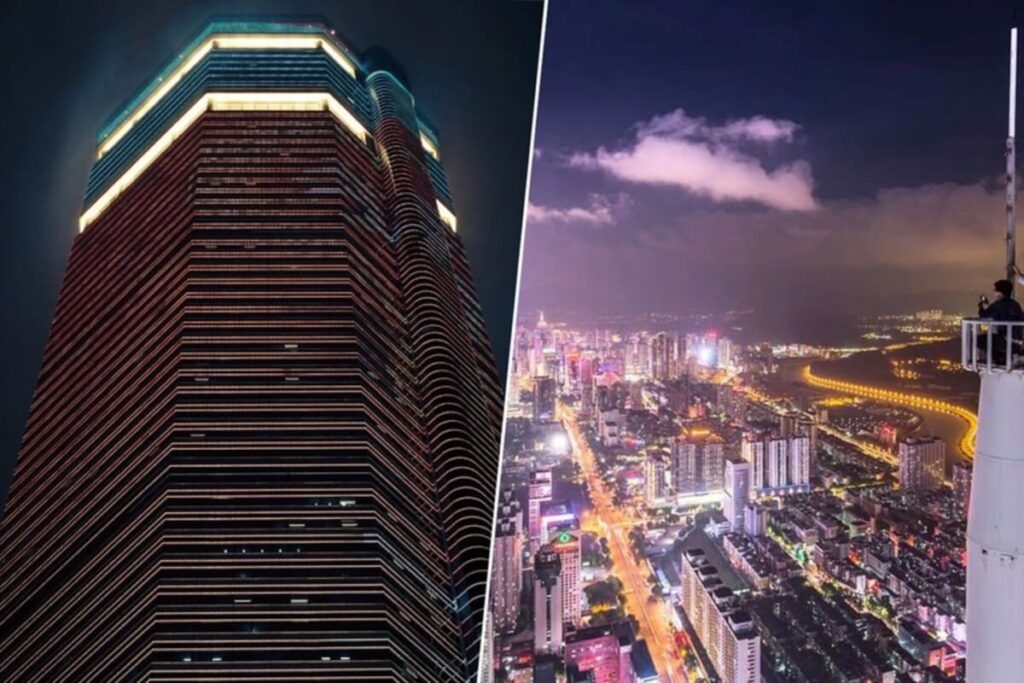
A job built on urgency – and fragility
Take the example of Li Linxing, a 16 year old who spends his days outside SEG Plaza. For around 100 yuan a day – roughly 13 euros – he races up and down tower corridors for about 28 cents per order. He competes with dozens of other climbers, all hoping to be the next one chosen by an incoming delivery driver.
According to the International Labour Organization, informal gig work often fills gaps where formal employment is unstable. Shenzhen’s “building runners” embody this reality. Students on holiday, retirees with tight pensions and migrants with few options all crowd at tower entrances, hoping to earn just enough to get by.
The process is surprisingly organised. A delivery rider arrives on a scooter, hands over the meal, scans a QR code to log the handoff, and speeds off to the next job. The climber takes on the most time consuming part – the slow lifts, the endless corridors and the tricky apartment numbers.
Some individuals have even turned the idea into a mini business. One early pioneer, known locally as Shao Ziyou, has built a team of subcontracted climbers. On busy days, he coordinates between 600 and 700 deliveries, taking a small cut from each. In a city obsessed with speed and efficiency, he has become an unlikely entrepreneur.
A brutal competition on the edge of legality
Of course, where opportunity appears, rivalry follows. The growing number of delivery climbers has created intense competition, often boiling over into arguments on the pavement. A single mistake – a wrong door, a delayed delivery – can lead to fines from delivery apps, which official couriers then pass down to the climbers. Fights over misdirected orders have become commonplace, though most disputes end as quickly as they start.
The work exists in a legal void. There are no contracts, no insurance and no social protections. The UN Human Rights Office warns that informal labour without safeguards places workers, especially minors, at significant risk. And indeed, the situation in Shenzhen became controversial when even children below secondary school age tried their luck after seeing viral clips online.
Authorities have since intervened, limiting the job to those aged 16 and above – but the precariousness remains unchanged.
A portrait of a city on the move
What happens outside SEG Plaza is a snapshot of the larger story of China’s megacities. It’s the collision of high tech ambition with the day to day realities of millions trying to make ends meet. In a place where innovation is constant and inequality visible, people invent new ways to survive – even if it means sprinting through skyscrapers for pocket sized commissions.
This unusual micro-economy may be born of necessity, but it reveals something essential about modern urban life: when cities grow upward faster than they grow fairer, entire worlds emerge in the shadows of the towers.