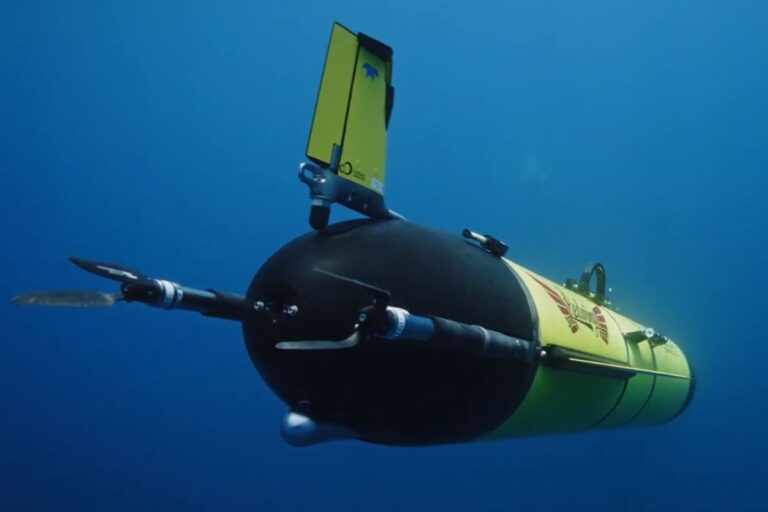
Five centuries after Ferdinand Magellan’s crew completed the first circumnavigation of the planet, another explorer is preparing to follow in their wake – this time, beneath the waves. Barely the size of a surfboard, an autonomous submarine named Redwing is set to embark on a journey that could rewrite the history of ocean exploration.
A tiny vessel with a colossal mission
At just 2.57 metres long and weighing 171 kilograms, Redwing looks unassuming. Yet this compact drone is about to attempt what no vessel – human or robotic – has ever done before: a fully autonomous underwater journey around the world.
Developed by Teledyne Marine in collaboration with Rutgers University in New Jersey, the glider will launch from Martha’s Vineyard off the coast of Massachusetts in October 2025. If all goes to plan, it will travel more than 73,000 kilometres over five years, collecting data about the world’s oceans along the way.
Unlike traditional submarines, Redwing doesn’t have a propeller. Instead, it moves by adjusting its buoyancy. When it becomes slightly heavier than the surrounding water, it glides downward; when it becomes lighter, it rises. This gentle seesaw motion allows it to move forward at about 1.3 km/h, carried by ocean currents – a bit like a sailboat beneath the sea.
Powered by patience, not petrol
The glider’s endurance is its greatest strength. Fitted with oversized batteries and designed to slip silently through the water, Redwing can operate for nearly two years before needing a recharge. Halfway through its global journey, it will make a planned stop for a battery replacement, then continue its mission.
Each day, Redwing will surface twice to transmit data to scientists via satellite and receive updated navigation instructions. ‘It’s like checking in with a very slow but very reliable colleague,’ joked one Rutgers researcher. Over the course of its voyage, the glider will gather a vast trove of information about temperature, salinity, and ocean currents — vital clues for understanding climate change.
Following Magellan’s path, underwater
Redwing’s route echoes Magellan’s historic voyage. It will head from the U.S. East Coast towards the Canary Islands, then on to Cape Town, Western Australia, New Zealand, the Falklands, and possibly Brazil, before returning to Cape Cod.
This path isn’t just symbolic. It crosses remote and under-studied regions of the world’s oceans, where scientists still lack long-term data. By gliding slowly and methodically, Redwing will create the most continuous oceanic dataset ever collected by a single vehicle.
‘This mission is a marathon, not a sprint,’ said Alexander Phillips from the UK’s National Oceanography Centre. ‘Each dive and ascent gives us a clearer picture of how our oceans are changing beneath the surface.’
The hidden dangers below
Storms won’t trouble Redwing – it spends most of its time hundreds of metres below the surface, safe from waves and weather. But there are other hazards. Fishing nets, large cargo ships, and even curious sharks pose real risks.
The team is particularly wary of biofouling, the gradual buildup of algae, barnacles and microorganisms that can weigh the glider down and affect its movement. Previous missions have lost drones to this problem. ‘A single patch of growth can ruin years of planning,’ Phillips explained.
Still, the team remains optimistic. Every extra day the glider survives will be considered a small victory.
Science with a light footprint
Beyond the engineering challenge, Redwing’s mission carries a powerful environmental message. Unlike traditional research vessels that burn thousands of litres of fuel, a glider like Redwing works silently, cleanly, and sustainably, powered by physics and patience.
The data it collects will be shared with universities and schools worldwide, helping students and scientists alike to better understand how the oceans regulate global climate.
Inside Teledyne’s control room, researchers already refer to Redwing as if it were a crew member. On their screens, a single blinking dot will represent the tiny explorer as it inches across the globe – a reminder that groundbreaking exploration doesn’t always roar; sometimes, it hums quietly beneath the surface.
Building on decades of oceanic innovation
Redwing’s voyage is the latest chapter in a story that began decades ago. In 2009, the Scarlet Knight RU27, another Rutgers creation, became the first autonomous glider to cross the Atlantic. Two years later, Silbo, developed by Teledyne and the University of the Azores, repeated the feat over 6,000 kilometres. In 2012, the PacX Wave Glider travelled from San Francisco to Australia using only solar and wave power – still a record for surface drones.
Now, Redwing is poised to go further than any of them. Diving to depths of 1,000 metres, travelling farther and longer than any autonomous sub before it, it represents the next step in robotic ocean exploration.
If it succeeds, Redwing will quietly join the ranks of the world’s great explorers – proving that even in an age of satellites and AI, our planet’s greatest mysteries still lie beneath the sea, waiting to be discovered by a little yellow glider with a very big ambition.