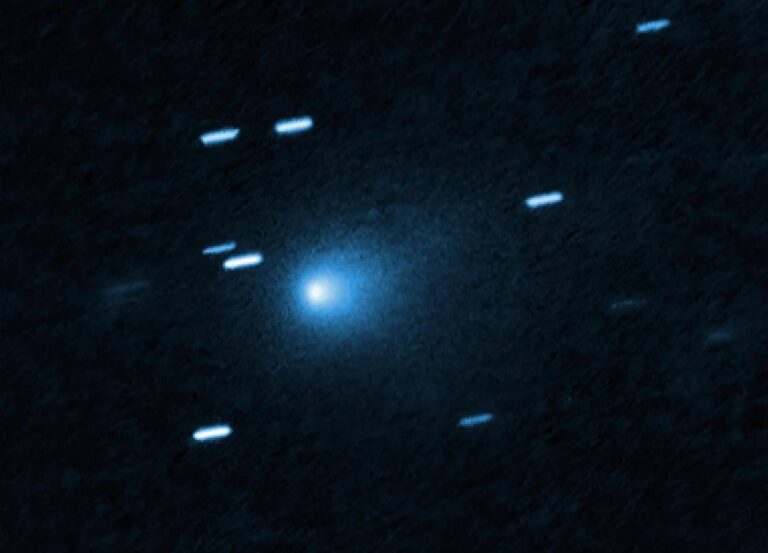
A mysterious object hurtling through our Solar System at record speed has left scientists scratching their heads — and possibly peering into the very origins of the Universe itself. Known as 3I/Atlas, this interstellar visitor could be one of the oldest remnants ever observed, a frozen witness to a time long before Earth even existed.
A comet unlike any other
When astronomers first detected 3I/Atlas in July, they immediately realised it wasn’t just another icy wanderer. Moving far faster and appearing significantly more massive than most comets, it stood out from anything previously observed. Researchers across the globe began speculating about its origins, and a team from the University of A Coruña in Spain may now have an extraordinary answer.
Their new study, submitted to the Astrophysical Journal, suggests that this peculiar comet might date back more than 10 billion years — older than our own Solar System.
‘If confirmed, it would make 3I/Atlas one of the most ancient objects ever detected,’ explains Xabier Pérez Couto, the study’s lead author. ‘It’s essentially a cosmic time capsule, preserving clues about the earliest planetary systems that formed after the Big Bang.’
Tracing a 10-million-year journey
To uncover its past, the researchers used data from the European Space Agency’s Gaia mission, which maps the position and movement of more than one billion stars. By digitally rewinding the clock, they traced the comet’s path across 10 million years of galactic history, comparing it to the orbits of over 13 million stars.
Their goal was simple: to identify a point in space where 3I/Atlas might have come close to another star — an encounter that could have propelled it into interstellar space and eventually into our Solar System.
Yet the findings told a different story. The team found 93 close approaches, 62 of which were considered significant, but none showed any gravitational influence strong enough to explain the comet’s current trajectory.
‘We didn’t see any evidence of a major stellar encounter within the last 10 million years,’ said Pérez Couto. ‘That suggests 3I/Atlas has been travelling undisturbed for a staggeringly long time.’
A relic from before our Sun
If the comet’s path hasn’t been shaped by recent interactions, then it must have been set on its journey much earlier — possibly during the chaotic birth of the Milky Way itself. According to the researchers, its composition and motion indicate that it may have originated in the same thin disk region that holds most of our galaxy’s stars.
This means 3I/Atlas likely formed in one of the Universe’s first planetary nurseries, billions of years before our Sun began to shine. Its current visit offers a rare opportunity to study material that has remained largely unchanged since the dawn of time.
‘Each observation gives us a window into the early Universe,’ Pérez Couto added. ‘We’re looking at matter that predates the Solar System — fragments of the first building blocks that shaped worlds.’
A new chapter in interstellar exploration
3I/Atlas joins a short but growing list of interstellar objects spotted in our cosmic neighbourhood, following ʻOumuamua in 2017 and 2I/Borisov in 2019. But its apparent age and mass make it particularly intriguing.
Unlike ʻOumuamua, which puzzled scientists with its cigar-like shape and unusual acceleration, 3I/Atlas seems to be made of more traditional cometary material — ice, rock, and dust — yet its composition could reveal how the earliest planetary systems differed from ours.
The comet that time forgot
The researchers admit they may never identify the parent star that once hosted 3I/Atlas. After all, the galaxy has shifted dramatically over billions of years. But that doesn’t lessen its importance.
To scientists, this silent traveller is a messenger from the Universe’s youth — a reminder that some stories have been drifting through space for billions of years, waiting for someone to listen.
And as Pérez Couto put it, with a mixture of awe and understatement: ‘It’s not every day you get to study something that might be older than the Sun itself.’