“Finding yourself alone suddenly” is Marco Giudici's new album which arrives 5 years after “Stupid things of enormous importance”.
He returns with a record that courageously confronts loss, in a literal and more abstract sense. Loss, or rather detachment, in all its various forms. The detachment from a person, the one you put away from some habits, the distance from certain desires. Letting go of some pieces of yourself, which is perhaps the most significant aspect.
For me, writing it meant starting to dialogue with some things in life that scared me a lot and that perhaps now scare me a little less, just enough to be able to face them.
Nine tracks, two of which are instrumental, which bring the listener face to face with pain, loneliness, fragility. And at the same time the desire to succeed, the strength of sharing, the courage to change.
In this long conversation the artist talks about loneliness as a starting point, the fascination for imperfect timbres, the relationship with loss and the choice of a more physical and material musical approach. A dialogue that reconstructs the long path that led to the new release and the live horizon that awaits it.
THE INTERVIEW
The new album arrives after five years: a long decantation. Why did you let so much time pass? What was born in this period and what was your creative approach?
It's a question that opens many doors. My first record was released in the midst of Covid: I couldn't experience it, and for me “living a record” simply means carrying it around, playing it, understanding how it resonates within me through experience. That phase allows you to understand how the songs transform, what kind of life they take on. Not having been able to do so, and with everything that was happening in the world, a moment of strong personal change was created.
I started asking myself why I was making music, how I was making it, what I was looking for in this job. Questions that I had to answer, because either I faced that internal dialogue or I would simply stop.
Then it is also my job: I have responsibilities, but I believe that many have gone through similar questions. From there came a certain natural slowness.
In 2022-23 my EP “Io cerca per semper un bivio safe” was also released, which was then incorporated into the album. There I started from ambient music that I was producing for my well-being, to fill my spaces. It came naturally to me to write about it and I felt the need to recount that passage.
Plus I often work on other people's music, and everyone has their turn: I never consider myself ahead of anyone. For example, there was the Any Other album, which required a lot of energy and time. One thing after another, it was simply time for my music.
I don't think there should be any hassle in creativity: when it arrives, it arrives. It can happen in a month or in five years. I also experience music in a collective way, with a lot of exchange, and this means less time for my personal journey – but it is an exchange that enriches me more than the anxiety of constantly producing.
On a lyrical level you address complex emotional angles: loneliness, mourning, detachment. What did you try to tell in these tracks?
There is a sense of solitude which however is more a starting point than a destination. A reworking of detachment, of mourning in the broad sense, not necessarily linked to physical death. These are difficult feelings to dialogue with on equal terms: perhaps it has something to do with this phase of my life, with the ability – new, still under construction – to stay within it.
For me, these corners aren't really uncomfortable: they're how I relate to the people I care about, my friends. I realize that sometimes they weigh heavily, and that not everyone experiences these emotions with the same degree of openness. I understand and respect that. But for me it's natural to talk about it, in fact it's a relief. I believe that music ends up reflecting this way of being in the world.
Musically there is a great timbral research, even through unusual instruments. How did this more “organic” work on sounds come about?
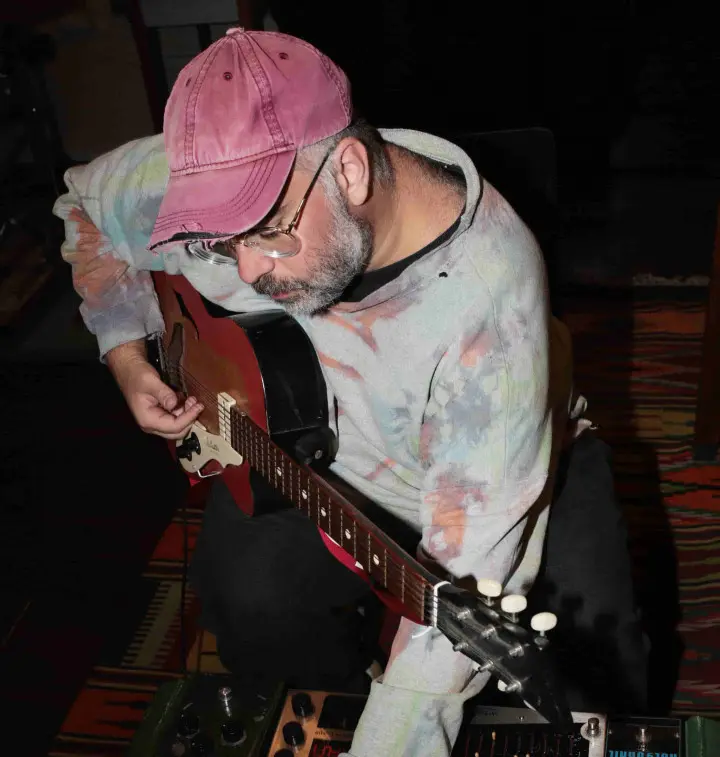
For me it's not really research: it's my daily life. I realize that from the outside it might seem bizarre to fish out a celesta or a dulcitone and stick a distortion tube in it, but it's just my natural fascination. I'm interested in the timbre of physical instruments, the movement of air, the sound that lives in a room. It gives me an immediate sense of organicity.
I also like imperfection: you touch something and whatever happens happens, without control over a thousand variables. The challenge is to seat these timbres within a sonic context that is, in a certain sense, in conflict with that imperfection. The effects and post-production serve to maintain the identity of the instrument and at the same time integrate it into a more “unreal” space. It is a summary of reality: a dialogue between physical truth and sound treatment.
What are you listening to these days? Is there anything that struck you or that you rediscovered?
To be honest, I come from a long period of fasting from listening to new music. I often returned to things I already knew.
Lately the textual dimension has moved me a lot, perhaps because working on music every day I am already immersed in a continuous flow of sound inputs. I like to find musical sensations that don't necessarily come from instruments. And I'm listening to D'Andrea's first album a lot: I never thought I'd do it, but it's really fascinating me.
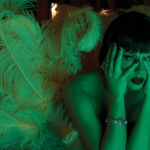
The cover: how was it born, who created it and why that image?
He did the cover Jacopo Lietti, first of all a friend, and then a person with whom I also share the band Liquami. In the last two years we have been very close: I made the album by End Before You Camehis band, and he had already created Bivio Sicuro.
I didn't give him any directions: I just told him to listen to the record and follow what felt right to him. One day, in the car, talking about the sensations that music gave him, he brought up the image of what happens to your eyesight when you look at the sun for too long. A light bulb went on in my head: it was exactly the same indication I had given to the trombonist Federico Fenu to find yourself alone. It must have sounded as if he were a little blinded by the sun, moved, disoriented.
When Jacopo sent me the first proof, I immediately felt something. The more I looked at it, the more it convinced me. And in the end I understood that it was the right one: a glow that leaves a halo in the eyes, just like certain emotions.
And live? How do you imagine the transposition of the album onto the stage?
We are working on the tour. Live I tried to maintain a simplicity that is more hidden on the album. All the layers, the complex sound processes, will not be ignored because my ear otherwise suffers, but I tried to reduce the sensations to something more direct.
If there is a blue, it will not be a light blue. If there is a red, it won't be a rose. A clear gesture rather than the sum of many small gestures. There will be four of us: guitar, bass, drums and keyboards. An essential formation, which returns the emotional core of the pieces. On stage with me there will be Alessandro Cao and Luca Sguera, plus a fourth musician. It will be a simple but very precise live show.
In the review of the album we wrote: “Marco is a safe crossroads to listen to, a life habit, a means of understanding so as not to find yourself alone, suddenly alone.” Is it an image that you feel is yours?
Yes, there is. It's my record, so of course I take responsibility for it. If you have seen a mosaic there, it is probably because that mosaic is really there.
PRODUCTION
The production and arrangements, in some cases also the writing (in a safe and cold crossroads), are shared with Adele Altro, with whom Giudici confirms a close and proven artistic and personal partnership.
The drums are by Alessandro Cau, chosen for the reading and emotional depth of his playing; and Nicholas Remondino, wanted for his very personal way of deepening sounds, of adding layers, gestures, of carrying time in a fragile and engaging way.
Federico Fenu played the trombone and Fausto Cigarini the viola and violin.
The choir voices are Marta Del Grandi, Cecilia Grandi, Adele Altro, Marco Fracasia, Giulio Stermieri, Alessandro Cau and Nicholas Remondino.
LIVE
Marco, on Saturday 29 November, will perform with Adele Altro at FESTIVALINO, scheduled for this evening, Friday 28 and tomorrow, Saturday 29 November in Ferrara.
In addition to him on stage, Giulia Mei, Juni, Korobu, Citrus Citrus, Carlo Pastore and Elisa Graci are among the guests of two days of live shows, talks and showcases
On the streets of the festivals, which will come to life in two important places for the social and cultural activity of the city: Officina MECA and the Circolo Arci Bolognesi.
WEB & SOCIAL
@marcogiudici.it