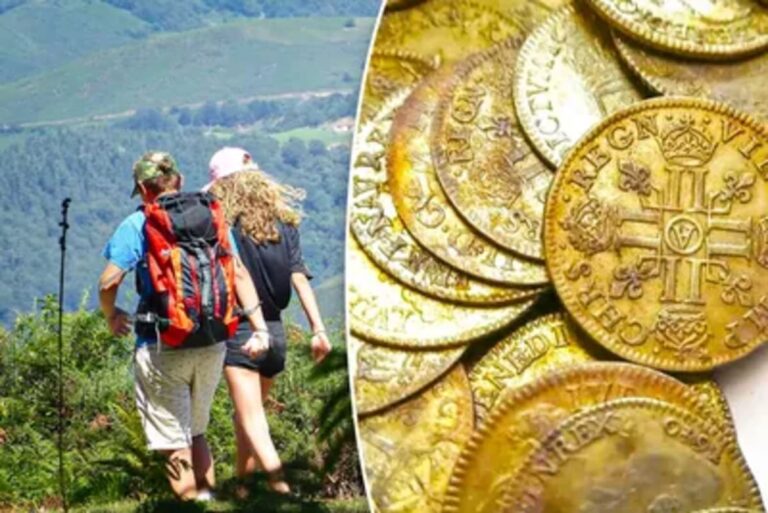
Every so often, a discovery surfaces that feels as if history has tapped us on the shoulder. That is exactly what happened in the Czech mountains, where a pair of winter walkers quite literally stumbled upon a treasure hidden for a century. Gold, personal belongings, fragments of lives interrupted – all carefully tucked away in the earth. Finds like these do more than dazzle; they reopen conversations about fear, resilience and survival in turbulent times. This is the story behind one of the country’s most striking modern hoards.
A hidden treasure in the Czech hills
Two hikers, out for nothing more than fresh air and a bit of winter sunlight, stopped beside a dry stone wall on the slopes of Zvičina. What they found behind a few loose stones turned an ordinary day into something fit for a museum catalogue. Inside two small containers, barely a metre apart, were 598 gold coins, wrapped in dark cloth and stacked with quiet precision. The cache weighed about seven kilos in total, including nearly four kilos of pure gold.
Alongside the coins were everyday possessions that felt almost intimate: a metal purse, a tobacco case, jewellery, a comb and a fine chain ending in a small key. These objects, now kept in secure conditions, sketch the outline of a life interrupted – someone who packed what mattered most before hiding it away.
A curious mix of coins
What makes the find particularly intriguing is the coins’ unexpected composition. Most were French, followed by pieces from the former Austro Hungarian Empire, Belgium and the Ottoman world. Yet none were German or Czechoslovak, an absence that numismatists find striking in this region.
Some coins bore tiny countermarks applied in the Balkans in the 1920s and 1930s, suggesting they travelled widely before their final burial. According to museum specialist Vojtěch Brádle, this pattern hints that the owner preserved them not for their imagery but for their intrinsic value, a kind of private insurance policy during an era of deep uncertainty.
Gold as refuge in a century of upheaval
Central Europe in the early twentieth century was a landscape of shifting borders, political turmoil and monetary instability. Against such a backdrop, burying gold was less a romantic act of secrecy and more a sober attempt at protection. Historians often describe such deposits as material archives of collective stress, signs of families doing what they could to safeguard their future when traditional security nets felt fragile.
The presence of personal trinkets adds a human note to the narrative. Rather than wealth meant for trade, this feels like the hurried gathering of precious belongings, perhaps in response to an impending displacement or a sudden threat. It is a quiet reminder that objects can embody both fear and hope at the same time.
Cutting edge analysis for fragile treasures
To uncover the origins of these artefacts, researchers are turning to X ray fluorescence spectroscopy, a non destructive technique widely used by conservation institutions such as the British Museum. It allows scientists to determine the chemical composition of metals without damaging them, providing clues to purity, date and sometimes even workshop of origin. This method will be used not only for the coins but also for bracelets, powder cases and other items in the hoard.
Such detail matters. Stylistic features, alloy mixtures and microscopic markings can help narrow down ownership and create a clearer picture of how these objects travelled across borders before being hidden.
Protected by law, studied with patience
Under Czech heritage legislation, discoveries of this nature fall under public stewardship. The walkers who reported the find followed the correct procedure and may receive up to ten percent of the hoard’s assessed value, depending on rarity and cultural significance. For now, every item is stored under controlled conditions while experts move methodically through cataloguing and analysis, resisting the temptation of rapid publicity in favour of rigorous study.
When gold becomes a storyteller
Beyond its monetary worth, such a trove reads like a chapter torn from a forgotten diary. The countermarks from the Balkans, the dominance of French currency, the complete absence of German coins – all these elements offer insights into trade patterns, saving habits and the psychological landscape of the interwar years. The region itself, shaped by regime changes and population movements, adds another layer of poignancy to the discovery.
And what is it worth today?
With gold prices soaring above four thousand dollars an ounce, the material value alone reaches several hundred thousand euros. Yet specialists often emphasise that historical resonance outweighs the market price. In a climate of renewed scepticism towards financial institutions and inflationary pressures, interest in old caches and forgotten hoards continues to grow – a reminder that, even today, people turn to tangible security when the world feels uncertain.
The Czech treasure is more than a lucky find. It is a whisper from a turbulent past and a testament to how humans, across generations, cling to protection, memory and whatever hope they can carry.