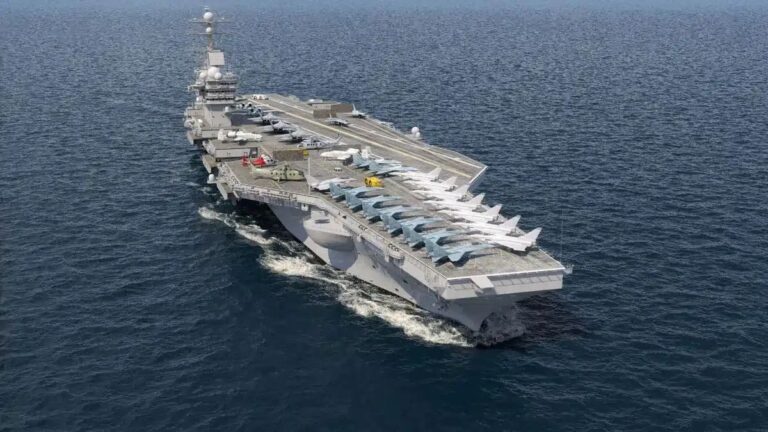
At first glance, it looks like a blueprint pulled from a Cold War thriller. In reality, it is France’s most ambitious naval project in decades. Quietly unveiled but loudly discussed in defence circles, this future aircraft carrier is already reshaping how allies and rivals alike view Europe’s military reach. And it will not even touch the water for another decade.
A Strategic Giant Taking Shape
France’s future aircraft carrier, known as the new generation carrier, marks a turning point for the French Navy. Scheduled to enter service in 2038, it is designed to answer modern maritime threats while securing France’s long term presence on the world’s oceans.
Once operational, it will be the largest warship ever built in Europe and one of the most imposing globally. For defence analysts at organisations such as NATO, this alone signals a shift. Size is not everything at sea, but it still sends a powerful message about strategic deterrence and ambition.
A Collective And High Stakes Project
This floating giant is the result of a carefully balanced industrial partnership. Naval Group and Chantiers de l’Atlantique are sharing construction responsibilities, with the ship to be built in Saint Nazaire, a historic hub of French shipbuilding. Nuclear systems will be overseen by TechnicAtome, a key player in France’s defence energy sector.
The formal order is expected by the end of 2025, leaving little room for delay. Defence economists often note that projects of this scale are as much about national industry as military power. Thousands of skilled jobs depend on keeping the timetable intact, adding economic weight to the project’s military ambition.
A Vessel That Redefines Scale
Numbers tell part of the story. The carrier will stretch roughly 310 metres in length, with a flight deck 85 metres wide. At full load, it will displace around 78,000 tonnes, placing it firmly among the giants of modern naval fleets.
On board, around 1,100 personnel will live and work, from flight crews to command staff and technical specialists. Powered by two nuclear reactors producing a combined output of 440 megawatts, the ship will reach speeds close to 50 kilometres per hour. That propulsion system also gives it exceptional endurance, a key factor in power projection far from home waters.
Air Power And Defence At The Cutting Edge
The carrier’s air wing will include around 40 aircraft. These will range from Rafale Marine fighter jets and their future replacements to E 2D Advanced Hawkeye surveillance aircraft, a cornerstone of modern airborne command. Helicopters such as the NH90 and H160 will round out the fleet.
Defensively, the ship will be heavily protected. Surface to air missile systems, including Aster missiles and Mistral 3 launchers, will form layered shields against airborne threats. Close range defence will be handled by 40 millimetre naval guns, ensuring protection even in congested or hostile environments.
Technology And A Carefully Managed Transition
One of the most talked about innovations is the use of EMALS electromagnetic catapults, similar to those on the latest US carriers. These systems can launch heavier aircraft more smoothly, expanding operational flexibility and underlining France’s commitment to naval innovation.
Detection capabilities will also be upgraded through Thales’ Sea Fire radar, featuring fixed active panels for constant surveillance. According to defence technology specialists, this significantly enhances reaction time and situational awareness.
The transition from the current flagship, the Charles de Gaulle, will be gradual. While the new carrier undergoes fuelling and sea trials in the mid 2030s, the existing vessel will receive upgrades to ensure continuity of operations. For military planners, this overlap is essential to maintaining uninterrupted European defence capability.
Why Rivals Are Paying Attention
Even years before launch, the project is already being closely watched. In an era of rising geopolitical tension, a nuclear powered aircraft carrier of this scale alters regional balances. It reinforces France’s role as a leading military power and gives Europe a rare asset in global naval operations.
As one retired naval officer once told me, standing on a harbour wall in Toulon, ships like these are built not just to fight wars, but to prevent them. Whether that proves true will unfold over the coming decades, but one thing is certain. This carrier has already made waves long before it meets the sea.