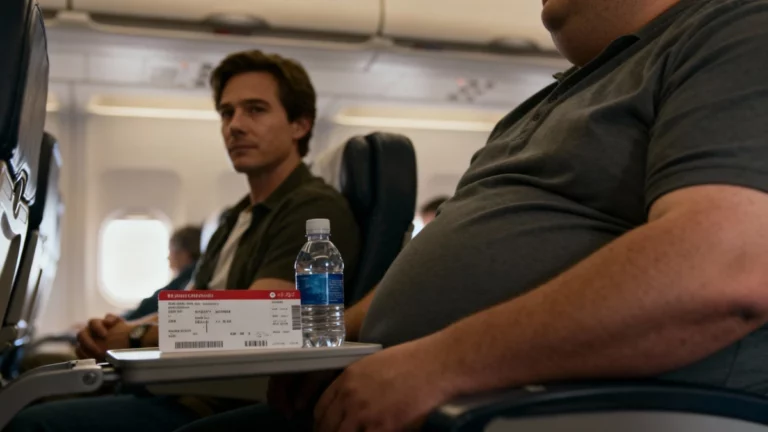
A Flight Too Close for Comfort
If you’ve ever felt like the person next to you on a plane was a little too close for comfort, you’re not alone. Sydney Watson, a conservative party member from Australia, found herself in exactly this situation during a three-hour American Airlines flight in the United States. The ordeal began when Sydney was seated between two obese passengers, leaving her—quite literally—caught in the middle. Feeling trapped, Sydney took to Twitter to voice her frustration, posting photos that showed just how little space she had.
“I don’t care if it’s mean. My entire body is currently being touched without my consent. I can’t even put my arms on the armrests on either side because there’s no freaking space,”
she tweeted, pulling no punches as she detailed her discomfort. But she didn’t stop there—she upped the ante, describing her seatmates as “sweating on me,” sparking heated debates online and accusations of fat-shaming. The incident quickly gathered traction, generating headlines and commentary far beyond her original audience.
The Airline’s Response: Apologies and Compensation
The backlash didn’t go unnoticed by American Airlines. At first, the airline kept things brief and buttoned-up, replying publicly:
“Our passengers come in all shapes and sizes. We are sorry you were uncomfortable during your flight.”
They also declined her official complaint at that stage. However, a week later, American Airlines changed course and sent Sydney an email—one she promptly shared with her followers—apologizing more personally and sweetening the message with a $150 travel voucher for a future flight. It was a self-preservation move as much as a gesture of goodwill, trying to put an end to the negative publicity.
Sydney, however, was less than thrilled with the offer. Her reaction? Lukewarm at best. Instead of seeing it as an olive branch, she mused that she’d prefer to donate the $150 to someone who needed a gym membership or a fitness program. Whether she meant that literally or as a pointed jab is anyone’s guess, but it certainly fanned the flames of the already smoldering online debate.
Larger Questions About Comfort and Consideration in the Skies
This episode goes beyond one unhappy flyer. It’s a perfect storm of questions that will be familiar to anyone who faces crowded planes—especially in the United States, where domestic flights are indispensable for longer distances. How responsible are airlines for ensuring passenger comfort? Where’s the line between legitimate complaints and public shaming? And how can travelers advocate for themselves without making someone else feel worse?
It’s a tricky balancing act. Airlines must manage limited space, tight schedules, and passengers whose needs, sizes, and personalities are all different. Meanwhile, flyers are left to navigate not just the cramped dimensions of coach seating, but the equally tightrope walk of being honest about their discomfort while showing empathy for those around them.
What’s Next for the Friendly Skies?
Sydney’s story draws attention to the need for:
- Clearer communication about seats and space expectations
- Fair management of passenger concerns and expectations
- A culture of understanding and mutual respect among flyers
This incident is a microcosm of both the challenges and opportunities facing modern air travel. As much as we hope for smooth flights and plenty of space, sometimes we’re given the chance to rethink how we treat each other in those moments when comfort is in short supply.
One thing’s certain: as airlines and passengers keep negotiating this delicate territory, the conversation is far from over.
Meet Sarah Jensen, a dynamic 30-year-old American web content writer with a knack for the worlds of film, TV, tech, and logic games. Since making Austin, Texas her creative base, Sarah’s talent lies in sharing her passion for entertainment and technology—and making sure every story she tells feels just as engaging as the stories themselves.