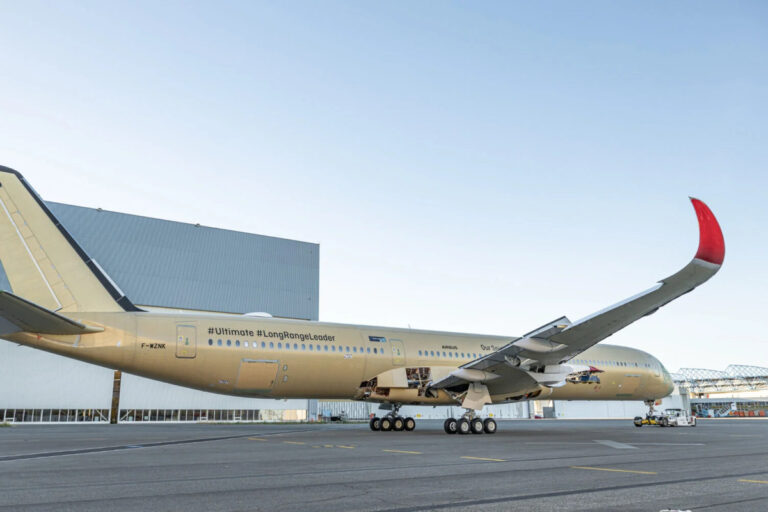
Imagine stepping onto a plane in Sydney at sunrise and stepping off in New York or London—without a single stop in between. That’s exactly what Airbus and Qantas are preparing to make reality with the new A350-1000ULR, an aircraft designed to push the limits of what modern aviation can achieve.
A new era of ultra-long flights
Inside the Airbus assembly hangars in Toulouse, engineers are building what may be one of the most ambitious commercial aircraft ever conceived. The A350-1000ULR—ULR meaning Ultra Long Range—is being crafted to handle up to 22 hours of continuous flight. That’s enough range to link Australia to the opposite side of the globe, covering nearly 18,000 kilometres in a single journey.
These marathon routes are part of Project Sunrise, Qantas’s bold plan to connect Sydney, Melbourne, and Brisbane directly to major global hubs such as New York and London. It’s not just a record-breaking idea—it’s a shift in how we think about long-haul travel.
Built for endurance and efficiency
Technically, the A350-1000ULR shares its DNA with the standard A350-1000, but it has been significantly re-engineered. Its rear central fuel tank has been expanded by 20,000 litres, ensuring the plane can handle these extraordinary distances without refuelling. Combined with refined aerodynamics and more efficient onboard systems, it can cruise at around 900 km/h while optimising fuel consumption over the long haul.
There is, of course, a trade-off. To make room for the additional fuel and maintain optimal performance, seating capacity has been reduced to just 238 passengers, down from more than 300 in standard versions. But what travellers lose in numbers, they gain in space, comfort, and a level of in-flight care rarely seen outside first-class cabins.
Comfort meets science at 35,000 feet
Spending nearly a full day inside a plane might sound daunting, but Airbus and Qantas have gone to great lengths to make it not only bearable but potentially enjoyable. In collaboration with researchers from the Charles Perkins Centre at the University of Sydney and Australian designer David Caon, the cabin has been carefully crafted to support passengers’ physical and mental wellbeing during these epic journeys.
One of the most innovative additions is the “Wellbeing Zone”, a dedicated area between the Premium Economy and Economy sections. Here, passengers will find stretching bars, hydration stations, light snacks, and guided movement videos displayed on screens. The idea is to encourage gentle activity throughout the flight, improving circulation and reducing the effects of jet lag.
Lighting and meal schedules have also been programmed to sync with passengers’ circadian rhythms, easing the transition between time zones and helping travellers arrive feeling more human than zombie.
The next leap forward
Airbus reports that the main fuselage sections—the front, centre, and rear—have already been assembled. The installation of engines and flight testing equipment is set to follow soon, with test flights expected in 2026. If all goes according to plan, Qantas will receive its first aircraft by the end of that year and begin commercial operations in early 2027.
The airline ultimately plans to operate twelve of these aircraft on its longest routes, cementing its role as the pioneer of non-stop intercontinental travel.
Redefining the skies
Beyond the impressive range figures and technical prowess, the A350-1000ULR represents a turning point for global aviation. In an era increasingly focused on energy efficiency, passenger wellbeing, and sustainability, this aircraft demonstrates that long-haul doesn’t have to mean uncomfortable or environmentally excessive.
It’s a bold statement: that technology and design, working hand in hand, can make even a 22-hour flight something to look forward to. For those who’ve spent years connecting through multiple airports on the way from Australia to Europe or America, this Airbus may well redefine the meaning of a direct flight—and what’s possible at 35,000 feet.