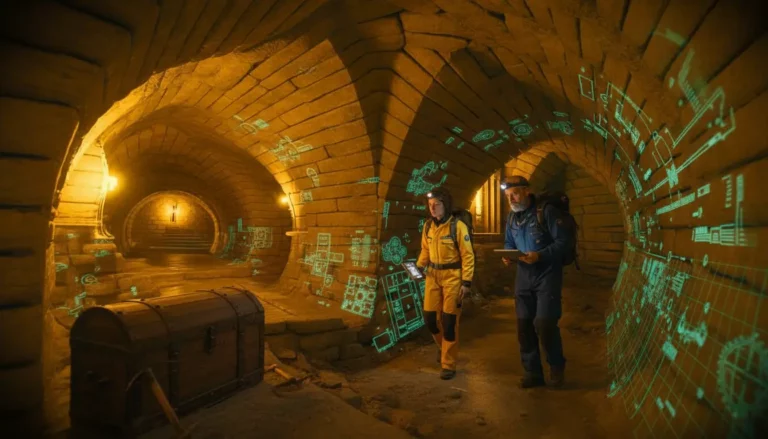
The Secret World Beneath Sforza Castle
Sforza Castle (Castello Sforzesco), nestled in the bustling heart of Milan, underwent dramatic transformations during the 15th century thanks to the Duke of Milan, Francesco Sforza. This historic site morphed into a formidable fortress, bristling with towers, courtyards, and grand halls covered in intricate frescoes. In 1494, as Renaissance creativity flourished, Ludovico Sforza—Francesco’s successor—hired none other than Leonardo da Vinci to lavish the castle with his artistic brilliance.
It was during this period that Leonardo documented, in his Codex Forster I, a mysterious network of underground tunnels said to run beneath the castle. For centuries, these tantalising sketches triggered curiosity and speculation. But only the introduction of modern technology—ground-penetrating radar and laser scanning, no less—has finally confirmed their existence. Chalk up a point for the da Vinci fan club.
Military Secrets and Personal Mysteries
What was the purpose of these subterranean hallways, hidden beneath centuries of history and Milanese bustle? The best guess is military: a fortress needs its secret escapes and defensive tricks, after all. Yet not all of the tunnels were purely about war. Some passages seem to have played a more intimate role. For instance, one corridor apparently connected the castle directly to the Basilica of Santa Maria delle Grazie—home, as any art lover knows, to Leonardo’s iconic mural, The Last Supper.
This link might have provided swift access to the tombs of the Sforza family—a symbolic bridge between secular power and spiritual heritage. In short, even as the tunnels speak to strategic defence, they also whisper tales about the private life and rituals of the Sforza dynasty themselves.
Modern Technology Unveils Renaissance Secrets
Confirming the existence of Sforza Castle’s underground passages has only been possible thanks to recent advances in technology. Ground-penetrating radar and laser scanning let researchers map out hidden voids and tunnels, filling in the gaps of our historical knowledge.
Francesca Biolo, a researcher at Politecnico di Milano (Polytechnic University of Milan), emphasised how essential these technologies are: “They reveal spaces otherwise totally inaccessible, opening new opportunities for future studies on secret passages.”
These cutting-edge techniques don’t just make it possible to visualise existing structures—they offer a way to explore lost historical features, too. Feeding all this data into digital models opens up exhilarating possibilities for archaeology and historical research. Technology, it turns out, can take our understanding of the past and give it a fresh new light. Who says history can’t be revitalised with a little help from the digital age?
From Digital Twins to Augmented Reality: A New Way to Experience History
The next step for the researchers? Creating a digital “twin” of Sforza Castle: a detailed digital replica that captures not just what the castle looks like, but also lets you explore its evolution over the centuries. Franco Guzzetti, professor of geomatics at Politecnico di Milano, explained that this digital model will incorporate historical elements and provide a sweeping overview of the castle’s many transformations.
This digitisation project is likely to be paired with immersive augmented reality features. Imagine museum visitors navigating the castle’s underground passages and hidden chambers, all from the safety and comfort of a virtual environment (no risk of bumping into a ghostly Sforza family member). This could completely transform the modern museum visit, turning it into an engaging blend of technology and time travel.
Leonardo da Vinci’s art continues to enchant and captivate audiences, and now, thanks to new technologies, it also enriches our understanding of both his legacy and the hidden depths of Renaissance history.
Today, Sforza Castle is home to three separate museums: the Pinacoteca del Castello Sforzesco (Art Gallery), the Museum of the Pietà Rondanini, and the Museum of Ancient Art. The discovery of the underground tunnels is poised to have a significant impact on cultural tourism in Milan. These new insights into the castle and its secret structures are already drawing the attention of researchers and history aficionados alike.
The prospect of virtually exploring these tunnels with digital and augmented reality tools could also energise Milan’s local tourism industry. Visitors may soon uncover a lesser-known side of Milanese cultural heritage, greatly enhancing their museum experience. This discovery is a perfect illustration of how technology can redefine our relationship with history, making the invisible visible, and opening up fresh perspectives on heritage sites we thought we knew.
As work on the digital twin of Sforza Castle moves forward, it begs the question: how will these emerging technologies shape our understanding and experience of cultural heritage in the years ahead? Are the recent discoveries at Sforza Castle just the beginning of what lies hidden beneath our feet?
Jessica Roux is a journalist specialising in economic communication, with a hybrid background in writing, editorial strategy, and project management. A graduate of Sciences Po, she brings clarity to the changing information landscape and the major trends shaping today’s media and economy. Contact: [email protected]