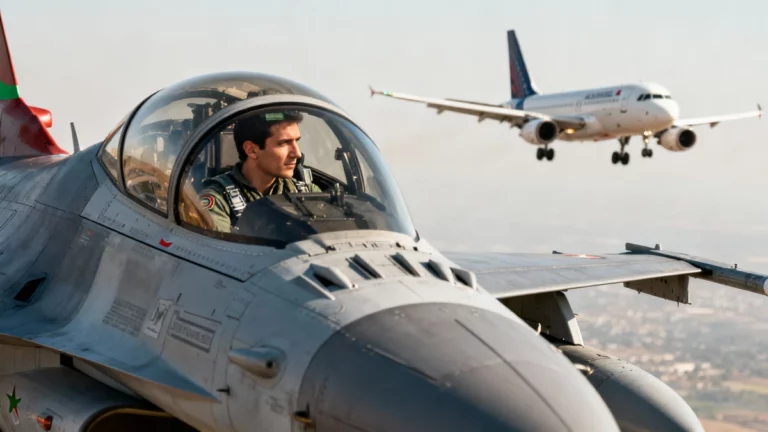
Locked On: Moroccan F-16s Move In
A single aircraft stands out on the radar. Instantly, Moroccan F-16s take off, slicing through the sky toward the identified plane. Visual acquired, approach steady—no drama, just pure precision. Inside the cockpit, the tone is cool and focused. Facing them: an A330 MRTT Phénix, accompanied by two Rafale B. Everyone knows the rules, but not a single pilot relaxes.
Air traffic control lays down the law, no room for ambiguity:
Return to international airspace, or there will be an armed response.
Nothing aggressive—just absolute discipline.
These kinds of exchanges are never a game. This is the Marathon 25 exercise in its purest form, with every crew committed to their part till the very end. Identification is confirmed, the separation is clean, and instructions are followed to the letter. Improvisation? Not on the checklist.
Intensity and Precision, Under the Surface
That moment when everything seems almost instinctive reveals the depth of cooperation. The interception could easily be real. It’s not—but the intensity is unmistakable. The Airbus—centerpiece of the whole setup—is both a tactical target and the anchor of this simulation.
But Marathon 25 is more than just an interception drill. It pushes crews to the edge of their endurance and drills their reflexes into muscle memory:
- Five French Rafale B jets
- Eight Moroccan F-16s
Taking turns, they all practice aerial refueling with the MRTT Phénix—an aircraft that’s a game changer for Moroccan pilots used to flying with Hercules tankers. Here, it’s about millimeter-level accuracy. There’s no margin for error.
Approaches stack up, one after the other. Every attempt to connect with the drogue beneath the tanker demands a steady hand, finesse, and nerves of steel. The smallest slip, and you’re starting over. Even so, radio discipline is pristine; movements flow almost like a choreographed score. Through the canopy, pilots exchange brief glances—no need for extra words.
Structure, Stamina, and Unspoken Trust
The Airbus sets the tempo—offering the range, steadying the pace, imposing a rhythm. Each pass only reinforces the value of this training. Everyone comes away sharper. Marathon 25 proves stamina alone isn’t enough: it takes control, composure, and flawless teamwork.
Exercises like this don’t spring up by chance. They’re built on years of work: sometimes in silence, sometimes under pressure. Franco-Moroccan relations aren’t always simple. Yet in the sky, crews aren’t debating diplomacy. They fly. They execute. They protect. The goal is shared:
- Maintain control
- Learn to work together
- Refine every move
The upcoming live-fire campaign in Morocco will demand even more—more precision, more discipline. But the foundation is set. Marathon 25 isn’t just a demonstration, it’s a rehearsal for the day when you have to answer the real call—when every minute counts, and the alert is anything but a drill.
More Than Machines: The Human Factor
Radio discipline, identification protocol, rules of engagement—nothing left to chance. There’s no room for approximation.
And yet, behind all that discipline, there’s trust. The real kind. The kind you build in a cockpit, not around a conference table.
What Marathon 25 reveals, ultimately, is that modern defense relies as much on people as on machines. And when people know what they’re doing—when they speak the same operational language—it changes everything.