The making—and breaking—of a dream restoration
If you know anything about rare Ferraris living to see another day, chances are you’ve heard of Ratarossa—the British YouTuber with a knack for bringing life back to legends most gearheads would send straight to the scrap yard. For over fifteen years, his weekends, nights, and often his savings have gone into rescuing models like the 308, 328, 512 BB, and yes, the 360 Modena. His dream? To one day find a Ferrari F40 to restore.
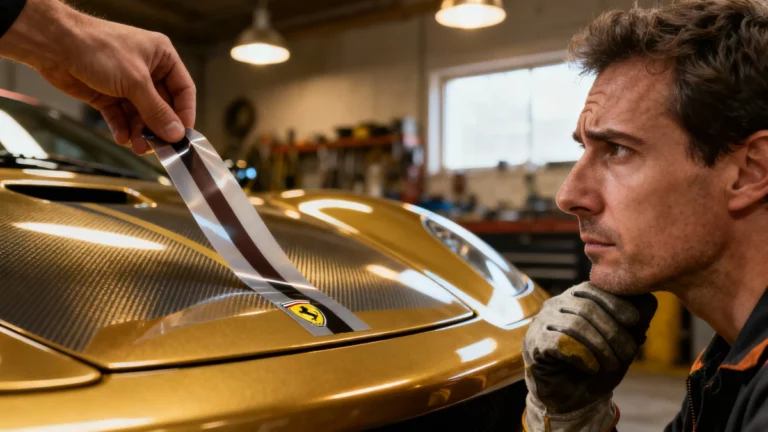
But this time, it’s his trusty 360 Modena—his real daily driver—that threw him a curveball. After nine months of painstaking work, including a full strip-down, complete repaint, rebuilt interior, upgraded brakes, and a restored engine bay, the car looked flawless. Gleaming, reborn, ready for the open road. That is, until a humble vinyl stripe brought this fairy tale screeching to a halt.
When a vinyl stripe becomes a nightmare
Inspired by the Ferrari Challenge Stradale, Ratarossa had a tricolor vinyl stripe laid down the middle of his black 360’s body—a typically Italian sporting touch. But, just a few weeks after its return from the paint shop, the perfect-looking line began to betray him. First, a blemish here, then another there, and soon the once-pristine stripe became a string of bumps and sharp cracks, almost as if someone had gone at the paint with a scalpel.
“It’s a nightmare,” he confides in his video. “We spent nine months making the car perfect, and now the vinyl stripe is shrinking day by day.”
The diagnosis? The vinyl stripe had shrunk, leaving a visible ridge under the clear coat. Worse still, flaws were spreading from the hood up to the roof. Fixing it properly would mean sanding and repainting nearly two-thirds of the car. Ouch.
Expert insight: Wrong type, wrong place
After the video went live, a vinyl specialist with forty years in the game gave his verdict: the stripe had been printed on a “calendered” vinyl, a less stable material, instead of the high-performance “cast” vinyl typically used for automotive applications.
The issue? Calendered vinyl doesn’t cope well with major temperature swings—especially on a black car that soaks up sun and heat. The result: swelling, shrinking, and eventual peeling under the clear coat.
“On a black car, vinyl gets extremely hot in the sun. I’ve seen stripes shrink by almost an inch!”
explained the expert. In his view, the only solution was to repaint the hood and apply a new “cast” vinyl stripe—without re-clearing over it.
Paint problems beyond the vinyl
As if the vinyl fiasco weren’t enough, Ratarossa spotted several clearcoat issues on other sections—doors, fenders—where there hadn’t been any vinyl applied. The apparent culprits?
- Runs and drips
- Dry patches
- Tiny bubbles
These issues probably stem from the painting process itself: cold winter conditions, uneven drying, or too-thick clear coat can all produce such imperfections. So while the vinyl is to blame for the disaster on the hood and roof, the rest is down to classic body shop mishaps—a proper respray being the only long-term fix.
Visibly discouraged, Ratarossa admits that putting things right will take plenty of time and money.
“I’m not a perfectionist, but when my ten-year-old daughter asks what those marks are on the paintwork, I know they’re too obvious.”
Still, despite the frustration, he keeps his sense of humor and passion alive. The V8 engine runs beautifully, the brakes are spot-on, and the interior looks fantastic. So a full repaint is on the cards—maybe even a dramatic new color like metallic purple. Why not?
As is often the case with Ratarossa, this story is unlikely to end here. But one thing’s for sure: in the world of classic car restoration, even the smallest detail can wipe out months of hard work.
Expert takes: More than just a simple stripe
Back in the eighties in the US, some car makers gambled with new primer brands, only for owners to discover the primer wasn’t always compatible with the paint—leaving whole generations of cars with the infamous “missing paint” look still seen on American roads.
On the many American car restoration shows out there, two methods for stripes regularly pop up: you either use adhesive stripes or paint them on. The latter is more time-consuming, trickier, and costlier, but definitely lasts. In Ratarossa’s case, the body shop clearly wasn’t at the top of its game—those paint runs are a real letdown on a restoration. In all likelihood, they’d have struggled to paint the center stripe well anyway.
Ideally, stripes are laid down after paint but before clear coat, so both paint and stripe are sealed together and baked, preventing contraction or expansion issues later on. If stripes are added after delivery, only factory-approved materials applied by certified staff are generally warrantied.
Today, automotive-grade vinyl has a higher proportion of saturated polymers and less cellulose—making it tougher against abrasion, more water resistant, and less prone to thermal expansion issues. The only real worry is UV yellowing, but modern anti-UV additives and the protective clear coat keep that at bay.
Preserving Maranello’s glory—one challenge at a time
In the end, hats off to this endearing YouTuber—what a noble mission, scouring for old Ferraris to help preserve the heritage of Maranello. Although, honestly, his dream of restoring an F40 might remain just that—a dream.