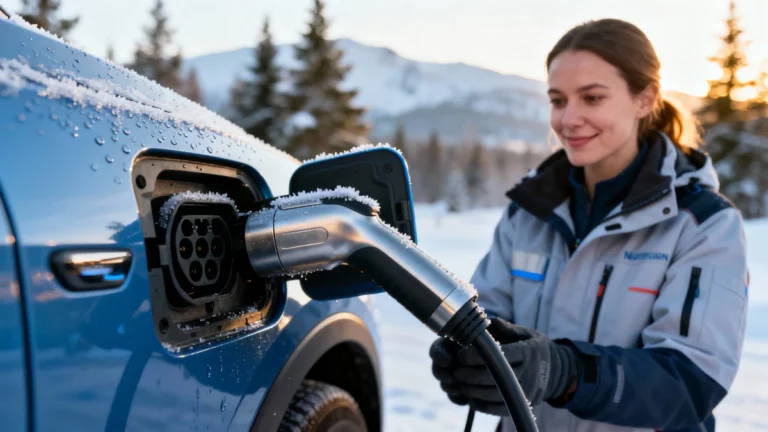
How Norway Became the EV Capital of the World
In September 2025, Norway once again smashed its own records: a staggering 98.3% of all new passenger cars registered were 100% electric. This jaw-dropping statistic marks the first time the country reached such heights for a single month. For the first nine months of 2025, the cumulative share hit 95%—a milestone never seen before. According to data from the Norwegian Public Roads Administration (OFV), the country is now just a hair’s breadth away from its political target: making all new car sales zero-emission by 2025.
But let’s be honest: nor does this success have anything to do with luck. Achieving this in a land where winter can feel eternal and batteries contend with the worst cold snaps on the continent required a unique blend of measures, incentives, and, yes, a little Nordic stubbornness.
The Power of the Carrot (and the Stick)
Norway has played its game well. While combustion vehicles face sky-high import taxes, dramatically raising their price, electric cars are fully exempt from those same duties. Up until 2022, thanks to Norway’s generous policies, EVs even escaped the national VAT (set at 25%). Since 2023, though, this VAT exemption only applies to vehicles costing up to NOK 490,000 (about USD 46,000). There are also tailored incentives to encourage electric vehicles within company fleets and lease markets.
- For a period, Norwegian EV drivers enjoyed toll-free roads, sharply reduced ferry and parking fees, and could even drive in bus lanes—making city commutes much less of an ordeal.
- These perks have gradually been phased out, as the e-car population exploded and the roads began to look more like a silent parade of EVs.
Cecilie Knibe Kroglund, State Secretary at the Ministry of Transport, summed it up: “A stick for fossil vehicles, and the carrot for electric vehicles.” Apart from low taxation, EVs also benefit from very real privileges. One more thing to keep in mind: Norway has no local car manufacturers, so the government doesn’t have to wrestle with the industrial or economic risks that policy changes can stir up elsewhere.
Coping with Arctic Winters: Norway’s Infrastructure Edge
Of course, the obvious question arises: how can a country as chilly as Norway manage to electrify almost its entire new car fleet? You’d think sub-zero temperatures would have EV batteries shivering in their boots, but Norway was ready for this challenge. The country has rolled out a dense, reliable charging network, even in the less populated stretches between towns and cities. This network swept aside motorists’ biggest concern—range anxiety, especially in winter.
Having test-driven cars there myself (yes, I braved the Norwegian winter, all in the name of research!), I noticed something curious: drivers only charge as much as they need for their trip, leading to high turnover at charging stations and, consequently, low waiting times or station occupancy. Most cars sold in Norway now have battery packs equipped with thermal management systems that preheat the batteries before charging—including in the coldest weather—which dramatically reduces range loss even in an Arctic freeze.
In fact, the NAF, Norway’s motorists’ association, regularly stages real-world EV range tests, winter and summer alike, revealing the difference between what the official WLTP range tells you and what you’ll actually get on Norwegian roads. These telling results gain international coverage and shine a spotlight on EV strategies—so much so that manufacturers themselves have started running their own on-the-ground range tests to fine-tune battery performance.
The Results: Record Sales and a Model for Others?
All this has given Norway a unique edge, not just in Europe but globally. The fruit of this combined strategy? An impressive surge in new vehicle registrations—over 10% more than the previous September. Over the last nine months, the number of new cars reached 113,325, translating into 23.5% growth versus 2024. Tesla is the clear front-runner, accounting for nearly a third of sales in September, with the Model Y yet again topping the charts at 4,132 units sold. To put this in perspective: where I’m from, that’s almost three times fewer Model Y registrations than we’ve seen year-to-date—reminding us that, however tempting it is to copy Norway’s blueprint, the scale of our own market poses its own set of challenges.
More beach hut than pilot’s cockpit, I thrive on a daily blend of information and two-stroke oil to feed my passion for two and four wheels. A lover of tech and anything with wheels, I look forward, without ever forgetting the past.