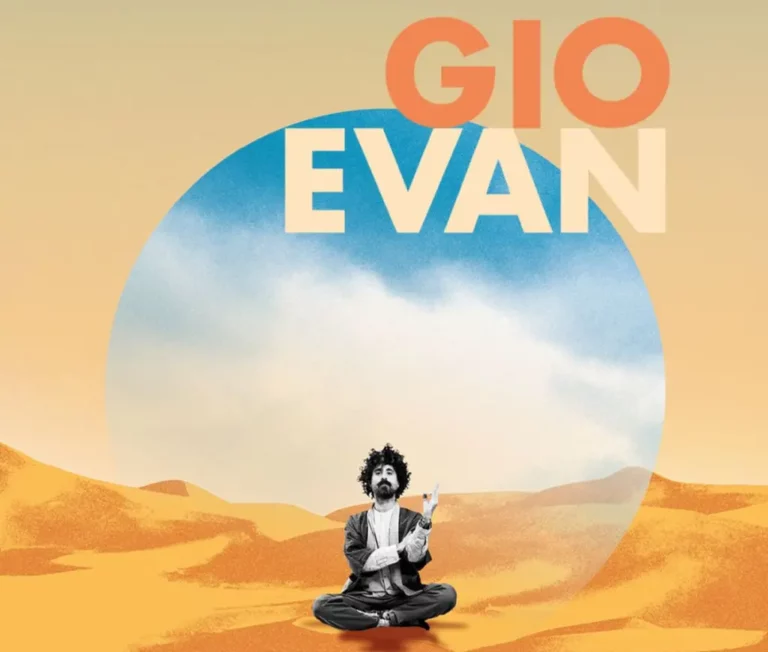
On February 6th, GIO EVAN's live album, “L'Affine Del Mondo Live”, will be released digitally, recorded during the theater tour of the same name which last year saw him as the protagonist in twenty of the main Italian theatres.
In June and July 2026, after a performance in London in March, his summer show — musical, comedic and spiritual — entitled “Extra Terreste” will take place.
After the great success of last year, on 25 and 26 July the fifth edition of “Evanland”, the international festival of the inner world created by Gio Evan and his manager Bruce Labbruzzo, returns to Rocca Maggiore and throughout the city of Assisi (Perugia). Cisco and the former Modena City Ramblers (25 July) and Valerio Lundini with I Vazzanicchi (26 July) have already been announced as guests. Montoya, the Colombian DJ, will also be a guest on July 25th.
All this is a lot for a shy character, deliberately in search of solitude, lover of spirituality in a transreligious key, attracted by shamanism and attentive observer of alternative lifestyles, always in search of contact with nature “which we have long lost”.
Gio Evan brings his philosophy of life and his ideas into his live shows, made up of music and many words with which he expresses fascinating concepts that conquer the public. Portable speakers
Gio Evan is an artist – even if he doesn't like to define himself as such – who goes beyond being a singer-songwriter, he is in fact a poet and writer, author of numerous books. The last of which, the novel “Joy is hard work” (inspired by the concept and his vision of death), will be published by Feltrinelli on March 31st.
THE INTERVIEW
Gio Evan, leaving for the Mexican desert, told us about his projects and his activity in an interview.
What is “Evanland”?
It's a beat generation vision. Those who frequent wonder, unlike the “bad guys”, lack the ability to meet, commune and organize. This observation gave birth to the idea of 'Evanland', a festival dedicated to interiority for which someone coined the term 'gathering of the good', an idea that I certainly make my own. Those present at the festival respond to a profound, spiritual and curious call. They are 48 hours of 'together' in which we do not disunite but unite with workshops and exercises, mixing shamanism, energies and meditation. There is a lot of play, which is a part of spirituality. The latest editions have seen 6000 attendees: a community that stays together has been created. It is nourishment, attention towards others, and not the promotion of fake happiness. There is no force to achieve happiness: it is spontaneous joy.
How does it actually work?
The doors of the festival open at 4pm with a welcome from me, accompanied by a copy signing because 'Evanland' often coincides with one of my releases, whether record or book. Then follow workshops on transcendental meditation and yoga, practices, exercises and games. At 8pm, with a very high energy load, the concerts start.
Why do your concerts combine music and words?
Thinking as a user, a 'classic' concert is too expensive if the content is just music: just for that I don't move, I don't spend energy looking for parking, changing times or other required things. Rather, I want to be part of a vital demonstration. I transfer this 'customer' thought into my role as an artist, offering a complete experience to those who come to see me.
This is a very “high” and “noble” concept, however you also arrived in Sanremo (2021), a different environment…
Every stage is an unmissable opportunity, it is a sacred place at the service of music. The stage is the artist's home and there is no difference between a lavish or a media one: the important thing is that I go on stage saying things that belong to me. So it was with 'Arnica'.
Besides being “the artist's home”, what is the stage for you?
I like it because it is the place where I am catalysed: I offer my body to other energies so that things are said. I put myself at the service of the stage; I see the theater as a sacred place, with lots of words, lots of attention and reasoning. It's not always spontaneous: every word is cataloged, excavated. On stage it's no longer me: I rent out my body; those who use it come from a benevolent part of life and the universe.
Your “bouquet” of shows is divided between theater and summer open air shows. Is there a difference between the two worlds?
They are two different, almost bipolar paths. Theater is the serious moment, where there is no need to joke: everything is compressed, functional to the show and its philosophy. In the theater there is mass, a psalm: everything is concentrated and there must be no distractions. In the summer, however, it's hot, people are standing, perhaps with a cocktail in hand, and so we lighten up: the theatrical part becomes closer to stand up comedy, I talk about my fools, my misfortunes, how unlucky I am, while still seeking teaching in my tragedies. The choice of songs also often changes: there are 'summer' ones and 'theatrical' ones.
Is it difficult to balance words and music?
It's difficult: I think, say and write too much. My monologues are intense and require attention; I'm always afraid of weighing it down and I'm afraid of disturbing those who listen to me.
You've done quite a few shows abroad. For someone who has invested in the word and makes it the central element, it is curious. How do you overcome language barriers?
It's complicated. As soon as I go on stage I immediately try to understand where the Italians are and to immediately hit them and address them. Even during concerts abroad I talk a lot because I like the thought, but on those occasions I also rely a lot on the music and the band: the music must contain the emotional field that the words bring.
Your activity is accompanied by important numbers, including viewers, readers, online listeners. How do you explain this phenomenon?
I can't explain the numbers. I don't think I'm interesting enough to deserve such attention, also because I like to stay on the margins. I'm in love with what I do and with sharing it: if I didn't write or make music I would get sick, but I certainly don't do it looking at the results. It amazes me to know that every year in 'Evanland' there are people ready to cry, who have crazy stories; it is a place where I feel protected and happy. Outside I don't feel protected and seeing these people makes me happy, because it's half my loneliness.
The next summer show is called “Extra Terreste”. For someone who plays with words like you, I assume it's not a random title. Can you explain it to us?
'Terreste' comes from the verb 'to hold'. It talks about the concept of the superfluous, of the 'extra' things we are keeping, and this state is tiring me. I also miss the experience of innocent ignorance: today, when you don't know something, you just need to look it up online and you know it straight away. We have accumulated the superfluous that we don't need; we must invest in the transparent and the void, refraining from purchasing nothingness. How many things do we have that we don't need and that fill us up?
THE TOUR
– 20 June at Villa Ada in Rome (Villa Ada Festival)
– 25 June at Magnolia in Milan
– 2 July at the Red Barracks Park in Bologna (Bonsai)
– 4 July at Villafranca Castle in Verona (Villafranca Festival 2026)
– 5 July at the Certosa di Collegno Park (TO) (Flowers Festival)
CLICK TO BUY TICKETS
WEB & SOCIAL
@gio_evan
www.gioevan.it