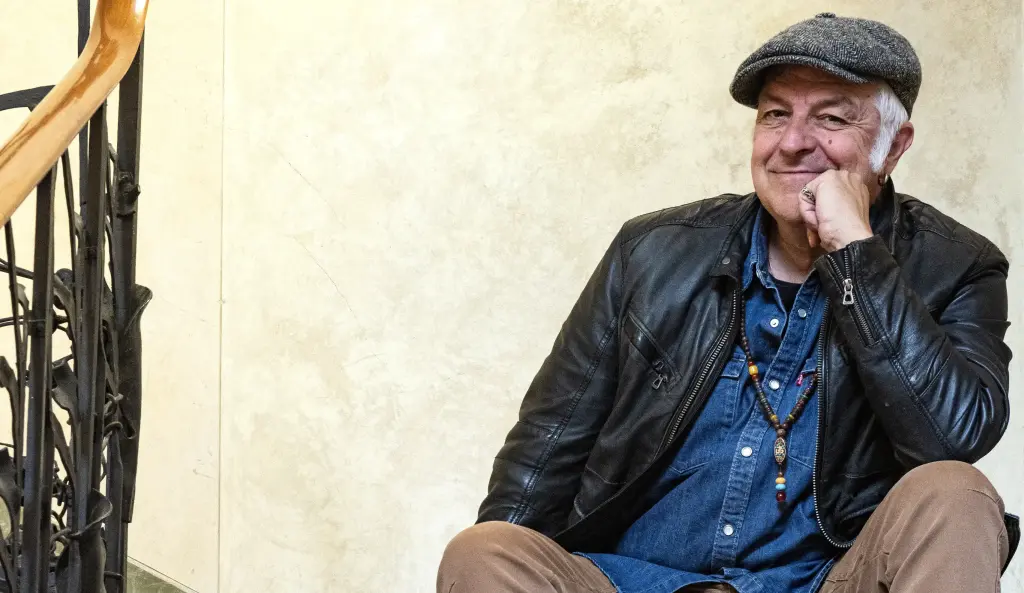
Van De Sfroos_creditCarloPozzoni
Lake Como, on gloomy days, stops being a background and becomes a character. The water becomes dark, still, compact, almost thoughtful; the horizon lowers, as if everything were forced to look inside itself.
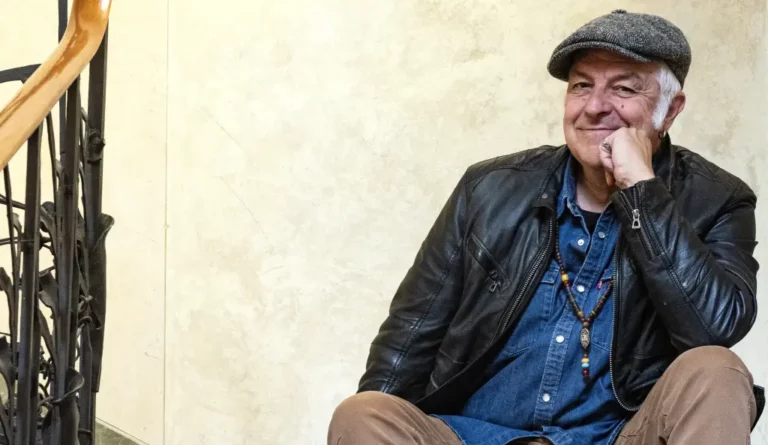
It is here that I meet Davide Van De Sfroos, standing in front of the lake, with his gaze seeming to follow an internal line more than the movement of the water.
The tour with Folkestra has just begun, but the air that accompanies it is already full of emotional stratifications.
Van De Sfroos tells us about his music without ever separating it from places, songs from people. The lake behind is not a decorative image, but a starting point: territory, memory, listening.
It is from here that a conversation takes shape that crosses the community, the theater as a privileged space for listening, folk as a sound identity, curiosity as the only possible posture to stay alive in the present.
THE INTERVIEW
The 2026 tour started at an emotionally delicate moment, marked by the death of Paolo Bono, known to all as “the Mustache”. Who was he for you?
Paolo was my first fan, but in reality he was much more.
He was a silent guide, a constant presence, someone who always followed me and who, in a certain sense, held my hand.
He was one of those who was never missing: at concerts, at important moments, but also at less visible moments.
Wherever he is now, I know he will continue to be there. And this, for me, is more important than any official commemoration.It happened right when we started with the live show. At that moment I understood something very simple: we had to go on stage for him and with him. Not as a symbolic gesture, but as a necessity.
Music, in certain moments, does not console: it accompanies. And that evening she had to accompany him too.
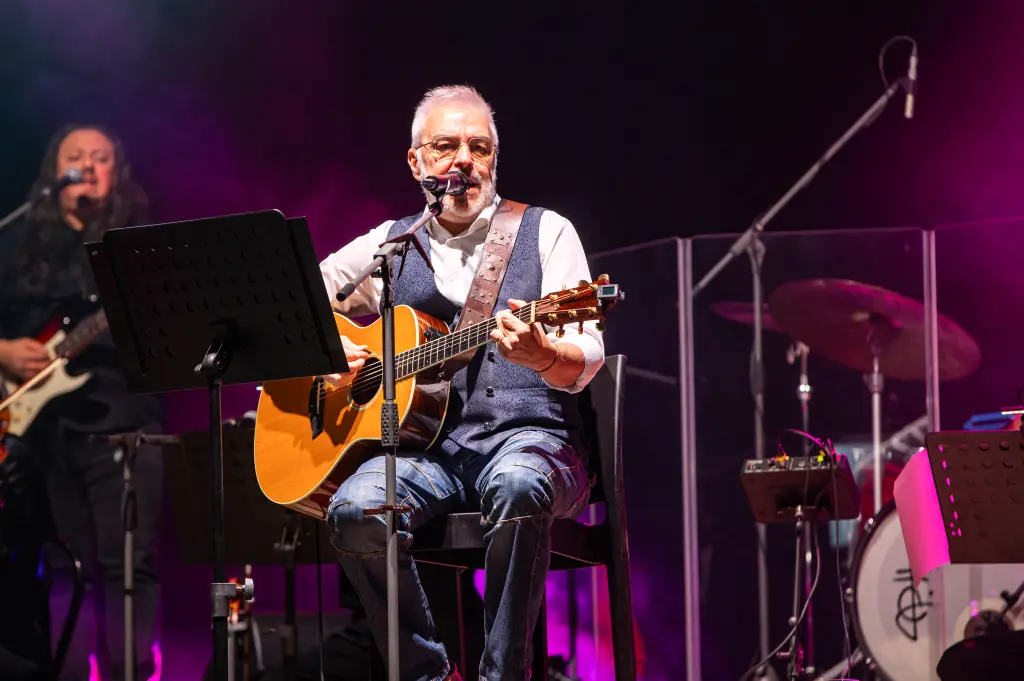
There are eleven musicians on stage. What kind of project is this live with Folkestra?
This tour is a way to rediscover my songs in a different light with new colors, new breaths. La Folkestra brings with it the energy and depth of the collective sound, but remains faithful to the spirit of the stories we have always told together with the public.
It is a folk structure, in the deepest sense of the term. It is not an orchestra placed there to magnify the sound, but an organism that breathes together with the songs. We have rearranged many songs working on violins and weavings, looking for new perspectives without losing the original essence. The songs remain recognizable, but they change posture.
What does working with such a large lineup and new musicians give you?
Every time it's an injection of energy. The new musicians bring a different look to the sound, to the future, to the very act of being on stage. They have a more physical, more instinctive relationship with the energy of live performances. It's something that, over time, you risk taking for granted. They put it back in front of you, they force you to remember why you are there.
There are songs that particularly benefit from this new look.
Yes, especially the slower and more narrative ones. Songs that need time, depth. With Folkestra they find a new dimension, as if they finally had an adequate theatrical backdrop. They are not weighed down, but supported.
The theater seems to be the ideal setting for this project.
Theater rewards you with listening. There is silence, there is acoustics, there is attention. You can allow yourself to murmur, not always raise your voice. Summer concerts are wonderful, vital, but also chaotic.
Winter in theaters is more congenial to these songs, which need space, breathing space, a gaze that doesn't escape.
In your work folk is always linked to the territory.
By force. Folk is not an abstract genre, it is something deeply territorial. It is the way in which a place becomes music, story, identity. You can't separate it from where it originates.
Como remains a fixed point, even today.
Above all, the football team today is a constant surprise. I have always supported Como and seeing what he is doing is incredible. It's a source of pride for the whole city, something that goes beyond football.
The fans have adopted one of your songs.
Yes, Pulenta and galena. They change a word and sing “with the Como scarf”. It's a real honor.
But I almost never go to the stadium. I would be too cramped in the stands. I have to move constantly and I can't stay in the stadium.
I watch the match with my old men, with their invectives, their complaints.
It's another type of cheering, more domestic, more authentic for me.
Do you continue to write new songs?
Yes, I always have something new in my room. Songs that try to become songs. My studio is a bit of a chaotic place: books, records, instruments, notes. It is a laboratory more than a studio. We'll see what comes of it, no rush.
What kind of listener are you today?
Very curious. I listen to a lot of music that I don't know, I like to search, investigate, discover new things, even among the new generations. I don't believe in the idea of stopping at a canon.
However, there remain strong references.
Of course: Dylan, Genesis, Creedence Clearwater Revival are strong points. But they are not enough. Lately I've also listened to Yungblud's new album with Aerosmith and I found it full of ideas, energy, modernity.
What does it mean to remain curious today?
It means understanding that even a Nerissimo Serpe, for today's kids, tells their world. We shouldn't demonize new music but try to understand. And if you want to continue making music that makes sense, you have to at least try to listen to that world.
THE TOUR
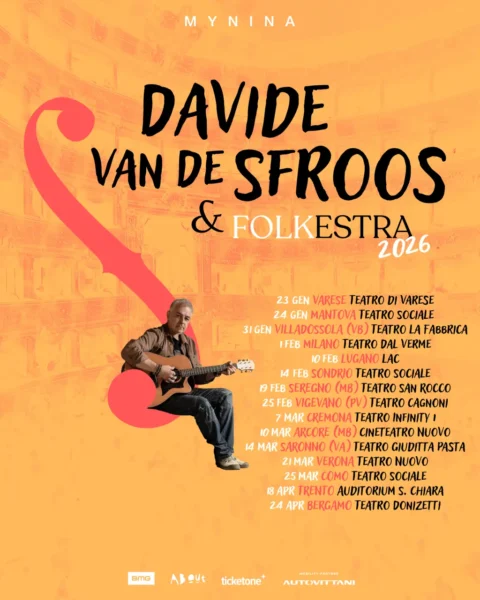
31 January VILLADOSSOLA (VB) Teatro La Fabbrica SOLD OUT
1 February MILAN Teatro Dal Verme
February 10 LUGANO Lac
14 February SONDRIO Teatro Sociale SOLD OUT
19 February SEREGNO (MB) San Rocco Theater SOLD OUT
25 February VIGEVANO (PV) Cagnoni Theatre
7 March CREMONA Infinity Theater 1
10 March ARCORE (MB) Cineteatro Nuovo SOLD OUT
March 14 SARONNO (VA) Giuditta Pasta Theater SOLD OUT
March 21 VERONA Teatro Nuovo
March 25th COMO Teatro Sociale SOLD OUT and waiting list for the boxes
18 April TRENTO Auditorium S. Chiara
24 April BERGAMO Donizetti Theatre
CLICK TO BUY TICKETS
WEB & SOCIAL
www.davidavandesfroos.it
@davide_van_de_sfroos