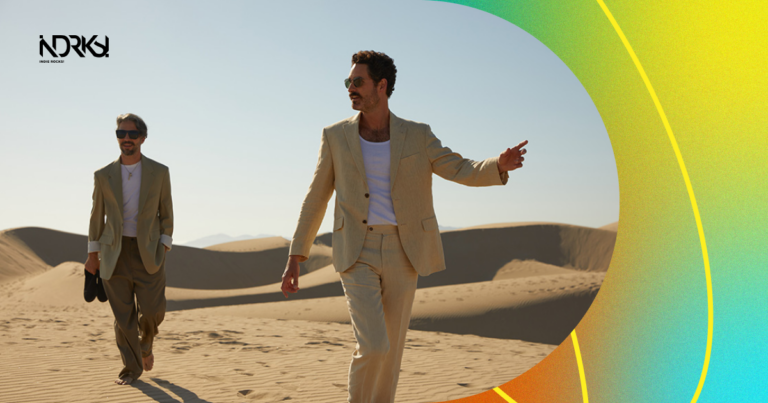
Celebration, cultural mix and dance floor: Paco Versailles talks about his connection with Mexico, his sonic evolution and the complete show that they will bring back to the country.
A few weeks after his return to Mexico, Paco Versailles confirms what is already evident to its audience: the relationship with the country is special, intense and deeply celebratory. Between references to childhood flamenco, the French touch that marked his adolescence and a creative philosophy guided more by intuition than by strategy, the project has found in Mexico—and particularly in Mexico City—a space where its mix of genres is not only welcomed, but celebrated. In this conversation with Indie Rocks!, Paco Versailles talks about identity, live shows, visuals, creative freedom and the path the band has taken from its beginnings to today.
Indie Rocks!: It is a pleasure to speak with you, especially a few weeks before your next visit to Mexico. I guess you're excited. I have heard that Mexico is a very special place for you. It is a country very open to rare and special combinations of genres, and you are no exception. Do you feel that Mexico has embraced Paco Versailles' music in a special way?
Paco Versailles: Yes, totally. In fact, even the data backs it up: our number one city is Mexico City. I think that both the city and the country in general have a very strong energy right now. There are many people moving to CDMX and a very clear creative effervescence is felt, a kind of permissiveness.
You go to restaurants, bars, and everything is done in a very creative way, almost bootlegbut with very good taste. People mix things up all the time: food, spaces, bars hidden in weird places. I feel like the culture in general is very open to mixing genres.
Additionally, Mexico has a very celebratory culture. You go to a festival and see a group of Mexicans celebrating something every five minutes. I don't know what exactly they celebrate, but they are going crazy (laughs). That energy makes playing there incredibly fun.
GO!: I imagine that this celebratory spirit is also reflected in your concerts here.
PV: Yes, totally. It feels a lot.
GO!: Speaking of mixes: it's no secret that they combine French and Spanish influences. Do any of you have Spanish roots?
PV: No, that we know of. According to DNA tests, I am 100% Armenian. But I grew up as if it had been in a Spanish house, because since I was born flamenco was the main music in my house. My dad was a professional guitarist and my mom was an actress, but also an amateur flamenco dancer. That's how they met.
So flamenco was always something completely normal for me, even though it sounds strange in an Armenian house. It was never foreign: it was as familiar as my folk music or my first language.
GO!: And where does the fascination with Daft Punk, Air and all that French touch come from then?
PV: Well, I don't know if I have French blood either, but my connection comes from having lived there. At the age of 12 I lived in Madrid for a year, a super formative period: I learned the language, we traveled throughout Spain, I went to traditional festivals such as Las Fallas, San Fermín, Cádiz…
And in high school I lived in Paris for two years, just between 1997 and 1999, when daft punk threw “Around the World” and air took out “Sexy Boy”. So I was completely soaked in very elegant French music. My connection with those countries is more experiential than genetic.
GO!: Although each album sounds different, there is a clear identity and they never repeat the formula. I want to congratulate you for that. The latest EP also proves it.
PV: Thank you. The truth is that we never have a master plan. We follow intuition, instinct, what the music dictates to us. We are not obsessed with genres, although we are aware that we have a recognizable sound, and there is a certain responsibility in maintaining that identity.
But if we write a song that we feel is good, even if it is not “flamenco dance”, we are going to release it. We are artists, not manufacturers hits gender. It may not be the best from a business point of view, but we can't help it.
GO!: Last year they played in Pa'l Norte. This time it's its own show. Is it more fun to play venue what at festival?
PV: In many ways, yes. Festivals are amazing, but also stressful: rapid changes, heat, unknown factors. In a venue you have full control: lights, sound, soundcheck long, your audience. It is another energy.
Also, this time many friends are coming, it coincides with Art Week in CDMX, so it's going to be a great weekend to be in Mexico.
GO!: Plus, they can now play new songs that didn't exist the last time they came.
PV: Yes, we have a lot of material. Almost three and a half albums. Sometimes it's hard to decide what to leave out of the set, because there are so many songs that we love to play. But it's a good problem.
GO!: Will we see the full show or a reduced version?
PV: They're going to see the full band, the original lineup. We don't skimp in Mexico. Paco Versailles It's the full band: electric guitar, bass, drums, five musicians on stage. Sometimes we do DJ sets, but that's something else.
GO!: Do you use electronic elements, sequences, Ableton?
PV: Yes, but in a minimal way. Only what is necessary for sounds that cannot be recreated live. We don't believe in this idea that everything should be 100% organic. The important thing is that the show sounds incredible.
GO!: How long will the concert last?
PV: We haven't closed the set yet, but probably between an hour twenty and an hour and a half. I think it's perfect. Better to leave wanting more.
GO!: Visually, its references such as Daft Punk or Alive 2007 are also very important. What can we expect?
PV: Visuals are key to telling the story. We're working with a lighting designer especially for the show in Mexico, and we're going to do something we've never done before. You will be the first to see it.
It will be more of a club atmosphere: lights sexysmoke, colors that accentuate the music. We want people to feel comfortable, to dance, to not feel observed.
GO!: Last question: the project was born in 2019 and shortly after the pandemic arrived. Do you think Paco Versailles would be different without that break?
PV: It's something we've thought about a lot. On a live level it was very hard, but it forced us to lock ourselves in the studio for years. It was a super prolific period: we wrote and produced constantly. That allowed us to define our sound.
I don't know what would have happened without the pandemic, but I think everything happens as it should. Of course: we were losing our minds (laughs). We even had clandestine parties in airplane hangars at LAX because there were no shows.
GO!: Thank you for resisting, for the music and for this conversation. See you at the show.
PV: Thanks to you, Maria. Thanks for the questions. See you very soon.