Sayf arrives at Sanremo 2026 without asking permission, with his naturalness and without offering easy and banal answers.
Competing among the Big Cons I like you a lotbrings to Ariston a writing that never separates the private from the political, emotional urgency from friction with the present.
One of the most interesting debuts created with language and the very idea of pop song as a neutral space.
We are all the same, at the bar and at work, our mother's children, we just want to love. And in this greed and in this demonstration, I like you so much.”
On the cover evening, Sayf will share the stage with Alex Britti and Mario Biondi for a reinterpretation of Hit the Road Jack by Ray Charles.
Britti's blues groove, Biondi's deep and jazz-soul vocality and Sayf's restless hybridity build a dialogue between different worlds, linked however by the same idea of music as a living, non-museum gesture.
We met him on the eve of his Sanremo adventure, to talk about writing, exposure and fragility, at a time when the song returns to being, first of all, a stance.
THE INTERVIEW
How it was born I like you a lot the song you will take to the Sanremo competition?
Spontaneously, as I hope all the songs I make are born. Inside there is current events, there is society, but above all there is my perception of the world. Historical facts, social facts, love, happiness, everything coexists. I never separate the plans: what I live and what I write are the same thing.
Musically I left more space for the chorus, I brought it back several times, I looked for a form that was more immediate even on the first listen. Usually I follow my instinct more, but here I also thought about fruition.
So a more “accessible” choice?
Yes, but without distorting my character. The chorus is more “cathartic”, it stays put, it doesn't need to open up or evolve too much. Musically, however, the song is consistent with my world. I understand that from the outside it may seem like a bit of a walk in the park, but it's also because I have many experiments in my head that have never been released. For those who only listen to what has been released, it may seem like a side step. Not for me.
In the lyrics of the song you quote Tenco, talking about the fear of not being understood. Why him?
It is not a direct quote, nor an iconographic homage. It is an emotional, personal reference. It serves to explain a state of mind, exasperating it. Talk about pressure, about entering a different, higher, more exposed circuit.
An irony that however touches on something tragic.
Yes, because behind it there is a lack of empathy. Between people, but also between art as an intimate gesture and its transformation into a product. Making music is a deeply empathetic act; sell it, often, no. And this fracture is one of the most difficult things to manage.
Your music seems to be crossed by very different influences, including South American ones.
It's normal. I listen to a lot of music: samba, cumbia, bossa nova, as well as hip hop, rap soul, pop. Then maybe I end up making a piece that sounds almost French. For me, music speaks all at once. I like mixing, studying, seeing what happens.
So imitation is never a goal.
Exact. If I try to make a cumbia, something of myself comes out in my failure. That's where the interesting thing happens. I'm not interested in replicating a model, but in understanding what remains after the attempt.
I study music, its history, contexts. I'm interested in understanding how a song was born in an era, in a place. I can no longer lock myself into a category. Every music has its moment and its meaning.
This approach can also bring different audiences together.
I hope so. I would like a young boy to listen to something he would never have listened to, and for an older person to overcome certain prejudices towards new artists. Music should do this: build bridges.
On several occasions you talk about a cultural system where value seems to be measured only by money.
Yes, because you're not better just because you make more money. This mechanism creates environments in which speculation wins and there is no real interest in growing the arts or culture. It is inevitable that the average level will drop, that the interest in knowledge will decrease. If we have fewer words, we can express fewer concepts. And without concepts we cannot move forward, we only accumulate numbers.
Political references to today's Italy and Europe also emerge in the song. What effect does bringing these themes onto a stage like Sanremo have for you?
Controversy doesn't scare me, because I'm not defending a party position or a specific ideology. My speeches are spontaneous, they arise from what I see, perceive, think. There is no strategy, there is no planning.
So it's not a calculated move.
Absolutely not. The song came out like this. Then, as it took shape, there were the demonstrations in Italy, the images of Palestine, a series of events that inevitably get inside you. But it wasn't thought out on the drawing board. I have nothing to hide, I have no ulterior motives. I tell my impression of the world, and within the world there is also politics, in the practical, non-partisan sense of the term.
Let's get to the covers evening: why that song and why those two guests, apparently out of your comfort zone?
The idea for the song was already there, we imagined a certain performance. Then there was also a component of chance: we came across a video online of Britti and Biondi (the new version of Gelido; ed.) singing together, and it seemed like a perfect couple for that song. From there the idea took shape.
Sanremo can introduce you to an audience that perhaps only associates you with last summer's piece. Have you talked about it with colleagues who have already been through it?
With some, yes, but not in a structured way. I happened to talk about it with people I have a closer relationship with, like Bresh or Geolier, even meeting by chance. The advice is always the same: go, rock, don't think too much.
And how do you experience this phase?
As an artist you're in a bit of a mess, because you're immersed in a continuous flow of images, questions, expectations. What I hope is that the dialogue remains. That there is real interest, that the things said are listened to. If this happens, then the context makes sense.
What are the things that matter in your life besides music
Family and friends are my true armor, my fixed point while everything around me changes quickly. They are the ones who remain when time accelerates, when the context moves and forces you to continually question your place. I like being in my city (Rapallo; ed.). I don't think about moving to Milan even if this is where all the discography is. I like the sea, meeting the local people, walking around with the shaker. I hope to start a family of my own and live here!
Are you already working on new music?
Yes, I'm preparing my debut album. It's almost ready. There isn't much time left, maybe a month, the right time for everything to find its definitive shape. I am very satisfied with what we created. I think it's a great job!
ABOUT
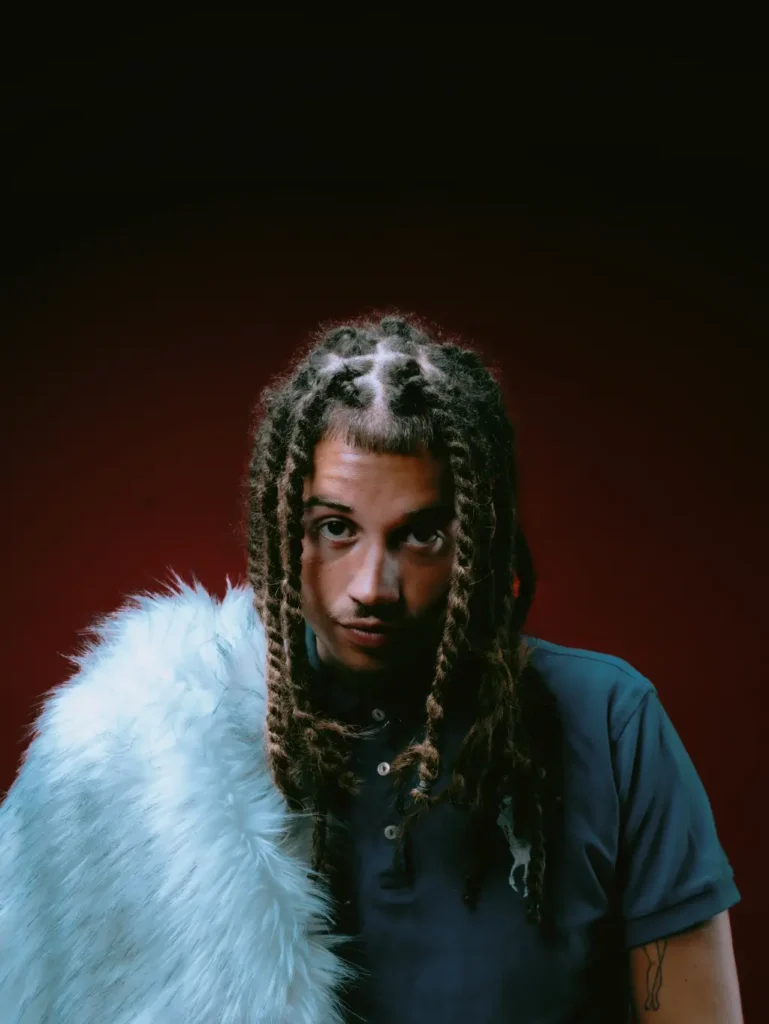
Sayf Adam Viacava was born in Genoa in 1999 into an Italian-Tunisian family. He began rapping, writing songs and playing the trumpet early. After years of apprenticeship and two mixtapes, he begins to establish himself on the Genoese scene. Between 2023 and 2024 his releases multiplied and his name began to attract attention even beyond the Ligurian borders, leading him to collaborate with emerging artists such as Helmi, Ele A, 22simba. In 2025 he released his first EP, “Se Dio Volante” (also featuring a feat by Rhove), which marked the beginning of a rapid growth, between sold out live shows, chart hits and the birth of his Santissima Fest in Genoa, already confirmed for 2026 at the Porto Antico, Arena del Mare. Live performances become his trademark, characterized by the very high quality brought to the stage together with his band.
The attention to every detail transforms his repertoire into a unique live experience, as it was for example during the special live at JAZZMI, with jazz arrangements of his songs created specifically for the occasion. The stylistic signature of Sayf it is his uncommon versatility, the skillful mix between rap and songwriting, melodies and bars, street stories and love stories, South American sounds and Arab influences, the Genoese musical tradition and contemporary urban. 2025 also sees him as the protagonist of the summer with 3 songs: “I'm happy at the seaside” by Marco Mengoni together with Sayf and Rkomi, “Figli dei palazzi” feat Néza and “Una can”, his solo single.
His latest single, “MONEY (feat. Artie 5ive, Guè)” was released in November.
WEB & SOCIAL
@sayfmaet