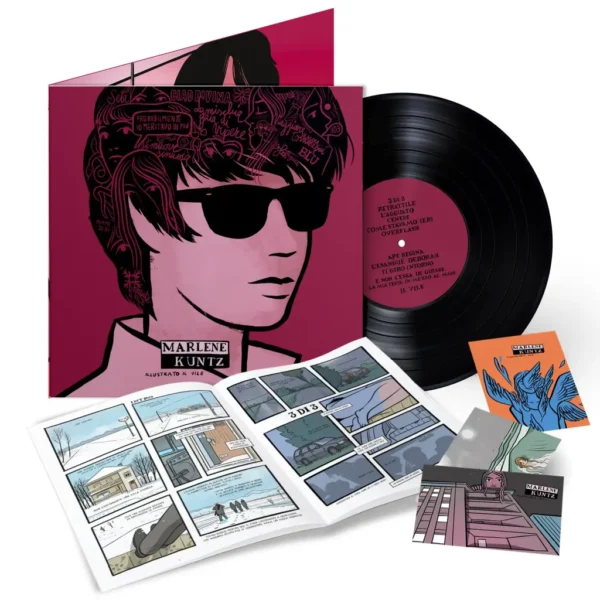
On the occasion of the thirty years since the publication of “Il Vile”, the second album by Marlene Kuntz, symbol of a generation and a reference work for Italian alternative rock, a special numbered and limited edition version will be released on March 6th, designed entirely by the illustrator Alessandro Baronciani.
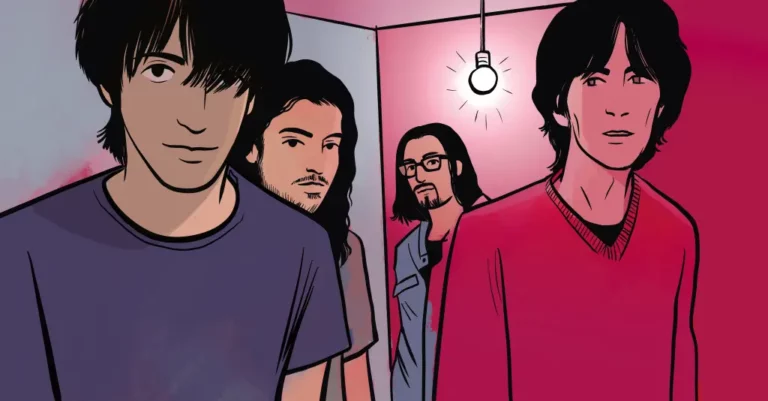
Passionate about rock music and Marlene Kuntz in particular, the cartoonist wanted to pay homage to this album that changed his life as a teenager, creating, in addition to the album graphics, also a booklet/comic with 11 plates, each of which represents his interpretation of the songs contained in the album, and 3 postcards with a cartoon taken from the comic itself. All copies are numbered and hand-signed by himself.
We talked about it with Cristiano Godano.
THE INTERVIEW
The republication of “Il Vile” arrives in March with a project that goes beyond the canonical celebration. Not just a reprint, but a conceptual operation. What have you built together with Baronciani?
The idea was born from a proposal from our team. They presented it to us, it seemed strong to us, we accepted it. We didn't want to limit ourselves to the rhetoric of the anniversary, which often coincides with a simple operation on vinyl. There is real added value here: Baronciani has created eleven micro-narratives, one for each song. Tables that condense the essence of the texts, without illustrating them in a didactic way. It is a visual crossing of the disc, not an ornamental accessory.
1996-2026. Almost everything in music has changed in these thirty years. What, however, hasn't changed in your approach?
The group experience. Today a lot of music is born in solitude, in front of a computer. It's not a moral judgment, it's an observation. Putting three, four, five people together means seeking a convergence between different personalities. Friction generates shape. Memorable bands are such because each element has an autonomous force that collides with the others. This process does not change. If anything, its diffusion has changed: few young people still choose that path.
Has writing also changed?
I would say yes. Excluding the more fragile mainstream, which was fragile even then, I notice a progressive downsizing of the vocabulary. We read less, and reading broadens our lexical range. If language narrows, the imagination becomes impoverished. Words recur, are repeated, become interchangeable. The writing loses tension.
The tour starts on March 5th. What lineup should we expect?
We will play the album in its entirety, with some incursions consistent with that climate. “Il Vile” has a tense, hysterical, at times angry mood. It's a nervous record. Even in the most lyrical moments there is an internal pressure. The setlist will follow that trajectory: pure intensity, few concessions.
Could a record like “Il Vile” be born today?
I struggle to imagine it. He was the son of fertile soil. When we released it, the grunge wave had opened up a space. We already existed before Nirvana's Nevermind, but that explosion created a collective sensibility. There was excitement. Today I don't perceive the same convergence. If a group emerged with those timbres and that urgency, it would almost be out of alignment with the context.
Listening to it again after thirty years, is there anything you would change?
No regrets. You feel the time passing, of course. But the record remains intact in its necessity. That's what matters.
In 2012 you participated in the Sanremo Festival. Would you do it again?
Yes, but with greater awareness of the competitive context. We approached it with an almost naive attitude, focused only on the idea of making the song arrive. In that edition we were eliminated early by televoting, but we left a mark. Doing it again would mean calibrating the strategy better, without distorting its nature.
How are you listening today? What do you listen to?
I try to be selective, inevitably. The information reaches me anyway, I read, I get curious, I listen to what is being talked about. Sometimes a record strikes me, I even like it a lot. But if I don't feel the urge to put it back on, it means it didn't really have an impact. At almost sixty I no longer have the anxiety of staying up to date on everything. As a boy I was voracious, I needed to accumulate names, sounds, discoveries. Today listening is more thoughtful, less compulsive.
When I'm at home I often go back to the classics. If I want jazz, I play jazz. If I need a certain type of rock, I choose what I know will give me a specific vibration. It is a less dispersive, more aware relationship. These days I listen to Tindersticks a lot: they have an emotional depth that continues to speak to me. Every now and then I'm curious about Turnstile, who have an interesting physical energy.
The problem, if we want to call it that, is excess. There is a huge amount of music available. Everything is accessible, everything is simultaneous. It is a wealth, but also a dispersion. For me, listening today is a choice, no longer a pursuit.
THE HISTORY OF THE RECORD
When it saw the light, on April 26, 1996, Il Vile was like a sudden tear in the Italian musical sky: guitars that scratched the air with sharp distortions, melodic lines that moved between shadow and light, words that fell like stones and at the same time rose like poetic visions. With this album Marlene Kuntz were able to transform restlessness and fragility into a new language, where pain became beauty, lyrical anger, anguish into choral singing. A writing that opened a hole in the collective imagination, transforming intimate torment into a shared experience.
Each song on Il Vile is a world unto itself: there is the electric impact that shakes the body, the sweetness that suddenly comes as a surprise, the alternation of fury and suspended silences, as if the music followed the beats of a restless soul. It's not a record to just listen to: it's an experience you go through, between scratches and caresses, between dizziness and abandonment.
Thirty years later, that urgency has not weakened, on the contrary, it resonates with even greater clarity, demonstrating that Il Vile does not belong to a concluded era, but continues to dialogue with the present. His words speak to contemporary disillusions, his guitars still scream against the void, his atmospheres offer a mirror to today's anxieties.
ALESSANDRO BARONCIANI
Among the most important illustrators and cartoonists on the Italian scene, he has designed the posters for the most important festivals such as Mi Ami, he has designed the covers of leading projects on the Italian independent scene (such as Baustelle, Bugo, Tre Allegri Ragazzi Morti, Perturbazione) and is the author of several books, The Girls in Munari's Studio, How to Vanish Completely and When Everything Turned Blue, many of which have won awards and were printed in the USA.
THE TOUR
With “Marlene Kuntz Plays Il Vile”, the band embarks on a celebratory journey that transcends the simple nature of live: a collective ritual that thirty years after its release returns to the public the incandescent impact of a record that has deeply affected the cultural memory of our country.
MARCH 5 – THE CAGE – LIVORNO
7 MARCH – MAMAMIA – SENIGALLIA
MARCH 12 – NEW AGE – TREVISO
19 MARCH – ESTRAGON – BOLOGNA
MARCH 20 – ORION – ROME
25 MARCH – HALL – PADUA
MARCH 26 – ALCATRAZ – MILAN
27 MARCH – VIPER – FLORENCE (C/o CdP Grassina)
8 APRIL – HIROSHIMA MON AMOUR – TURIN NEW DATE
9 APRIL – HIROSHIMA MON AMOUR – TURIN SOLD OUT
16 APRIL – HOUSE OF MUSIC – NAPLES
18 APRIL – DEMODÉ – BARI
CLICK TO BUY TICKETS
WEB & SOCIAL
marlenekuntz.com
@marlenekuntzofficial