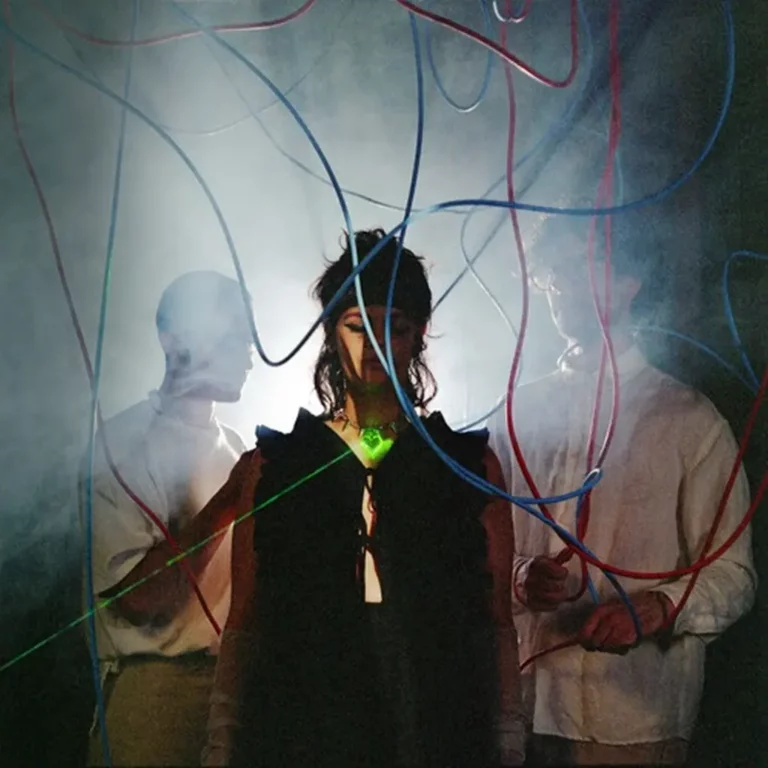
One year after “IN:titolo”, Giulia Impache releases “Alone Song” with Charlotte Jacobs and inaugurates a transition phase towards the next album.
“Alone Song” is configured as a liminal sound object, which undermines the very idea of a single and record progression. Giulia Impache works on an unstable form, choosing to inhabit the “between”: between a finished album and one still in gestation, between writing and abstraction, between emotional presence and dissolution.
Between cosmic avatars and abstract writing, between electronics and the memory of Italian songwriting, Impache constructs a passage that is already a declaration of intent.
We met her and chatted about compositional freedom, the live dimension, the homologation of the mainstream and an idea of evolution that rejects the comfort zone.
THE INTERVIEW
“Alone Song” arrives one year after “IN:titolo”. What nature does this song have in your journey?
It was born as an act of freedom. After one record you expect the second, a linear trajectory. Instead, this piece emerged while I was experimenting with new sounds on the synth, when I was already immersed in writing another work. It was not part of that project and for this very reason it risked being suspended.
I felt it had to come out now, without excuses. Sharing music doesn't always have to be a strategy. Sometimes it's just a necessity.
You dedicated the song to Bimba Splendente. Who is?
It is an avatar of mine, a figure that embodies the curious and playful side that I keep most hidden in everyday life. I perceive myself as a serious person, even in the themes I address in the records. Here I wanted to open a different space. “Alone Song” talks about cosmic journeys, about other worlds.
I chose English for a sound issue, not a semantic one. The sentences do not seek completeness.
I was interested in abstraction, the surreal dimension, a lightness that was not superficial but luminous.
How does Charlotte Jacobs fit into this constellation?
I met her through Marta Del Grandi, who introduced her to me during one of her tours in Italy. I hosted her in Turin, in the space I manage with the Pietra Tonale collective. There was an immediate affinity. After listening to my album she wrote to me, and when she returned to Italy we shared a concert at Germi in Milan. We said goodbye with the idea of doing something together.
When I composed “Alone Song” I thought of her: I also wanted the collaboration to be free, even geographically distant. I gave her some instructions, then let her move independently. I trusted his taste and his tonal sensitivity. His voice does not dialogue, it slips into the song like a further perceptive shift.
Your music has a strong visual component. How are image and sound intertwined?
I come from artistic studies, I attended art high school and graduated in art history. The image is always the first impulse. I compose as if I had a palette in front of me: I work with colours, with stratifications. In the past I dedicated myself to informal art, attracted by the strength of the stain and the chromatic suggestion.
That approach became vocal through improvisation. I look for different colors and layer them. I feel more like a painter who translates color into sound than a composer in the traditional sense. The image precedes the word. The melody and chords arrive, only then does the text intervene, often as an echo of an already formed imagination.
One year after the release of “IN:titolo”, would you change anything?
No. It was a necessary, almost foundational gesture. After years in collective projects, choosing the name Giulia Impache meant taking on full responsibility. Of course, he collected songs written three or four years earlier. It represents me, but not completely. The work I'm developing now goes elsewhere.
I feel a detachment that I consider healthy. I don't want to remain anchored to an already defined form. In this sense “Alone Song” is also a signal of transformation, a threshold that declares a movement in progress.
This new single is a starting point. Do you already have more material ready? Are you working on the new album?
Another single will be released in April, but it will be a cover. I actually prefer to call it a rework. “Alone Song” and this song are designed to coexist, like a diptych of transition between “IN:titolo” and the album I'm writing now. The new work will have many more texts in Italian, so these two episodes function as a bridge, as a transition zone.
Can you reveal what cover it is?
It is a very personal rereading of “Una Brief Season”, a little-known song written by Ennio Morricone And Sergio Endrigo for the 1960s film of the same name. It is a song that I discovered years ago, during research I was doing with Jacopo Acotesca on Morricone's pop and orchestral repertoires.
I was already performing it live, it seemed unfair to leave it confined to that dimension.I rarely talk about love directly in my records. In the next one, however, this theme will emerge more clearly. “A short season” has become a perfect gateway: it holds together my education linked to the Italian songwriting of the Sixties, contemporary electronics and a certain love for ancient music that I am exploring more and more.
Is this tension between electronics and tradition central to your path?
Yes, because I don't experience it as a contradiction. The Italian songwriting of those years was fundamental to my growth. Today I reread it with the tools I have at my disposal: synthesizers, vocal manipulation, improvisation. I'm not interested in the nostalgic operation, but in the friction. It is in that friction that I feel something authentic being born.
I'll ask you an inevitable question: what relationship do you have with Sanremo?
I look at it almost as a social experiment. Also due to professional deformation: I teach singing, so I have to stay up to date. With a colleague we analyze the performances in a technical way, we observe writing, interpretation, vocal management.
I don't like competitions in general. Sanremo has produced important songs in the history of Italian music, but today it seems to me above all to be a very homogeneous showcase. Italian music is plural, stratified. Only one portion arrives on the Ariston stage, often the most reassuring.
Would you ever see yourself on that stage?
I don't snub anything. If the opportunity arose, I would consider it. Sanremo is also part of an ecosystem. The important thing is not to get lost. For me, coherence comes before exposition.
You often talk about mainstream acceptance. Was it an act of courage to release a record like yours in Italy?
When I was looking for a label, I also received interest from abroad. In the United States there is perhaps a more natural use for a certain type of proposal. Then an Italian label responded to me and I thought it was worth trying here.
In a panorama bombarded by repetitive formulas, proposing something slightly oblique is already a political gesture. Paradoxically we fear artificial intelligence, but we have been practicing standardization for years. This is why I feel lucky: even if a project like mine finds attention, it means that the public wants a change.
And the live dimension? How is it evolving?
We are closing dates for spring and summer. “IN:titolo” has already crossed several cities, Rome, Milan, Bologna. I would also like to return abroad, where with other projects I have found very attentive responses.
I must say, however, that Italy surprised me. There is a real curiosity towards unreleased music, despite the dominant narrative to the contrary. It's fragile, but it's there. And this fragility, as in my songs, can become fertile ground.
LISTEN TO THE SONG
ABOUT
Julia Impache is an Italian singer and composer. His sound and musical research explore the voice in relation to the body on a technical and emotional level. It stays away from labels and genres, trying to maintain its hybrid nature, given by the mixture of influences ranging from ancient music to folk and from ambient to “space” electronics. Open to listening, she was able to shape a stylistic and sonic blend that involves the voice as an instrument to create enveloping, ethereal and dark sounds.
His research also aims to break the canonical link with words. Experimenting with sounds, he finds himself speaking new languages based on connotation, on the phoneme free from any predefined conceptual link, the same emotional and evocative mixture that a sound can bring.
WEB & SOCIAL
@giuliaimpache