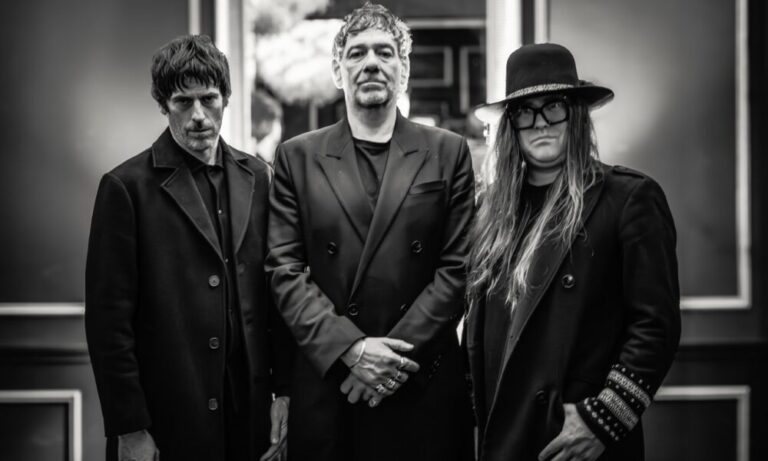
The new album from the Archive collective is called Glass Minds. But for him there is no question of an inaccessible glass ceiling with its always captivating atmospheres.
Find this interview with Darius Keeler, Dave Pen and Pollard Berrier from Archive in our weekly n°221. Discover our subscription plans.
The very first sounds that we can hear on “Broken Bits”, the first track of this new album, sound almost like the siren of an ocean liner. Do you have the feeling that Archive is sometimes like an ocean liner that is slowly – even painfully – heading back to sea?
Darius Keeler: As long as it's not the Titanic (smiles)!
Dave Pen: It's funny you mention that because he (Darius) moved to St-Leonard-on-Sea, and one day when we were at his house, I was watching ships passing in the distance and there's something very peaceful about watching, very calming, especially at night, floating like that in the darkness. But he’s the one who composed this intro, so you might as well ask him directly…
DK: I admit that I hadn't thought about it. I see it more as a call. Although I agree: there is something quite mysterious about a boat trip…
We could read here and there that it would be Archive's most ambitious album. How do you think Glass Minds is better than the previous ones?
DK: It’s not necessarily so in my eyes. All our albums are, but I would tend to think that the previous one, Call to Arms and Angelshad represented a much greater challenge, because of Covid in particular, but also because we had looked for something else in the composition, something more experimental. In comparison, this album was simpler, also more joyful in its creation. We were less focused on being experimental, just having fun writing songs. Something more natural, more peaceful there too.
Precisely, who does what within Archive when it comes to songwriting? How does it work internally?
DK: But you can't reveal something like that (laughs)!
Pollard Berrier: Those who work aren’t there (laughs)!
DK: Everything is done with AI (laughs)! It depends on the albums. We mainly compose as a threesome and together with Pollard and Dave, but on Calling Arms…, each of us had written separately before we found ourselves at the start of the recordings. For this one, we often found ourselves in pairs for the writing, Pollard and I, Dave and I, before all meeting up in Brighton.
Alain Fretet
Pollard, when Call to Arms and Angels came out, you said it came at a crucial time where everything everyone did was important. To what extent Glass Minds is he also imbued with the world and the situation around him?
PB: We thought then that we had witnessed the end of the Trump era, the end of autocratic propaganda. There was even a climate of rebellion among us with titles like “Mr. Daisy”. The irony is that with this new album, things have gotten worse, it's even more chaos, with more wars. Yet there are more glimmers of hope on Glass Minds. Like a feeling of stimulation, of elevation. This is what we needed and perhaps what the world needs. It came naturally like that and that's why the whole thing is more melodic. The positive is there, somewhere, even if there is always darkness. The songs gained in simplicity and therefore in strength.
If you find this album more positive, the texts and themes are far from exuding the joy of living…
DK: That’s true, but hope is not absent from what we write either. I really like “Wake Up Strange” for that and even on “Patterns”, although the theme is indeed very dark, there is this feeling of openness, that you can escape from all that and that is rather reassuring.
PB: It’s also fundamentally Archive, this way of proceeding. I've said this before in previous interviews, but it's a bit like when someone confronts you with a reality: it's difficult to hear but you almost always feel better afterward.
Is expressing yourself through music still therapy, as Danny (Griffiths, co-founder of the group with Darius Keeler, nda) once said?
PB: 100%! And it probably is for all artists to some extent.
DP: This is clearly how we translate our anxieties, our fears, our hopes too. This is how they come out! And when we play on stage, it's as if they come back to us and we transform them into positive energy that we send back to the audience. Never give up, always try to do better…
With the return of vinyl and the generalization of platforms, artists seem to have a tendency once again to produce shorter albums, while, for your part, you continue to offer longer formats, double albums when they are not triple… Should we conclude from this that Archive needs space and time to express itself?
DK: It's a little less true with this new album, but the fact is that since we've always been used to doing what we want, it doesn't occur to us to question if one of our songs is 15 or 20 minutes long. We don't think about the consequences, if it's going to “fit” on a vinyl, that kind of thing… Our conception of music has always been vast, global, that it is natural for us to express ideas or atmospheres in successive layers, with differences in level, with breathing.
Archive is also a very prolific group in terms of albums for 30 years. Is this consistency in writing the best way to avoid the fear of the blank page?
DK: There is indeed that. It goes even further in a way. I believe that the search for inspiration must be permanent, to always be on the lookout, always curious. In my eyes, it is even what is most interesting in the relationship with writing. Writing for the sake of writing, without necessarily having the inspiration that goes with it, is common among an artist precisely for fear of losing control, but this quest for inspiration is truly crucial. It is also what distinguishes the spirit and content from one album to another.
You can also view the interview via our reader below: