Rock as counterculture.
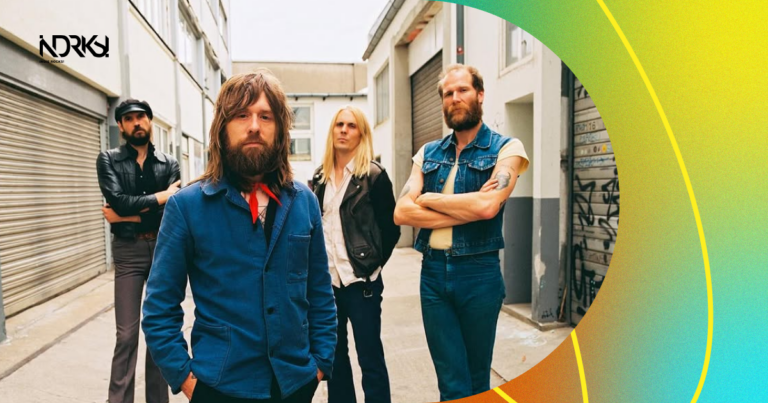
The German band returns to Mexico with their own show after their recent visit to Crown Capitalreaffirming a proposal that, 15 years after its formation, continues to bet on the raw energy of psychedelic rock and creative freedom.
Since its formation in Berlin, Kadavar has established itself as one of the contemporary bands that has best known how to reinterpret the tradition of psychedelic rock and seventies hard rock. With more than a decade of experience and several albums that explore different facets of their sound, the group has built an identity that oscillates between experimentation and the rawness of their first recordings. Before its presentation on March 14 at the Sports Palace Pavilionthe band talks with Indie Rocks! about his creative process, his vision of rock in the era of social networks and what the Mexican public can expect from his next concert.
Indie Rocks!: Last year they played here and also released a new album, so I think there's a lot to talk about. First I would like to ask you about your inspirations: what is the process like to write a song or an album and finally release a record?
Kadavar: It's hard to answer that question because our two most recent albums couldn't be more different, both in how they sound and in the recording process. I Just Want To Be A Soundfor example, it took us more than two years to develop the concept and write the songs, plus it was the first album we made as a quartet with yasha on the second guitar. It took us a while to find a formula that worked for everyone.
On the other hand, the album that followed, Kids Abandoning Destiny Between Vanity and Ruinreminds me more of our early days: we just recorded several takes on tape without thinking too much about it. It was a much more spontaneous album. In general, each album has its own story and its own way of being made, and these two in particular were very different from each other.
GO!: For me you are a very interesting band because when I listen to Kadavar I remember a lot of the time when I listened to bands like Led Zeppelin, stoner rock or psychedelic rock. That's why I want to ask you: what is it like to make rock in 2026, in an era dominated by TikTok, social media and short three-minute songs?
K: Sometimes we feel that our way of making music is appreciated by a specific group of people, but not necessarily by the mainstream. In our 15 years of career we always come to the same conclusion: even with the success we have had, what we do is still a kind of counterculture.
There doesn't seem to be much potential to grow indefinitely, but that's not the goal either. We play for a scene that really appreciates what we do. We've also learned that to be happy with our music, we have to constantly remind ourselves that what we like is something quite particular.
Throughout the albums we have experimented a lot, but we always return to the idea of being different and being inspired by certain moments in rock history. In that sense, things change and at the same time they don't change.
GO!: I find that very interesting, because I think it is important that this type of music and that counterculture continue to exist. You also mention that Kadavar's goal is not necessarily to grow more and more, but at the same time it is a band that has grown quite a bit within its own niche: they have been around for 15 years, they tour all over the world… how do you see that success?
K: After 15 years I have a somewhat ambiguous view of success. I am very grateful for everything we have achieved and for the opportunities that have come with it.
But it is also true that these opportunities can lead you to make mistakes. You are always faced with the dilemma of staying true to yourself or letting other people decide what you should do. I think that in general we have handled that situation well, although it is still a challenge.
After so many years you have to honor your values, stay true to what you like and think very carefully every time someone suggests you do something different.
GO!: Speaking of this tour and the concerts you are giving now, which also celebrate those 15 years of experience, what can fans expect from these shows?
K: You can expect songs from our two most recent albums, but above all a lot of energy. We know that the concerts are going to be very good and that the energy of the public is always special.
Just as we are looking for a rawer sound on the album, we are also trying to transfer that feeling to the stage. In rehearsals we are playing in a very simple, very direct way, listening to each other without using the recording system. in-ears and playing very close to each other. I think that dynamic is going to be reflected very well on stage.
GO!: So they will play without in-ears on this tour?
K: Not exactly at concerts. We continue to use them live because they allow us to have greater control of the sound. But in rehearsals we do seek that more direct experience of listening to each other. Then we bring that energy to the stage, which is a different context.
GO!: Speaking of setlistyou mentioned that they will play songs from recent albums. Will we also hear songs from other stages of the band?
K: Yes, definitely. We are going to play songs from practically all of our albums.
GO!: They will soon be playing in Mexico. I know they were here about six months ago. How do you feel about returning and what do you expect from the Mexican public?
K: For us it is a very special occasion and we are very excited to return so soon. Our show at the festival Crown Capital It was very good for us, and now we are happy to return with our own concert as headliners.
That means we will be able to play a longer set, and I hope it will be a great party and a time where we can connect with the audience. I am sure it will be so.
GO!: For someone who hasn't seen you live yet and is reading this interview thinking about going to the concert, with what mindset would you recommend attending a Kadavar show?
K: When I go to a concert I try to let my body and mind experience the entire moment. I like to immerse myself in music without having too defined expectations.
I think that's a good way to live it: go with an open mind. In our case we also improvised a little on stage and there are elements of freestyleso we ourselves came up with the idea that anything can happen.
Each person has their own way of opening themselves to that experience: it can be an attitude, a substance, whatever. The important thing is to go with an open mind.
GO!: So, comfortable clothes and an open mind?
K: Exact. Comfortable clothing definitely helps.
GO!: To close, two quick questions. If someone reads this interview and wants to start listening to Kadavar but doesn't know where, what song would you recommend to enter his discography?
K: It's hard because I'm too involved with our music to choose just one. But I would say “Lies”, the first song from our most recent album. It has new elements and also some of the band's classic sound, so it could be a good entry point.
GO!: And the last question: if you had to describe Kadavar in just three words, what would they be?
K: I'm going to use a comment we once saw on YouTube that described us as “Cream on steroids.”
Stay tuned for Indie Rocks! for more details.
TikTok / Instagram / x / Facebook