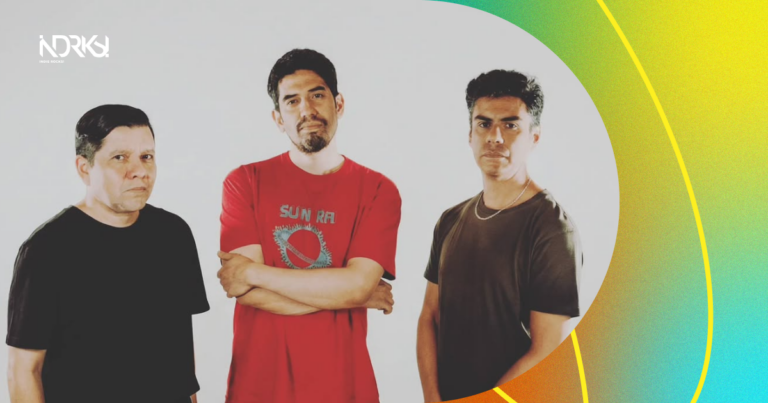
New music with the power of 30 years of experience.
The nineties alternative music scene in Chile was advancing in the shadows of the mainstream. This is a country of conjuncture and resistance, it can be seen in its artistic works, in its literature, in its history and in the bands that build other ways of creating music, other possible worlds. In this context, it was created Freezera trio made up of Walter Roblero and the brothers Rodrigo and Jorge Santis. Now, after 10 years without releasing new music, Freezer returns with one of the best albums of 2026: Distance.
In an interview, we spoke with Walter Roblero and Rodrigo Santis about his return to the studio, the collaborations with new Chilean talents and the contrasts with the alternative Chile of the nineties.
Indie Rocks!: At what point is Congelador, after so many years without new material?
Freezer: Well, we find ourselves precisely in the recent edition of this album, which is our album that brings us a little back to the issue of record publishing, because it has been 10 years since we released anything. Yes, we continued doing things with each other, playing, sending some ideas and, well, doing some live performances, but we haven't done it in a long time since we entered the studio, and we are in a moment of reactivation of the group in terms of rehearsals and concerts.
I would also say that with quite a bit of enthusiasm because we are also a bit in that spirit, because the album has been received quite well. It seems to me that the spirit that we have always had of innovating within what we do has been refreshed, so I think that has also been well received by people who listen to music like the one we make.
GO!: This new release could not go unnoticed in the eyes of Mexico, because Congelador is a band that has been followed for years, a lot of time has passed since the formation, and something that caught our attention is the integration of new voices, from very young projects, in contrast to the 30 years of experience that you have, what was it like to integrate into the sound of Congelador new people who are entering to make music, who are entering the alternative scene in Chile, such as Renatto Olive groves?
C: Yes, well, in a minute we had a forced foot, self-imposed a bit, which had to do with working the songs in a different way in the usual format that we have had for most of our career, which has been like the format of the power trio: bass, guitar, drums. For a few years now we were distorting that format a little, incorporating machines; I had stopped playing guitar, and for this particular album I had no intention or desire to sing, like on some previous albums.
We have an instrumental album in between and we were looking forward to, we have always liked the song format, and we also really like structures with voices, like the voice as an instrument is something that always catches our attention in the things we listen to as well.
So yes, it was kind of fitting for us to add well-known people who sang, and there along the way we started to think a little, well, we had already worked with aka Lore of the band Chicarica for some live concerts; with her we played in the version of Primavera Sound that was made here in Chile. We had also played with Laurelaand I in particular was seeing very continually Renato of Hesse Kassel. So we added people who were around us, close people, for this task of adding voices, because those new textures, those new colors that they could contribute also seemed striking to us. So it had a little bit to do with that.
Also in other songs, in demos we made, we invited other friends to sing. It was an intention from the beginning to work on the songs like this. There were some that we even thought could be instrumental, but we always lacked that element, so they ended up taking shape when these new voices were incorporated.
GO!: All that seal is reflected in the new songs, talking about these young bands that you have approached, how do you discover them? Are you the ones who stay close to the Chilean alternative circuit?
Freezer: Going to see live shows has always been a very pleasant moment in my life. It's something I do constantly, on the weekends, I like to go to concerts. So I'm always watching bands. I had already seen many of those bands a long time ago. I think that in the case of us we do actively go to see live shows. In Santiago the circuit is not that big, the places are repeated, so it is normal to find these bands.
Although there is a new scene, which I also feel is something real, there are always those types of bands that are more or less on the surface. In particular, I see them all the time. So yes, there is that recommendation thing, but many times we arrive before they release albums, seeing them live. And there is also something about bonding and friendship with the people we invite to collaborate. I like interacting with people of all ages. Even though you are older, it is good to stay curious about what the younger generations are doing, and also learn from older people. I emphasize this because sometimes there are generational prejudices, but intergenerational collaborations are much more fruitful.
GO!: Of course, it nourishes the project. And well, we have also talked a lot about the album as a form of resistance against the current industry, which pushes more toward singles. Even a song like the 14-minute “La Meridional” could look like this. How do you perceive it? Why is it important to make an album today?
C: In our case, I think we have the peculiarity – and perhaps that is why we have been around for 30 years – of not focusing so much on the industry. We do not do things to satisfy those needs, but rather personal needs, of expression.
So we have heard those types of concerns, but they have to do with how music is consumed today, with attention spans, with making songs shorter, etc. We have never thought about it or talked about it. The work is governed by other parameters, more linked to what we want to express. We're in the industry in a way, so we know that happens, but we don't incorporate it into our decisions.
In fact, it's curious because in Chile now it seems that there is a tendency to make long songs, the opposite. In our case it does not respond to industry impositions, and we believe that these limits can affect the quality of the work.
GO!: Yes, it kind of ends up being limiting.
C: Of course, in general that tends to degrade the work. It happens in many arts: when you prioritize the commercial over the expressive, you change the intention.
GO!: Thinking about this new album, are there live performances coming up? Are there plans to leave Chile, maybe return to Mexico?
C: The rhythm of Freezer It is very slow. The band is not our main source of income, we decided that a long time ago. We have parallel jobs and we take care of the project as something more “sacred”, so that it is not affected by economic decisions. Now that we are more active with the album, we want to take advantage of this momentum to play it live. We are resuming rehearsals and we want to coincide the presentation of the album with activities for the band's 30 years. We also want to play old songs, something we were a little reluctant to do. We have several projects for this year in Santiago and Chile, and we really want to show this abroad. There is nothing concrete yet, but we would love to travel. Much of the band's most important moments have been traveling: Spain, Mexico, Argentina, Peru. I hope it can be repeated.
GO!: To close, what are the most significant changes you have seen in the Chilean music scene from the 90s until now?
C: Today there are many more facilities for making records. Before it was much more difficult, now you can record in a self-managed way with a good level. There are also several scenes operating quite actively, despite difficult moments such as the social revolt of 2019 and the pandemic, which in Chile was very restrictive. That generated a slow reactivation, but also promoted new forms of self-management.
People manage to keep things happening, even in adverse contexts. At first, when we released our first album, we had to go record store by record store; there was no internet. Today all the technological change has transformed the way music is disseminated, consumed and valued. There is also a greater saturation of musicians, which changes the dynamics. And that implies new forms of self-management, very different from those before.
Dale play to “The Meridional” a song of Freezer in collaboration with the voice of Laurela. This is part of the new album Distance: