“The most rewarding and longest-lasting collaborative project we have ever been part of. » Since 2011, American brewer Sam Calagione, co-founder of Dogfish Head, and Canadian archivist David Lemieux have married hops, sustainability and Deadhead culture. Immerse yourself in an artisanal union between psychedelic rock and pale ale — between On a Back Porch vinyls, Play Dead streaming and 5.3% alcohol lagers.
For Sam Calagione, Deadhead through and through, the best mornings start aboard the 19-foot whaler that he takes out on the Atlantic, where he can fish while listening to the Dead. Once the canal that runs alongside his Delaware home is carefully crossed to reach the right spot, he drops anchor, starts shuffle play on one of the three iPhones he has on board (two spares in case he drops one), and waits for the bars to strike. This charismatic brewer, who co-founded Dogfish Head Craft Brewery with his wife Mariah in 1995, can then work on his tan, sip a beer and live the Dead.
The brewer, looking relaxed in a neon yellow hoodie in the colors of the ROIR label, and his Canadian associate David Lemieux, official archivist of the Grateful Dead — dressed in a short-sleeved shirt that hides Grateful Dead accessories on all four corners of his person — burst out laughing. “I like it”says Lemieux. “We should start telling people that. » “It's better than 'take two and call me back in the morning'”engages Calagione.
Calagione and Lemieux have worked together since 2011, when they launched the partnership that made Dogfish Head the official beer of the Grateful Dead. Their first collaboration, mischievously named American Beauty, was a strong pale ale — but a high-end vintage served in a champagne bottle, designed for special occasions. The partnership continued, and the beers have since become more accessible. Calagione sums up this spirit thus: “Let’s make beers that prove that every day is a special occasion. »
This state of mind also fits the vision of the people who manage the Grateful Dead business ecosystem. The band's team at Rhino, the Dead's label, initially floated the idea of a partnership with a beer brand as an extension of the Grateful Dead branding — which already covers everything from skis to skateboards, t-shirts to wallets — because downing a cold beer before or after a Dead concert makes “integral part of Grateful Dead culture”explains Lemieux.
Some in the group's organization initially wanted to partner with a large brewing multinational. But someone, quite conveniently, objected to the idea of going to see Dogfish Head. “Bob Weir famously said: “The Dead are the power of the marginalized. » »says Lemieux. “So yeah, the Dead are huge, but they're quirky, if you will. » Together, the Dead and Dogfish Head have developed vintages with the same power of the marginalized, now accessible to all.
Calagione leans forward in his chair in the meeting room and uncaps two cans he brought in an ice bucket. “You don't have to finish everything, but taste both to understand how we thought about the balance, making them both close and distinct”he says. (Editor's note: we didn't have to finish the beer… but we did.)
Grateful Dead Citrus Daydream Lager has a medium body and low bubbles. It is just bitter enough but without an aftertaste. The Grateful Dead Juicy Pale Ale, on the other hand, is deliciously bitter with tiny effervescent bubbles that never overwhelm the palate. It’s a pale ale, complete and assertive. “We said to ourselves: let’s make two very approachable and complementary beers, but distinct from each other”explains Calagione. “They are both exactly 5.3% alcohol, so very accessible in terms of ABV. They each have two different key hop varieties, and each has a grain with a strong sustainable vocation. »
The company brews Juicy Pale Ale with granola and a grain called Kernza, which Calagione says, “sequesters carbon from the atmosphere at a rate ten times greater than that of an acre of traditional malting barley”. Citrus Daydream Lager is made with lime, lemongrass, lemon zest and fonio, “an African grain cultivated since before humans invented the wheel”.
For Calagione, it's crucial that Deadheads understand that the brand is on their side, that Dogfish Head shares the same values as the band on topics like sustainability, “that we care and that we are all on board”. He says he's honored that the Dead and Rhino have allowed Dogfish Head to use iconic artwork like the Dead's dancing bear in the past, and for current beers, the “Stealie” (aka the “Steal Your Face” skull).
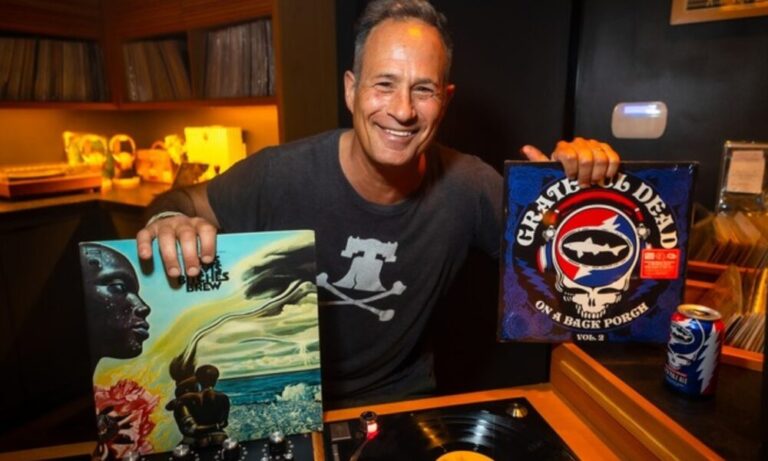
Another way to demonstrate their commitment to Deadhead culture is through limited edition vinyl releases. Dogfish Head is the official beer of Record Store Day and has been involved in the festivities since 2025, via a series of limited edition Grateful Dead compilations called On a Back Porch. The third volume was released last Saturday. It contains six rare live recordings, including “Samson and Delilah” captured in 1976, a nine-minute version of Chuck Berry's “Around and Around” from 1978, and “Touch of Grey” — the band's biggest hit — taken in 1989.
As with previous volumes, Lemieux worked closely with Calagione, his son Sammy, and a friend of Sammy's named Dash, to sift through their favorite recordings (some of which were selected aboard the brewer's boat). “As with beer, these albums are some of the simplest co-productions I have ever made”explains Lemieux. “We produce them in a few minutes. It's a few text messages. The “Samson and Delilah” on that one, dated June '76, Sam just wrote me, “Hey, what do you think?” “. I know it well because everything on it comes from Grateful Dead albums already released but out of print on vinyl or CD. So we're going to look for a lot of deeper cuts. It's extremely pleasant to ride. For me, it's almost a beginner's guide to discovering the Grateful Dead. »
Lemieux understands the need to provide a gateway into the Dead's sprawling catalog, having worked with the band since 1999 and personally listened to the 1,800 concert recordings held in the band's vaults — about 1,500 of them, by his estimation, of sufficient quality to be released. It took him nearly eight years to go through everything, and since then he's been taking notes for eight or nine years preparing the band's archival releases and his own favorites for the “Dave's Picks” series, active since 2012. He now estimates he spends at least six hours a day listening to the Grateful Dead. “I never get tired of it”he said, beaming.
When he says that, both WECB and Calagione want to know how he knows what's good among 1,500 concerts. “I listen to spot the moments that stand out”he replies. “When I went to Dead shows, I called it the 'frenzy point.' It's when the band — six guys on stage — hits the X factor and you feel the energy filling the room, and suddenly there are 36,000 fists raised in Madison Square Garden, because it's a liberation. It can happen once in the evening, or ten times. It can happen during “Me and My Uncle”, or during “Scarlet Begonias”. I also listen to Jerry for an extra inflection on a lyric, or Bobby (Weir) who screams a little louder on “Estimated Prophet”, when he loses his temper at the end of the song. When it gets a little more extreme and a little more intense, that means they're into it. »
Lemieux recently helped launch a new streaming service, Play Dead, through Nugs, which on its first day offered more than 400 full Grateful Dead concerts, including twenty completely new ones — with many more to come. “We are going to release two concerts per week, or 100 per year”he specifies. “The ultimate goal is to get all the vaults online. » The archivist also recognizes Deadheads' thirst for physical media (like Dogfish Head's On a Back Porch LPs) and assures that there is no end in sight for his own “Dave's Picks” compilations, with a new big box set planned each year.
Although he is already excited about a surprise release that will be announced later this year, it is especially 2027 that galvanizes him. “It’s the 60th anniversary of the first record, the 50th anniversary of Terrapin Station, the release of The Grateful Dead Movie, the famous Cornell concert, the famous Englishtown and New Jersey concerts”he lists. “There are a lot of big birthdays in the Grateful Dead universe next year. This year has a few, but next year is a big year for us. »
On a Back Porch offers a bite—perhaps more aptly comparable to a beer flight—of what's in the Dead's coffers. “Live concerts are where the magic happens, and these records are a good place to start”said Lemieux. “They're really fun albums, and they're 45 minutes of Grateful Dead music that's already been released, but has become very difficult to find. We love it. »
The special records and the band's partnership with Dogfish Head are all part of a larger culture, according to Lemieux. “Above all, what we do is music”he said. “For Deadheads, I think part of the very identity of being a Deadhead is wanting to show it. Right now, I'm wearing Grateful Dead socks, a Grateful Dead belt, a Grateful Dead phone case, a Grateful Dad hat, and a Grateful Dead wallet. And it’s not because they’re offered to me; It’s because I honestly love this thing. Our identity is being Deadhead. I think we've all said that having a beer is part of the Grateful Dead lifestyle — and it boils down to this: it fits the Grateful Dead lifestyle. »
Calagione says he has always admired the community that Deadheads have built. “Definitely, a big influence on how we grew the brand (Dogfish Head) was observing how the Grateful Dead community always put its audience first, business second.”he explains. “We never let the tail of money wag the dog of inspiration at Dogfish Head. This is why this project has truly been the most rewarding and longest-lasting in which we have participated. It's great to see people my son's age, in their 20s, diving into the Dead with the same intensity that David and I did when we were young. »
Calagione is also eager to win over new fans. As he leaves, the brewer pops his head into another WECB meeting room, introduces himself, and tosses Dogfish Head/Grateful Dead caps to the executives present. “You have a cap, and you have a cap”he smiles. Before, of course, leaving a bucket of the group's cold beer for everyone to enjoy.