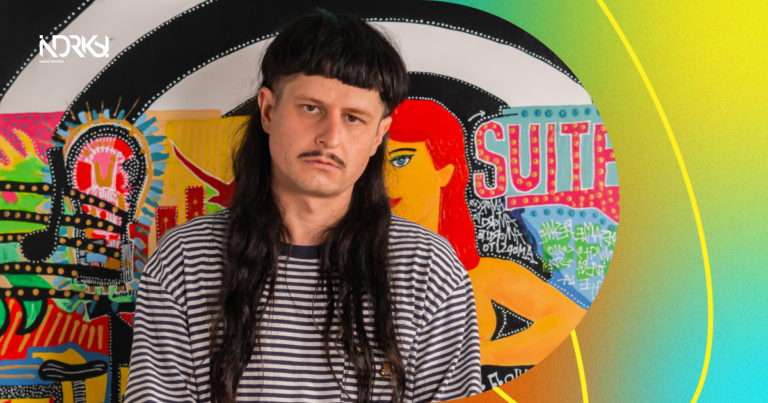
A new stage, more independent in Love You Madly, Hate You Badly.
Singer, songwriter, producer, rapper, comedian and filmmakerfrom Santa Cruz, California, Oliver Tree has begun a new stage in his career with his fourth studio album, Love You Madly, Hate You Badly, released by his own record label, Alien Boy Records. With this, he stopped working with a major label and recording in professional studios to adopt a more approach. DIYrecording 17 new songs on seven continents over two years, with a laptop and an interface in hotel rooms.
The process included his previous visits to Mexico and a brief residence in Antarctica, where he performed his first shows in that part of the planet. Prior to the release of this album we had the singles “Superhero”, “Joyride”, “Flowers”, “Deep End” and “All You Ever Wanted” that give us a sound that is not as produced, but that feels as authentic as in their past albums.
Prior to his next show at West Pavilion from Mexico City, we spoke with Oliver Tree in depth about his new album, this new way of working on his music, his memories of past visits to CDMX and his weekend, which took him from walking through Chapultepec to a surprise presentation at the Supernova Genesis next to the influencer Aaron Mercury.
Indie Rocks!: You just released your fourth studio album Love You Madly, Hate You BadlyWhat was it like working on these 17 new songs for 2 years in different places around the world and at the same time releasing it under your pure record label?
Oliver Tree: I went to 82 countries over two years and just traveled and explored the world while making music. It was similar to how I used to make music as a bedroom producer, alone, except this time I did it in hotel rooms. I realized that the amount of money I was wasting on studios and paying engineers was so high that, for the same cost as a day in a studio in Los Angeles, I could fly to South Africa, Bogota or Kyrgyzstan, stay in a hotel room for four or five days, make four or five songs and come back. That really helped me reconnect with my roots as a bedroom producer. Although the vocals are perhaps rawer and the sound less hi-fi, it feels like a very authentic version of me. As an artist, I was really inspired.
GO!: What was it like working on the production, recording and everything behind the album yourself as opposed to your past albums?
OT: Being the only person to produce the album, that was a huge challenge. I made over 100 songs just to complete it, and finishing each song meant going through 50 or 60 versions to get to the final one. So there was a big difference between me as an artist and me as a producer. As a producer, I tried to create the right environment for Oliver Treethe artist, was happy and inspired. I sent him to beautiful and unusual places that many people have never heard of, places where he could take photos of concrete buildings, eat strange things like iguana or even cow brains, drink blood in Macau, spend time with the Maasai tribe, record album cover in Afghanistan, go to Iraq, stay in mud houses or sleep in the caves of Petra with the Bedouins. It was an investment in myself and learning to enjoy being alone. I built such a beautiful relationship with myself through the process that even if no one liked the album, I would still love it. I'm at a point in my career where I don't care as much anymore; I'm basically semi-retired and focused on enjoying life while I'm alive and healthy.
GO!: During the recording of the album was there a moment in which you recorded something and by doing it in a more DIY in which there were interruptions due to recording in hotel rooms in different parts of the world, that you forgot to record some part of the project or something else?
OT: There were times when the hotel staff got upset because I was recording music too loud. It didn't happen very often, but it happened in the first country I went to, and I understood that I had to be smarter about choosing hotels with thicker walls. The saddest part was losing a phone that had about 117,000 photos and videos: it fell into the ocean after the back broke, so I lost all that content. A large part of the album, in fact, was linked to my idea of making a photography book, and my only rule was that each photo had to be taken with my cell phone. I had a good camera, but I didn't even want to use it. I wanted everything to feel raw and personal, like music. Luckily, I built the book as I went, and many of my favorite photos were still saved because I was constantly reviewing them and adding them to the project. I also recorded all the sessions in hotel rooms and was planning to use that material for the release, but I lost that too. Maybe there's something beautiful about that: preserving the memories and not obsessing so much about the content, because in the end that was never really the goal for me.
GO!: You are a very active artist on social networks, is there some content that you plan or does everything come out very spontaneously?
OT: My social media is probably the most inconsistent anyone can have. Sometimes they are the simplest and clumsiest videos; Other times they are things that cost $40,000 to make and then I lower them because I didn't like the performance. It's not about vanity: I make content for the audience. If you like it, it stays up. If not, I clean it. People are so saturated that I like to keep it simple and curated. All my style like Oliver Tree is based on this idea of being lowbrow and highbrow at the same time: something that at first may seem like total nonsense, but if you look closer, there is something much deeper underneath. That space in between is what I call unibrow.
GO!: Do you feel that there is an evolution both professionally, artistically and personally that you have noticed while working on this new album?
OT: I would say that, as a human being, I am evolving just as I hope others do. The growth of a person is also reflected in the growth of an artist. This album is very clearly a concept album focused on falling in love and the heartbreak that can come with it. Some people might say I'm writing the same song over and over again, but for me I always forget to document the falling in love part. I usually turn to music when I'm broken and heartbroken; That's when music saves my life. This time I tried to capture some moments of falling in love and preserve them as something I could keep in a bottle and share. So yeah, there's definitely been a big evolution. The album is full of love, hate and sex, and all of it is intertwined. For me, it was very cathartic and therapeutic.
GO: Before your show in CDMX, you are here and you had a weekend not related to music, you visited Chapultepec and you were at the Supernova Genesis, is there something in the city that you like to do to relax and that you enjoy on each visit?
OT: I love Mexico City. I came several times while working on the album, and this year I've been here four times already. I'm coming back in a month to do a concert here, so yes, I love Mexico City and I love Mexico. I have been to Mexico more than 25 times. I grew up going to Baja California every year, and now that I'm older, I come to Mexico City more. I come here all the time, even when I don't have shows. Honestly, I like it more than the United States. To answer your question, I also love coming without a concert. Last night was brutal, it was probably one of the craziest nights of my life. I fell asleep around 6 or 7 in the morning. The party here is wild, and although I'm not much of a party animal, I've been working so hard finishing my documentary about Antarctica, releasing the album and doing press, that I've been trying to relax a little. There is no better place to do it than CDMX.
GO!: You mentioned that you were working on a documentary in Antarctica in addition to it being the first show on your tour, what was that experience like?
OT: The process of that project is pretty wild because it covers the year I lived in Antarctica. Yes, I went into the water several times, in the polar plunge and one time I almost got hypothermia, so someone had to jump in to rescue me. That was one of the scariest moments. In the end, my parents had to go to Antarctica and basically save me because I felt like I was going crazy there.
GO!: You have a tour coming up that will also be in Antarctica, you will have shows in South America and in Mexico City, what can we expect from this tour?
OT: The tour hasn't been announced yet, but we're actually taking it to all seven continents. The real beauty of this is that this album was recorded on all seven continents. I don't think there's ever really been a world tour like that. The dream is to take the show to countries and places that people don't even know exist, and beyond that, to connect with humans of all backgrounds. During the recording process, I played six shows in Antarctica, and also performed for the Maasai tribe in Tanzania; It was probably the most punk rock show of my life. It was literally just the tribe, and I rented the speakers from some Swahili kids in town. They had never heard music like that and didn't even know how to dance. I want the tour to reflect that energy: a global show for the world.
GO!: What can we expect in your music for the rest of the year?
OT: I also plan to release a documentary series called The One Man Band, which follows how I recorded the album at Machu Picchu, Christ the Redeemer, the Great Wall of China and other wonders of the world. I brought recording equipment and recorded music in many of those places. That's a huge part of what I hope to release this year. My feature film about Antarctica, which I edited myself, took about three months to finish, so I still have to figure out the workflow. I've had a hard time finding the right publishers, but hopefully these films will come out and show the process behind the album. Beyond that, expect the unexpected. My life is basically a series of side quests and random adventures with all kinds of people. That's the most valuable use of my time: not to get more followers, money, or impress people, but to connect with people. I want to continue building those connections, stay focused on Mexico City and do more things here. This feels like home to me, and I hope to spend a lot more time here.
IR!: Finally, is there anything else you would like to add?
OT: And for anyone who has a dream: you don't need permission. You don't need to wait to have money. Just do it. You have an iPhone, you have a camera phone, you have a laptop: there is no excuse. I made this entire album with a $150 used interface. You can record a song on your phone. You can do things right now. Don't wait for it to be perfect. If it's not perfect, what does it matter? Then you can perfect it. Just do it.