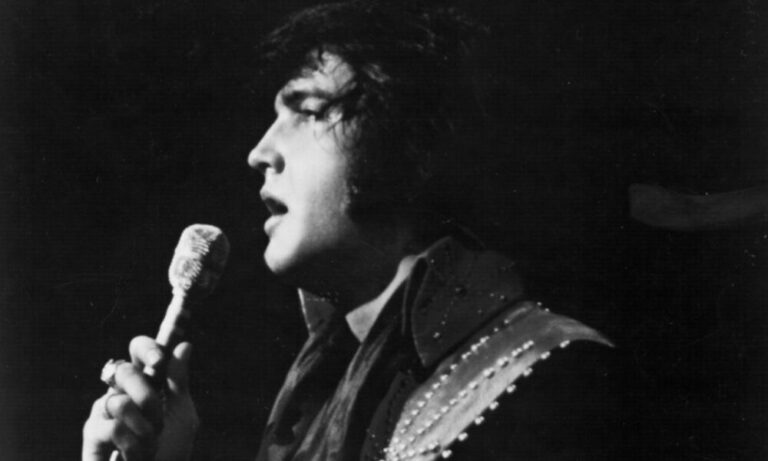
On August 1, 1976, an Elvis Presley worn out by touring and medication took the stage at the Hampton Coliseum, Virginia, for a concert scheduled for 2:30 p.m. A local journalist wrote a cruelly lucid chronicle, a year before the King’s death.
The journalist from Times Herald Cheryl Tucker walked into Elvis Presley’s concert on August 1, 1976, at the Hampton Coliseum in Hampton, Virginia, with no preconceptions. She had never seen Presley on stage and wanted to understand how the rock icon could transform “a grown woman in something akin to a screaming mass of jelly”.
She wasn’t impressed. “Judging by his performance, they are screaming for what he was, for what he symbolizes, rather than for what he is or for the way he sings todaywrites Tucker. He performed his songs well on Sunday, even if he didn’t do many of them. But there was no soul, no power, no momentum behind his voice, nothing that would even make me consider a fit of frenzy. Perhaps it is the years that have taken their toll, or perhaps our expectations have been set too high. Can we reasonably expect Elvis to put a lot of energy into his show when he is a 41 year old king? When he is well established in his profession? When he’s no longer hungry? Maybe that’s the secret. Maybe you have to be hungry. »
Tucker raises legitimate questions here, but this lackluster concert was not only explained by age or dull appetite. Presley was hopelessly addicted to prescription drugs and had a host of chronic health problems. He was also still reeling, financially and emotionally, from his divorce from Priscilla three years earlier, was no longer surrounded by several key figures in his Memphis Mafia — including his longtime confidant Red West — and was spending lavishly, to the point that a grueling pace of touring had become necessary just to balance the books.
When he arrived in Hampton, he went on tour for ten days without a single evening off, including two concerts on July 24 at the Civic Center in Charleston, West Virginia. For some unknown reason, the August 1 concert took place at 2:30 p.m., even though no second performance was scheduled in the evening. He was, understandably, empty. “We played late last night and I only slept two hourshe confides to the room. Good afternoon. God that sounds strange. I just got up. »
“Return to Sender”, a flash of spontaneity
Like hundreds of concerts before this one, Elvis Presley opens with “See See Rider Blues.” He shows a little energy at first, then begins to flag as the show segues into “I Got a Woman.” It’s particularly absent on old ’50s songs like “All Shook Up” and “Don’t Be Cruel,” but a rare moment of spontaneity arises at the start of the musicians’ presentation, when someone in the audience calls for “Return to Sender.” He repeats his request: “Sing “Return to Sender,” please? If we know her. »
It was one of Elvis’s big hits in 1962, but the song was not part of his usual setlist: he had only played it twice before, despite the countless concerts given after the 1968 comeback special. However, he launched into an improvised version with his group, which included guitarist James Burton, bassist Jerry Scheff, drummer Ron Tutt, as well as the vocal ensembles of the Sweet Inspirations and the Stamps Quartet of JD Sumner.
The concert lasts a little over an hour, including solo moments from several musicians, and yet the group manages to cram in 25 songs, often reduced to simple snippets. The great bravura moments of old — “Suspicious Minds,” “In the Ghetto,” “An American Trilogy” — are all absent, each probably demanding too much energy.
“Hurt”, the King’s startle
Tucker doesn’t say a word about “Hurt”—she rather regrets not having heard “Heartbreak Hotel,” “Blue Suede Shoes” and “Love Me Tender”—but it’s an obvious highlight of the concert. For a moment, the Elvis of a few years ago – the one documented in Baz Luhrmann’s revealing concert film, EPiC: Elvis Presley in Concert — resurfaced. There he proclaims, in a voice full of sincere emotion, a wound deeper than we will ever know, that of a man who still loves. He sleepwalks into a truncated “Hound Dog” which falls sadly flat.
The show ends with “Can’t Help Falling in Love With You” delivered in barely two minutes. The group continues to play after leaving the stage, and we are not even treated to the legendary “Elvis has left the building”.
For many in this room, being in the same room as Elvis and perhaps leaving with a scarf around your neck was well worth the price of the ticket. And it left them with cherished memories for the rest of their lives.
A man at the end
But it wasn’t the best Elvis they were offered. It’s easy to blame Colonel Parker’s greed and those absurd tour itineraries that left him no days off and forced him to play matinees, like that day. All of this really weighed in. But the truth is that Elvis Presley was simply exhausted. He should have been in rehab, not on stage at Hampton Coliseum at 2:30 p.m. this bicentennial summer.
Four years earlier, a slimmer and healthier Elvis had given a much better concert in this same coliseum. A film crew had captured everything for the film Elvis on Tour. The rushes lay dormant for decades in a Kansas salt mine, before being recovered by Luhrmann’s team. The director would now consider making a new film devoted solely to this evening from these images of the 1972 Hampton Coliseum.
This would be a wonderful gift for fans: this is the Elvis the world should remember. Which is not to say that he had nothing more to offer in the last years of his life. There were even moments, during the final concerts of 1977 – the most famous being “Unchained Melody” – where the Elvis from before briefly resurfaced. And despite his frightening physical decline, the King never lost his voice. She was with him until the very end.