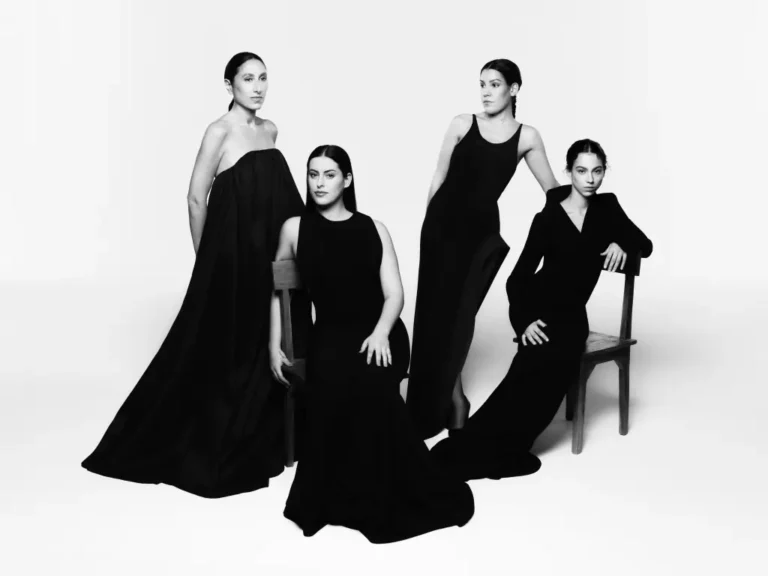
After twenty years of career, six albums and concerts in over fifty countries, Las Migas choose Italy to inaugurate a new phase of their journey.
He goes out Moonrereading in a flamenco key of I don’t want the moon, the classic brought to success by Fiordaliso. A tribute that comes from a childhood memory and which becomes the first step of a broader project, with the aim of bringing the group back to our country and showing a face of flamenco far from stereotypes.
We talked about it with Marta Robles, guitarist and founder of the group.
THE INTERVIEW
After a twenty-year career, you have chosen to reinterpret an Italian classic such as I don’t want the moon by Fiordaliso. How did the idea of transforming it into your musical language come about?
I listened to this song many times when I was a child. In Spain she was very well known and for me it is linked to my first memories of music. A few months ago we met the Warner Italia team and they proposed recording an Italian song. We immediately thought of this song because it seemed perfect to us precisely because of its distance from flamenco. It was an interesting challenge: taking something very different and bringing it into our world.
We worked a lot on the arrangement to make it very energetic, very rumba, a song that makes you want to dance.
It was a very fun job and we really hope that the Italian public welcomes it with enthusiasm.»
Why did you choose this song as a bridge between your music and Italy?
For me it is also a way to return to Italy. I have been there many times in the past, both with Las Migas and with other projects, and I have always had the feeling that here flamenco is associated above all with dance. We think about the ballerina, the dancers, less about the music.
We, on the other hand, are first and foremost a band. Of course, there is also movement on stage, but the center of our work are the instruments, the harmonies, the voices. With Luna we want to show exactly this: another way of experiencing flamenco.”
Is there a thread that unites Italian music and flamenco?
Maybe not all Italian music, but certainly that of the South. When I think of tarantella, of Neapolitan music, I feel many affinities with flamenco. There is the same emotional intensity, the same rhythm, the same dramatic way of telling stories.
Even in Italian songs there is great attention to the melody and the interpretation of the words. These are elements that I feel are very close to our musical culture.»
In recent years, flamenco has returned to the center of the international scene also thanks to artists such as Rosalía. Have you felt a change?
Yes, today I see many projects that use elements of flamenco, the palmas, the rhythmic language, even the aesthetics. It is certainly a favorable moment and I believe that this makes the public more curious about languages that until a few years ago seemed distant.»
Has Fiordaliso already listened to your version?
Not yet, we haven’t had the chance to meet her. Before recording the song, however, we asked for all the necessary authorizations from the authors (which is Zucchero for music). I was very nervous when we sent the first version, because I really wanted to respect the spirit of the song.
When they responded positively we were really happy. I would very much like to have Fiordaliso listen to this version personally.
Does this single also represent the first step towards a live return to our country?
Absolutely yes. We consider it the first step. We play continuously in France, Germany and many other European countries, but Italy has always been more difficult for us to reach.
It is one of the countries we love most and we would really like to be able to build something stable. We believe that our concerts will be very popular with the Italian public and we hope that Luna can open this door.»
Did Italian music also accompany your personal education?
Very much. When I was eighteen I came to Italy with a friend and we met some Italian guys who made us listen to a lot of music.
I remember Francesco De Gregori, Fabrizio De André, Jovanotti. We were completely in love with Italy and its songs. I often joke with my friends that we learned to speak Italian by listening to your music.
Years ago I also participated in a project dedicated to Fabrizio De André together with the Parma Orchestra. It was beautiful work. This is why recording a song in Italian today with Las Migas has a special meaning for me. It’s a new beginning.”
Are you also thinking about an international recording project that brings together musical experiences from different countries?
It could happen. Today everything is simpler thanks to social media and we have always been a very international group. Spain is a little tight for us now: we work a lot in Latin America, we are preparing a tour in the United States and we collaborate with artists from many countries.
We also recorded songs in French and worked with Ibrahim Maalouf. Perhaps the time has come to stop and imagine a project that truly looks beyond the borders of Spain. It’s a real possibility.”
WATCH THE VIDEO
WEB & SOCIAL
@las_migas
Zero algorithm, more choice. If you want WECB’s critical mediation to remain central in your reading ecosystem, you can save the publication among your favorites.