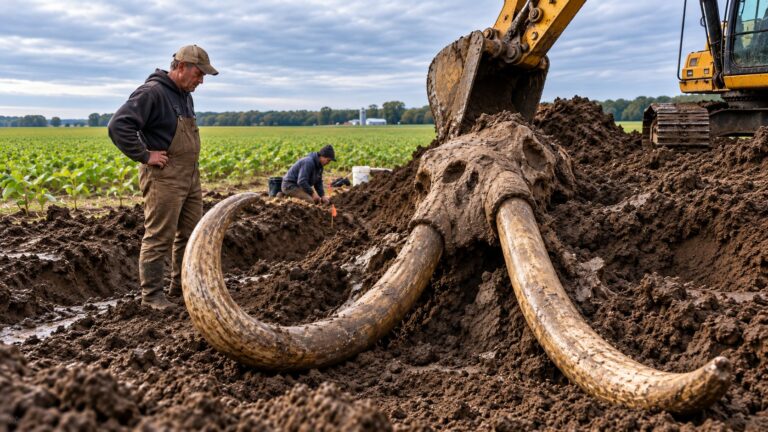
Nothing about the job suggested that the day would end with a prehistoric discovery. In a soybean field in Michigan, a farmer was digging a trench to install a new drainage pipe when his backhoe suddenly struck something that did not belong there.
At first, the obstacle looked like a large piece of wood buried deep beneath the soil. But as more dirt was removed, the shape became impossible to ignore. The machine had uncovered part of an enormous skeleton that had been hidden underground for thousands of years.
What began as routine farm work quickly turned into an archaeological emergency. Beneath the field were the remains of a mammoth, an animal that had walked across Michigan roughly 13,000 to 15,000 years ago.
The backhoe hit something no one expected
Farmer James Bristle was working with a friend when the backhoe struck a hard object beneath the field.
Their first thought was surprisingly ordinary. They assumed they had found an old fence post, a tree root or another piece of buried debris.
Then they started clearing away the dirt.
A huge object resembling an animal bone appeared, followed by other structures that were far too large to belong to any modern animal normally found on a Michigan farm.
Bristle stopped digging and contacted experts rather than risk destroying whatever was beneath the surface. That decision ultimately preserved a remarkable piece of the region’s Ice Age history.
A mammoth had been beneath the soybean field
Researchers from the University of Michigan soon arrived at the property, led by paleontologist Daniel Fisher.
It did not take long for the team to identify the remains. The farmer had stumbled across the skeleton of a mammoth, preserved beneath layers of wet soil since the end of the last Ice Age.
The animal was believed to have lived approximately 13,000 to 15,000 years ago, when Michigan looked very different from the agricultural landscape seen today.
As the excavation progressed, more of the animal appeared.
Researchers recovered several major parts of the mammoth, including:
- sections of the skull and jaw;
- its enormous curved tusks;
- ribs and vertebrae;
- additional portions of the skeleton.
One of the most striking moments came when heavy machinery was used to lift the mammoth’s massive skull and tusks out of the ground.
Against the backdrop of an ordinary soybean field, the scene looked almost unreal.
Scientists had only hours to excavate the site
The discovery presented researchers with an immediate problem.
This was not a protected excavation site. It was an active farm, and Bristle needed to continue working the land.
The scientific team therefore had only a very limited amount of time to recover as much of the mammoth as possible.
Researchers, students and volunteers worked rapidly, carefully removing soil while trying not to damage the fragile remains.
The wet conditions beneath the field had helped protect parts of the skeleton for thousands of years, but exposure to air meant some material had to be handled especially carefully.
Daniel Fisher later described the excavation as an unusually fast operation. The team effectively had about one day to examine and recover the remains before normal agricultural activity resumed.
There may be an even stranger story behind the bones
Finding a mammoth beneath farmland was already remarkable. But the position of the remains raised another intriguing possibility.
Fisher suggested that prehistoric humans may have interacted with the carcass.
One theory is that people butchered the mammoth and intentionally placed portions of the animal in a pond or wet environment, possibly to preserve the meat for later use.
The arrangement of some bones, along with stones found around the site, contributed to this interpretation.
However, the idea remains a scientific hypothesis rather than a completely settled fact. Establishing exactly what happened thousands of years ago requires multiple lines of evidence.
If human involvement can be firmly demonstrated, the site could provide valuable clues about how early people in the Great Lakes region interacted with enormous Ice Age animals.
Michigan once belonged to giants
Modern Michigan is covered with roads, cities, forests and agricultural fields, but its landscape during the late Pleistocene was dramatically different.
Mammoths, mastodons and other large mammals once moved across the region as glaciers retreated and reshaped the land.
Wetlands, lakes and open environments created conditions capable of supporting enormous animals that disappeared thousands of years before modern farming began.
Mammoth and mastodon remains have been found elsewhere in the state, but discovering such a substantial animal directly beneath an active soybean field remains extraordinary.
For Bristle, the day had started with a simple goal: improve drainage on his property.
A few passes with a backhoe later, the soil had opened a window into a world that vanished nearly 15,000 years ago.