«Scimmieeverywhere» is the new album of unreleased songs by Paolo Jannacci.
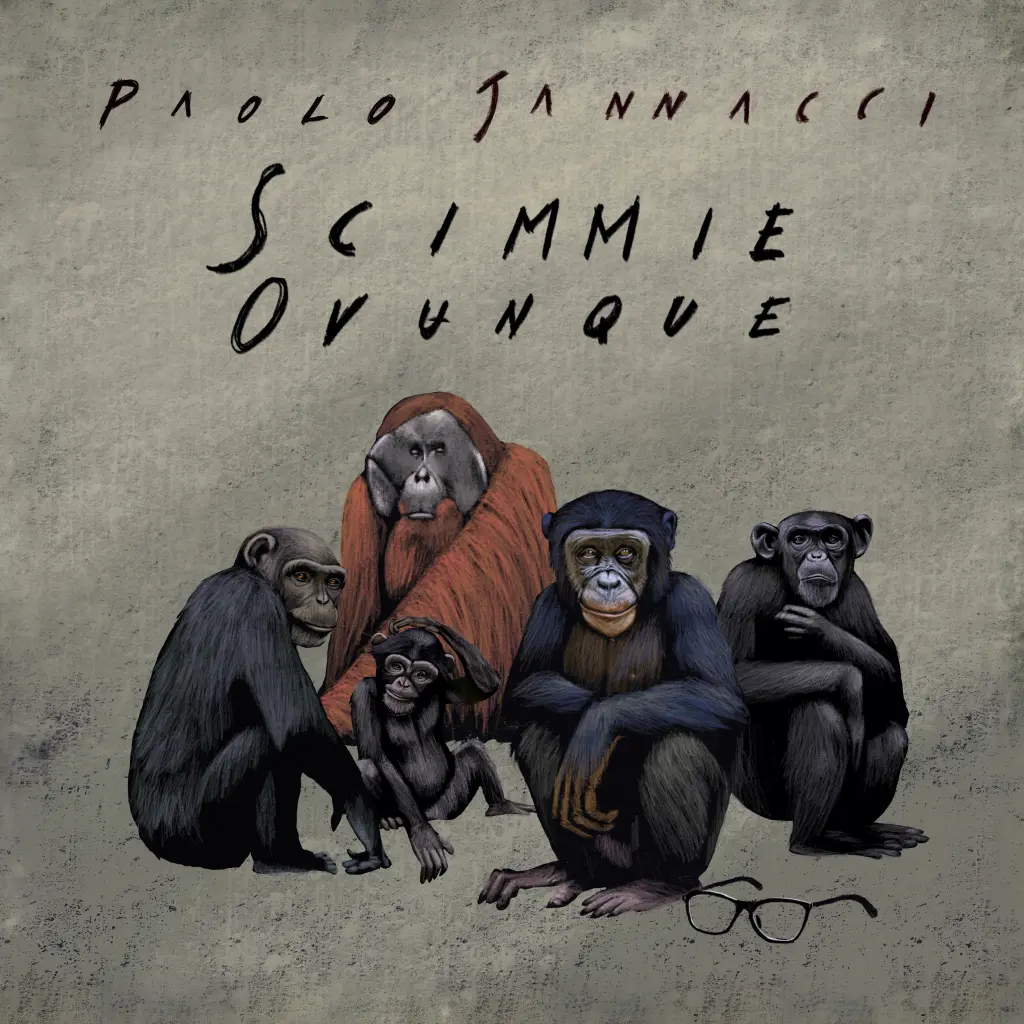
An album that required six years of work: eleven songs written largely with Paolo Re and inhabited by monkeys, friendly and at the same time dangerous figures, who embody the fear of regressing towards angry selfishness and, in the words of Jannacci himself, the reflection of his weaknesses.
Inside there are feminicide, deaths at work, political correctness, love stories and a dedication to the father, Enzo, the crossroads and everything else, which on the A side finds a counterpoint in the cover of Two ice creams.
There are two guests: Elio in Politically topless, the single on the radio, and Stefano Massini in The man in the lightning, the song about deaths at work that the two had brought to Ariston in 2024.
The jazz pianist takes a step back and the music becomes the soundtrack of the words. With Paolo we talked about monkeys, Montale and Ungaretti, about a Sanremo that didn’t respond and about yet another monkey waiting for us behind the screen.
Let’s start with the monkeys. Who are they and why are they everywhere?
Monkeys are ghosts that actualize themselves. They represent the fear of becoming involved, of returning to being that anthropomorphic figure from which we come.
I chose them precisely for their ambiguity: they appear nice, funny, but at the same time they are dangerous, because they have attitudes that sometimes get out of control and can become violent, as happens to any animal that feels threatened and protects itself.
That’s why they scare me, a lot. I would never want to become one of those forms, one of those ghosts who only know the selfishness linked to anger, the one that makes us live in a world of all against all, truly aimed at self-destruction. It’s a nightmare I have. But when I see the misfortunes that surround us, the wickedness, at a certain point I feel I have to tell them, that I have to say them, because perhaps it is the story itself that can change something.
Don’t you think that by involving ourselves, becoming a bit like monkeys again, we could be more human?
I might agree if we look at it from a poetic, almost bucolic point of view. The problem is another, and it is our great intelligence. It’s the one that put us at the top of the evolutionary pyramid, but it’s also the one we use, sometimes, in a negative way, for horrible purposes. This cannot be tolerated, because in this way we harm ourselves not only physically but above all spiritually.
Your signature, and in this you follow your father’s path, is to talk about everyday life and its problems with an ironic streak. The album talks about important social issues and yet you manage to be serious and light-hearted at the same time. How does this process work?
It is a legacy that I carry from the teachings of my father, who in turn had learned it from Dario Fo, and so on, backwards, up to the Greeks. Irony has become my weapon, my latch, my passepartout for tackling difficult topics.
If I wanted to treat them only as a poet I would have to be at least Montale, or Ungaretti. Since I am neither one nor the other, and I don’t have that expressive power or that literary depth, I have learned to do something else: dig deep into the human soul, to find the raw element that moves us all. Then I use irony to be able to deal with any problem and tell it to a friend, to a similar person, to another human being.
On a musical level, I had the impression that you wanted to put aside the craft, the virtuosity of the jazz musician, to bring out something broader.
I’m glad you noticed, because that was my intention. This time I realized that I had written texts that can remain, that can be noteworthy or at least of interest. I wrote most of them with Paolo Re, my adventure companion, who followed me over these five years. I have always used music to help words. Of course, at a certain point he emphasises, underlines, but I never wanted to build the virtuosic moment or the musical element as an end in itself. It was supposed to be the soundtrack to a film, and the film was the words.
The album features Elio, in «Politically topless», and Stefano Massini, in «L’uomo nel lampo». Do you have a dream, someone else you would have liked to involve?
No, on the contrary. I liked the experience with Elio a lot, like the one with Stefano Massini, with whom we are also working on a theater project that is ongoing, even if he is so multifaceted that in the meantime he is carrying out three or four others of his own. But in this album I needed above all to make it clear, even to those who don’t know me, who I am: how I interpret certain themes, my tone, my irony, my way of being. This is why two featurings are already a lot for me.
In 2024 you were at the Ariston with Massini precisely for «The man in the flash». And the next Sanremo?
I would like. I also sent some songs from this album, but unfortunately I didn’t get any response. I asked if there was even a minimum of interest after sending it, and nothing. So I preferred to release the record, let it breathe, finally make it sing and let it speak, because it had been stagnant for a long time.
Even faced with a no, which would have been very acceptable, I would have risked waiting another six months, and it would have been the death of certain songs.
And mine too, because I couldn’t wait any longer. But I’ll tell you one thing: if Sanremo were interested in Paolo Jannacci, I have a song.
Will the album also have a live dimension?
Yes. He will enter the show”Jannacci surrender the city listens!”, which was staged in March this year. In the summer we took a small break and transformed it for a summer version, now it returns to theaters in its truest dimension, the winter one. As soon as the album comes out we will be ready: I will play many new songs, in the theater and live.
Last question, I know you’re pressed for time. You used artificial intelligence in the video clip. Also for the single or album cover?
No, and actually mention them, because I care. He did the album cover Marco Cazzatoand that’s something exceptional in my opinion. The colored glasses are mine, he got everything right: he is a great artist. Another great artist is Annalisa Sartoriwho signed the cover of the single instead.
The artificial intelligence is only there in the video, and it is there as a criticism of the possibility of being replaced. I used it in a deliberately crude way to talk about a computer that tries to take over the director, Luca Tartagliaand of our minds, to make us do what he wants.
After all, it’s another monkey: it can be nice or very violent, it depends on how we learn to use it.
TRACK BY TRACK
1. THE MATTER OF THE KILLER
A vision of the ugliness of human beings and their evil actions, with particular attention to the misfortune of feminicide.
2. BREATHE AGAIN
The story of a boy who struggles, a drug addict considered a loser, who however must not be stigmatized, because in the end he manages to make it and still breathe.
3. POLITICALLY TOPLESS feat. HELIUM
I am, we are naked, topless, in the face of political correctness, of everything we don’t have the courage to say spontaneously: the game of asking questions about what can or can’t be said is the way, the ploy, to be able to talk about the annoyance of this self-censorship in an ironic way.
4. THE ROSE AND THE FLORIST
Perhaps one of the most intense and at the same time most delicate love stories.
5. MONKEYS EVERYWHERE
The image of my humanity that degrades, that becomes barbaric and loses all the values of sensitivity and beauty. In the song I identify with a kaleidoscope of increasingly unfortunate and bizarre characters; a jungle without saints or heroes, in which my characters increasingly lose their wonderful humanity in the most Shakespearean sense of the term.
6. TWO ICE CREAM (by ENZO JANNACCI)
A song of love and human reflection by Enzo Jannacci, almost unknown, with enormous potential.
7. THE BLACK MARKET IN HUGS
A dystopian world in which even physical contact is denied but human beings react and find a secret place to live and love.
8. THE MAN IN THE LIGHTNING with STEFANO MASSINI
Song dedicated to the plague of deaths at work. Poetics and humanity meet in the ruthless world of work.
9. ENZO, THE CROSSROADS AND EVERYTHING ELSE
Moving dedication to a father, to places and loved ones, who give meaning and poetry to everyday life.
10. THE DAY BEFORE
A story of how an important event marks our lives and the reflection of how one day before we were different people.
11. AND THEN THE TIME CAME
Careful and heartfelt reflection of significant moments that have characterized both the past and the future.
THE VIDEO
WEB & SOCIAL
@paolojannacci
paolojannacci.com
Zero algorithm, more choice. If you want WECB’s critical mediation to remain central in your reading ecosystem, you can save the publication among your favorites.