With SpiralsDominique A signs his most autobiographical and rock album. He tells us about this return to his roots, electric guitar first.
On the occasion of the release of his album Spirales, released this October, Dominique A gets involved in writing.
Spirals is your fifteenth studio album. Long attached to fiction, this time you have released a directly autobiographical record.
I let myself be carried away. “The wheel of the Jardin Garnier”, which opens the album, emerged in 2024 during a walk in Provins, the town where I grew up. It made me want to revisit my past, and other titles blossomed in its wake: “La rue des Flandres”, “La brick orange”… Beyond the evocation of my youth, I wanted to shape songs which follow the course of thought, in real time.
Why now, at 57, and not in your forties?
I had already published books in an autobiographical vein, with the feeling of having thus “ridden” myself of the subject. And when I write, I always anticipate the moment when I will have to perform the pieces in front of an audience. Singing things that were too intimate, did I really want that? So far, the answer has been no. This time, the question no longer arose.
Don’t you fear that this autobiographical burden will weigh on stage?
I don’t think so. Even when they draw on the intimate, my songs are constructed from a fictional angle, and the staging establishes a distance. Conversely, the public has often taken my fiction for confessions. Many remain convinced that “Vers le bleu”, on the album “Vers les éclairs” in 2012, relates a lived experience, even though it is invented from start to finish.
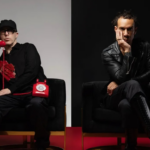
“Mark” pays tribute to Mark Long, the singer of The Opposition.
A small English group which meant a lot to me: a singular trio, with a sound oscillating between Cure and Police, which had the strange idea of establishing itself in France. When Mark Long died, the group died out. We shared the bill in 2019, and that day had a profound impact on me. I met a guy who embodied both my youth and possible horizons, we were perhaps considering playing together, as an extension of adolescence.
The outside world still invites itself, with “Bromide”, on the virilism of power, or “Coltan”, on the price of our digital addictions.
I don’t stop myself from talking about my time. When we start from a specific project, it has to branch out a little, otherwise we get stuck in it and it becomes stifling. I like Spanish inn albums, which jump from cock to donkey.
“Spirales” sounds more rock, more electric. Where does this shift come from?
Of a guitar. Just before leaving on tour, I entrusted my old Telecaster to a luthier in Nantes. In his workshop was an instrument he made, a hybrid of Gretsch and Telecaster. I try it: “wow”. It was she who dictated the color of the disc. I reconnected with the guitar, without worrying about my level. I’m not a virtuoso, but I believe I have a sound that belongs to me.
You returned to record at Garage Hermétique, where you mixed your first album, “La Fossette,” 35 years ago. Nostalgia?
Not really. The studio has completely transformed: it is an Ali Baba’s cave, a shambles where instruments abound, where everything breathes music. Location weighs heavily on a record. Some studios line up microphones and acoustic panels, but have no soul. The idea was to record in live conditions. It’s banal to say, but in these times, this “live” musicality is perhaps what can save us from a certain digital conformism. On certain albums, I didn’t absolutely want you to feel a group playing: all that mattered was the song, whatever the way. This time, the method was important: capturing the right take, preserving these fluctuations which are not errors but the imprint of a moment shared between musicians.
Sixteen tracks is a long time.
At first, I found it too. Then I felt that everything was balanced, that this collective energy justified the format. We recorded twenty songs in two six-day sessions. Establishing the order of the titles is sometimes an ordeal and takes up weeks. There, the sixteen were arranged in thirty minutes. The issue is not so much the duration as the material: do you have enough to constantly revive attention?