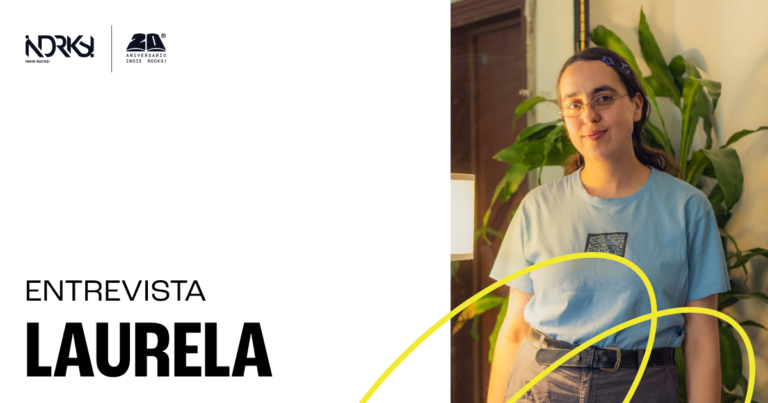
The guitar as an ally in nature
Laurela visited Mexico with a single double, “Plum” and “Quiet”. Their music is the very definition of “organic and natural, with the smell of wet earth.” Very much in his style, because it is not something classic folk, Laurela has been weaving, growing, experimenting, meeting incredible musicians and forming bonds of friendship that are reflected in their collaborations. In an interview, we spoke with the Chilean singer-songwriter about her beginnings, the guitar as an ally, Violeta Parra and the impact of the items we find along the way, like a random cassette or an improvised demo.
Indie Rocks! Magazine: We are very happy to have you here in Mexico. To start talking about your career, tell us how music comes into your life.
Laurela: It was a year when I went on exchange. I was in Thailand when I was 16 and I was very alone there. I mean, I was accompanied by people, but I didn’t speak Thai myself. So, I got myself a guitar. And then I started making… Well, I had already made a couple of songs, but I was still making songs there. And perhaps none of those songs stay with me to this day. But I remember returning to Chile and saying: “I want to dedicate myself to this.” I think the point was to feel that it was something essential that could accompany me. And beyond saying: “I want to work on this,” it was like: “I want this to accompany me in life.” Soon I had to choose what to study, so that was what made me decide to study music.
GO!: There are many musical genres that you could have dabbled in. You started with a folk side with very Chilean roots. How did you decide that this genre of music is what you want to play?
L: It wasn’t a decision. What was at hand. There I got the guitar and at home I still had a guitar. There’s also a piano, so I could have gone on that classical side as well. But I guess, since I wanted to make songs, the guitar was the ideal instrument. And right now I’m not doing so much folk anymore. I’m moving to other branches, but because I have new tools.
IR!: This reminds me of the first punk bands and the stories that the genre emerged not by decision, but by the self-taught and “careless” practice of the instruments that were available and that were more economically accessible. In your case, your music seems to be connected with nature, the mountain range, the countryside. Perhaps the influence comes from Violeta Parra or Víctor Jara in the acoustic tradition.
L: Yes, the first song my mom taught me on guitar was “The Petaquita”of Violeta Parra. So, there is this thing like singing the guitar with emotions, of describing what you are seeing. And I, at least, since I was born in Valdivia and lived my childhood there, nature is something that spoke to me about myself and those around me.
Furthermore, both of my parents are biologists or have something to do with natural sciences, so they were always showing me: “Look, this is what it’s called, this has such a use or in the forest it does such and such a thing.” So, they are things that one absorbs and that is knowledge that feels valuable as well. Now, I don’t talk about it explicitly in the songs, but it is there in terms of the images that I have when composing, like where I am imaginarily situated when making a song.
IR!: When composing your music, do you follow a linear process or do you discover sounds through freer searches?
L: Historically I do it from the lyrics, and over time I have realized that normality does not do it that way. So, well, I always assume that it will be something that is at hand, because I already know how to do it and I can continue doing it, but I have also tried to approach the songs from the other side of music.
For example, the collaboration I did with Freezer: that was like that. To me, the lyrics are anything, not in a bad way, but like it really was a flow of consciousness and humming. And it was really fun and I like that song. And I have another song that came out recently called “Quiet”and I wanted to compose that song from music and have the lyrics emerge.
Maybe I showed it to a friend when I had just made it and she said: “Ah, but it’s a song by Laurela “Just like that.” And I’m like: “Sure, maybe I got to the same place, but from a different technique.”
IR!: Well, I guess a little like with all art, rules are meant to be broken; Searching for the right shape can limit the creative process. About your collaboration with Congelador, one of the great Chilean alternative bands of the 90s, what can you tell us?
L: Well, I met them through friendship circuits and I think that friendship came before collaboration. And when they invited me to sing on the album, I was very happy. Before, they had invited me to play some songs live, the ones they have with Loreof Rich Girl. Because they went to Valdivia, to Riverand of course, they couldn’t take her and I was there. So we sang, we played those songs together and then they invited me to the collaboration. And for me it’s still very epic.
And that, the collaboration itself, was something very quick, like going to record the song. I was walking to the studio, just like… listening to the song. And I don’t know if it had been two or three takes and that was it. They dedicated themselves to post-production. And the friendship continues. And there in Chile I play with Walter Roblero and Rodrigo Herbage in my project Laurela. So the musical collaboration continues there.
IR!: Now that you are touring Mexico, how would you define Laurela live? That is, the contrast of Laurela composing and making music in her room, versus Laurela presenting her music in front of people.
L: I think I’m getting closer and closer to that, but in a way that I perhaps hadn’t suspected, or in a way that I’ve gotten to by playing a lot. And it is mixing songs with speech.
So, although I am not talking about “this song is about this”, I do start to wander around memories that come to me from the song and stories that I am telling. But everything becomes like a kind of dream, because it doesn’t make that much logical sense. And it’s like I’m talking to you, but I’m also talking to nothing.
And that has been much more entertaining for me. And of course, perhaps the fact that I am not explicitly speaking to the public means that I can get into a kind of personal bubble. A roll of mine, and being there, and being there, and going to the end.
Maybe being aware that people are there looking at me, and thus I can also see them. But it’s like covering yourself in a veil. We are seeing each other, but there is a veil between us that protects me in a certain way.
IR!: Tell us about your most recent release, “Ciruela” and “Quieta”.
L: Well, with Vincent and pinwho are the first collaborators, with them he played the Laurela. They were part of my band, which is a band format that we are no longer playing, but I think that at any moment I would like to reactivate it.
and with Eskapiarkawhich is in “Quiet”. He simply wanted to invite him. I didn’t know him that well, we had seen him at concerts, but I have a cassette of his at home, which was left by a friend, the Diego Bravoof Dolores the Tunantesand I liked it a lot.
I have listened to the cassette a lot, and it is guitar music, forest music, elves music, dark. And I felt that that was what I wanted to contribute to “Quiet”and indeed, just by rehearsing together the song emerged. It wasn’t difficult. It’s like saying: “I want your language to enter this song.”
IR!: To close the interview, we want to know what’s coming at the end of 2026 and if you have planned to continue releasing some other songs for next year.
L: Yes, I think that in 2027 I will release the album that I am preparing, perhaps in January, because in reality it is already half ready, but I am polishing the details. I don’t want to take the fruits off the tree prematurely. And so I hope to release a double single as well, another one.
one is “A Sun” and the other song is “I would take”so I think the single is going to be called “It Would Take One Sun”. “A Sun” It is a reinterpretation, a poem by Alfonsina Storniset to music, and “I would take” It is a cover, a Spanish translation of Joni MitchellI also knew her from a very young age and she was one of my inspirations when I started in music. And the album is going to be the longest I’ve made so far, and it’s like a green and purple fruit, a little toxic.
Give play to “Plum” here: