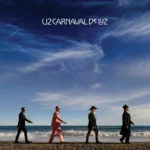
Reviewing a U2 album means dealing with something that comes before the music.
There are fifty years of career and two opposite temptations: taking refuge in banalities, clichés and prejudices, or exalting the album for merits that belong to the career. In both cases the objectivity that the album deserves is lost. That a band in its fiftieth year of activity still feels the need to write new songs, instead of managing the repertoire, is already a fact worth recording.
«Carnaval De Luz» is U2’s sixteenth studio album and the first unreleased album since «Songs of Experience», released in 2017. The twelve songs were recorded in multiple locations and produced by Jacknife Lee. Bono returns to the themes he has always been familiar with, faith and friendship, and uses them as a barrier against a present that the album perceives as hostile.
The album was born from the same sessions as the two EPs released surprisingly at the beginning of the year, «Days of Ash» and «Easter Lily», released on Ash Wednesday and Easter. «Carnaval De Luz» completes the cycle by going backwards in the liturgical calendar: Carnival, the feast of the flesh that precedes the Lenten renunciation and the resurrection.
The identifying signs are all there, The Edge’s guitar, Bono’s voice, Larry’s rhythm and Adam’s essence that occupies every available space, but a trademark alone is not enough as an alibi.
The album opens with his bravest choice: Go (Carnaval De Luz) moves on beats halfway between new wave and electronica. It lacks the rough urgency of the first albums, but it also lacks the tired manner of certain records that the band would have done better to save themselves. Silence it lasts two minutes and thirty-five seconds and recovers the punk brazenness of the beginning, with a surf feel that makes it the most physical song on the album.
Brian Eno returns with sparkling keyboards in The Greatest Show On Earth and Can’t Stop Us Now, which are also the two most successful episodes: here U2 sound mobile, capable of evoking something only with music. The Greatest Show On Earth however suffers from the flaw that runs through the entire album, a vague optimism, constructed on the spot. The rest give way more often. Glorifywritten with Martin Garrix, has an insistent melody that seems taken directly from Imagine Dragons’ repertoire. Midnight Sunshine it’s anonymous to the point of seeming commissioned for a commercial, and contains some of the weakest verses ever penned by Bono, with a discovery about human evil made in front of a small screen and a friendship celebrated like a prize won.
Rosalía is on the record only as a recipient. The Mirror Maker (Rosalía) it is Bono’s tribute to the Catalan singer-songwriter, but what remains of the homage are the acoustic arpeggios of The Edge, which nod to flamenco, and a chorus made up almost exclusively of her shouted name. The Spaniard, who returns at several points in the album, at least has a reason here: the song opens with a quote from Federico García Lorca. Elsewhere it sounds like a language borrowed for the occasion. In Silence there is the chorus of «amigo» pronounced syllable by syllable, involuntarily comical. In The Queen Bono invites us to sing reggaeton, and in Street of Dreams the title pronounced in Spanish lets you imagine the translator open on the phone screen.
The record fades with Come backthe perfect closing of the album, the duet between Bono and Dolly Parton in her last recorded performance. A poem written by U2 together with Parton and Johnny McDaid, it is a touching country ballad about breaking family ties, and it is also the thread that connects the album to the two EPs.
The risk of «Carnaval De Luz» is that the songs end up as a backdrop to the fiftieth anniversary celebrations. From a U2 album we have always expected emotional involvement, even at the cost of rhetoric: light and dark. Here the emotion is there, but it must be sought under layers of mannered enthusiasm and rarely arrives unannounced.
When it arrives, it feels like a group that still has something to say, and not just to remember.
TO LISTEN NOW
Go (Carnaval De Luz) – The Mirror Maker (Rosalía) – Silencio – The Greatest Show On Earth
TO BE SKIPPED IMMEDIATELY
47 minutes that flow well. On the first, second and even third listen.
SCORE: 7.50
THE VOTES OF OTHERS
Rolling Stone (USA) – Rating 9.00
Uncut – Rating 8.00
The Telegraph (UK) – Rating 8.00
The Guardian – Rating 8.00
Mojo – Rating 8.00
Record Collector – Rating 8.00
Pitchfork – Rating 6.50
Nme – Rating 6.00
Glide Magazine – Rating 5.00
TRACKLIST
Go (Carnaval De Luz)
The Queen
Street Of Dreams
The Mirror Maker (Rosalía)
Superficiality
If The World Is At War We Better Not Be
Silence
The Greatest Show On Earth
Glorify
Midnight Sunshine
Can’t Stop Us Now
Torn (Feat. Dolly Parton)
DISCOGRAPHY
1980 – Boy
1981 –October
1983 –War
1984 – The Unforgettable Fire
1987 –The Joshua Tree
1988 – Rattle and Hum (studio & live)
1991 – Achtung Baby
1993 – Zooropa
1997 – Pop
2000 – All That You Can’t Leave Behind
2004 –How to Dismantle an Atomic Bomb
2009 – No Line on the Horizon
2014 – Songs of Innocence
2017 – Songs of Experience
2023 –Songs of Surrender
2026 – Carnaval De Luz
VIDEO
WEB & SOCIAL
https://www.facebook.com/u2
https://www.u2.com/
@u2
The article Review: U2 – “Carnaval De Luz” comes from WECB.