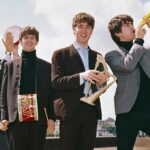
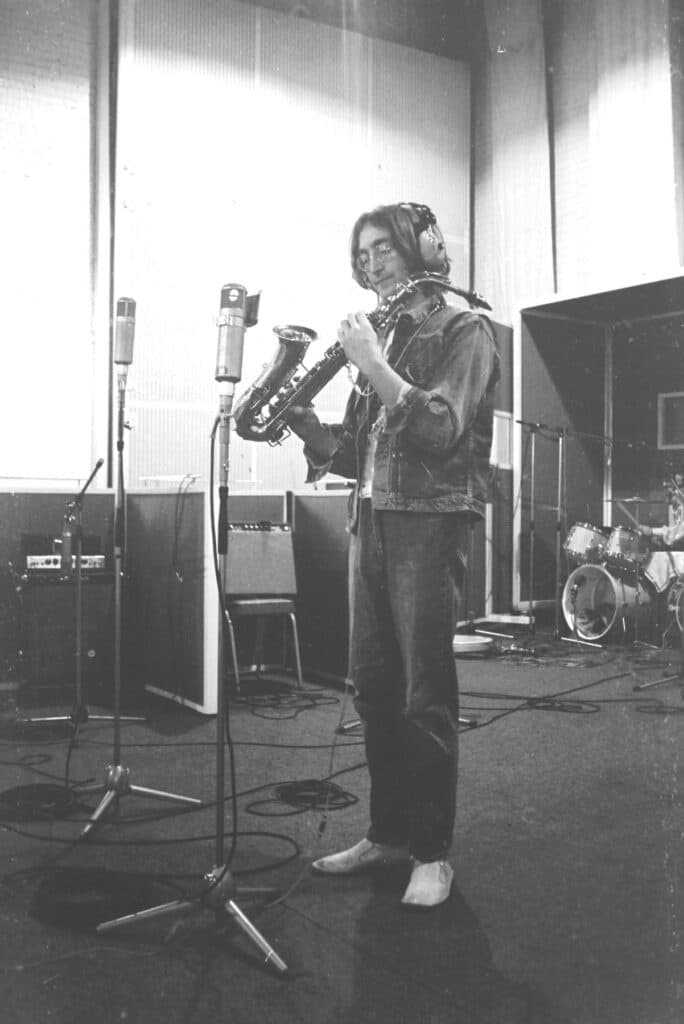
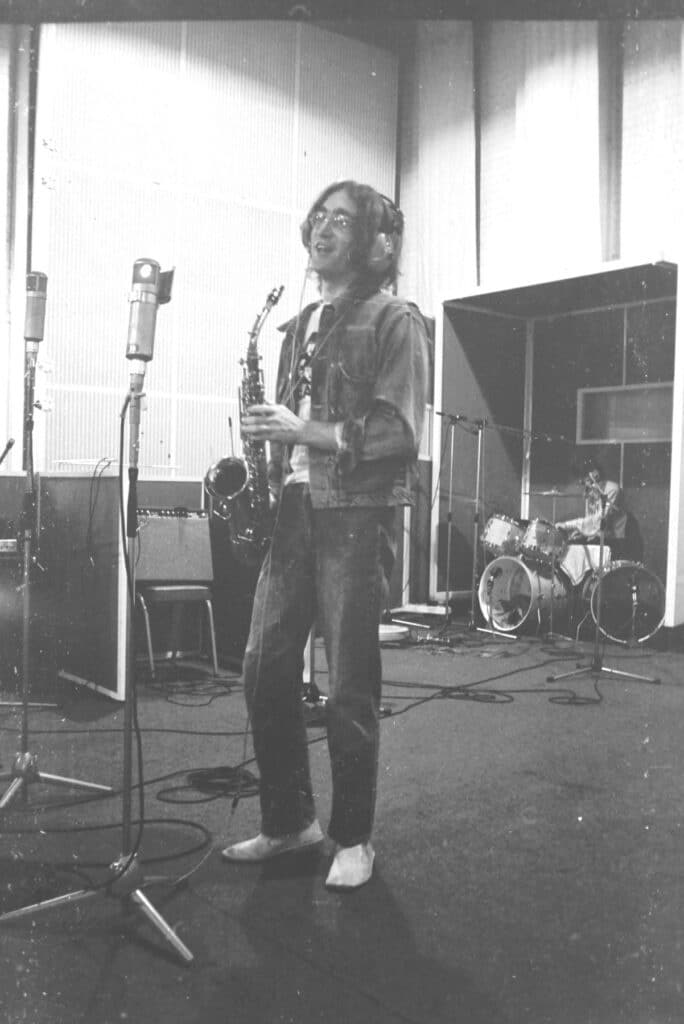
Never-published photos show John Lennon on alto saxophone during the recording of “Helter Skelter” on the night of September 10-11, 1968, at Abbey Road Studio 2. They come from the archives of Mal Evans, roadie and trusted friend of the Beatles, and appear in With the Beatles: Mal Evans’s Illustrated Journey, the book by Kenneth Womack expected on December 1 in the United States.
John Lennon on saxophone on “Helter Skelter”, one of the Beatles classics? The public had never before had access to such an intimate vision of the group. These exclusive, previously unpublished photos show Lennon in the studio in September 1968, while the Beatles recorded the White Album at Abbey Road. They come from the archives of Mal Evans, the group’s dedicated roadie.
Fans will finally be able to delve into these archives with With the Beatles: Mal Evans’s Illustrated Journey, the new book by Kenneth Womack, Beatles specialist, published by Harper Pop on December 1 in the United States (no French edition has been announced to date). The work brings together hundreds of previously unpublished photos, accompanied by Mal Evans’ diary, manuscripts and objects that tell the private side of John, Paul, George and Ringo.
These photos were born in the creative excitement of the White Album sessions, on the night of September 10-11, 1968, during the marathon overdub session of “Helter Skelter” at EMI Studio 2. The day before, the group had completed the basic track, but John wanted to try something radically different. So he grabbed an alto saxophone, an instrument he absolutely didn’t know how to play.
© Malcolm Frederick Evans Archives (MFEA)

© Malcolm Frederick Evans Archives (MFEA)
Evans joined him on the trumpet, which he had just found the day before at a second-hand dealer, according to his diary. Neither had ever touched their instrument, and yet we hear them in the mix of “Helter Skelter”. In his diary, Mal calls them “the two haired guys on brass: John on sax, me on trumpet”.
A rare glimpse of the Beatles at work, in the midst of unbridled experimentation at Abbey Road, more relaxed and playful than ever. In some photos, Ringo can be seen in the background, behind his brand new Ludwig Hollywood Maple drum set, which had just been delivered.
Mal Evans was much more than a roadie: he was one of the very few trusted friends in the Fab Four’s inner circle. Most fans know him thanks to the documentary The Beatles: Get Back, directed by Peter Jackson in 2021. It’s him, the friendly 1.98 m giant who hits the anvil on “Maxwell’s Silver Hammer”, or who skillfully keeps the police officers who came to interrupt the concert on the Apple roof waiting.
In the 1970s, after the group broke up, Evans was one of the few people who remained close to the four ex-Beatles. Both Lennon and Harrison thanked him in the credits of their 1970 classics, Plastic Ono Band and All Things Must Pass, for “tea and sympathy” (tea and comfort). He was working on memoirs, which the four had approved, proof of the confidence they placed in him. But in Los Angeles, his life turned upside down: alcohol, weapons and cocaine led him into a destructive spiral. In January 1976, Evans was shot and killed by the Los Angeles Police Department (LAPD) while brandishing a loaded rifle at officers and begging them to shoot him. His archives, long lost, were found in 1988 in a storage room, then finally returned to his family.
© Malcolm Frederick Evans Archives (MFEA)
© Malcolm Frederick Evans Archives (MFEA)
Womack first told Evans’ story in Living the Beatles Dream, a 2023 biography to critical acclaim. “Mal was the Beatles’ assistant, with Neil Aspinall”recalls Womack. “The Beatles had a tiny entourage. There was Brian Epstein, who didn’t get involved, and then Neil and Mal, who did pretty much everything. They were the Liverpool guys, the ones they trusted. Mal was therefore part of this very closed circle, as a direct witness. He was there when they recorded all those classics. »
Evans followed the group every step of the way, from the Cavern Club to Savile Row. “He loved being indispensable to them, helping them realize what they had in mind”confides Womack. “He prided himself on being the one who could wake up the people of Sound City in the middle of the night and say ‘John needs a new guitar’ or ‘We need some strings.’ He was the one who took care of everything, whether it was finding them a meal or finding an anvil and a hammer. »
The photos from “Helter Skelter” show the kind of scene only someone close to him like Evans could see. “Here’s John with the saxophone, in this crazy finale of “Helter Skelter””laughs Womack. “Mal and John have to be one of the craziest duos in rock history. »