Every so often, a discovery emerges that forces researchers to rethink what they thought they knew about an entire region. That moment has just arrived deep within the Amazon, where a fallen tree exposed traces of a long vanished civilisation. What followed was a journey by boat, canoe and foot through dense forest to uncover ceramics unlike anything previously documented. These urns are more than artefacts – they are windows onto a world where engineering, ritual and daily life intertwined in ways we are only beginning to understand.
A chance discovery beneath the roots
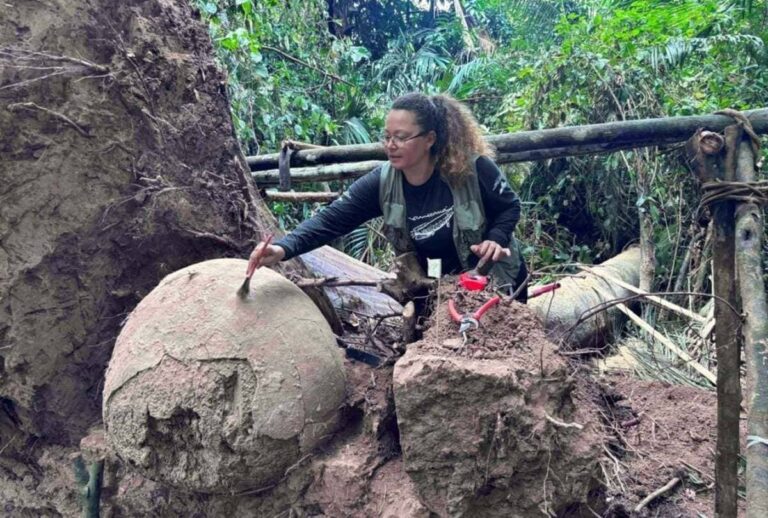
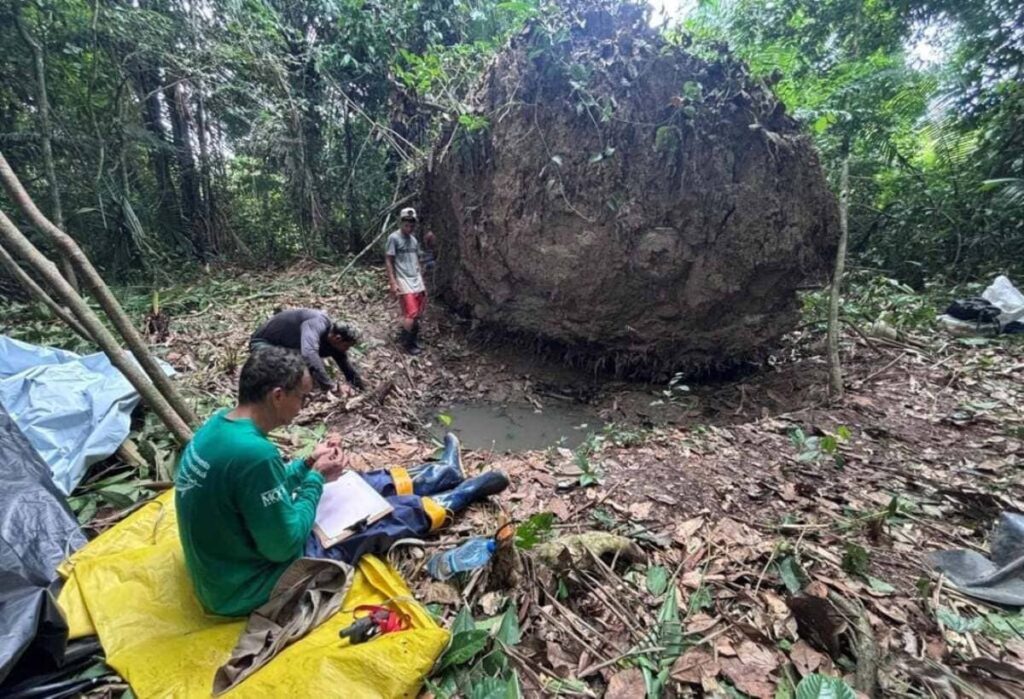
The story began in early 2025, when residents of São Lázaro do Arumandubinha noticed two large ceramic vessels hidden beneath the roots of an uprooted tree. Suspicious that the find was not ordinary pottery, a local fishery manager contacted the community priest, who in turn alerted researchers at the Mamirauá Institute. Before long, an archaeological team embarked on a strenuous journey to the Lago do Cochila site in the Fonte Boa region.
What they uncovered exceeded every expectation: seven enormous funerary urns, some weighing more than 300 kilos, resting just below the soil. Early examination revealed fragments of human bone mixed with remains of fish and turtles. These traces suggest complex funerary rituals involving both burial and offerings – practices rarely preserved in the floodplains of the Amazon.
Indigenous engineering on artificial islands
The site forms part of a vast network of ancient artificial islands built in the region’s periodically flooded plains. Constructed from layers of soil and broken pottery, these raised platforms allowed past communities to live, farm and socialise even during seasonal floods. Archaeologist Márcio Amaral describes them as evidence of sophisticated Indigenous engineering, revealing a level of territorial mastery that challenges outdated assumptions about Amazonian populations.
The urns were most likely buried beneath the floors of former dwellings, reinforcing the idea that these floodplains held permanent settlements rather than temporary camps. Their design is equally intriguing. Made from greenish clay and decorated with red slips, the ceramics belong to a tradition not yet recorded elsewhere in the region – a sign that archaeologists may be dealing with an entirely distinct cultural group.
Excavation shaped by science and community
What makes this project particularly striking is the collaboration between researchers and local residents. Community members joined every stage of the excavation: clearing forest, building suspended wooden structures and transporting the massive urns downriver with extraordinary care. As archaeologist Geórgea Layla Holanda recalls, nothing was improvised. Layers of plaster, bubble wrap and wooden supports were used to stabilise each piece, ensuring the fragile relics reached the laboratory intact.
Researchers emphasise that such cooperation is more than practical help. It is a model of community led conservation, where scientific expertise and traditional knowledge reinforce one another. As Amaral notes, archaeology in the Amazon increasingly moves “from the inside out”, grounded in the experiences and stewardship of the people who live there.
A story still unfolding
The urns are now undergoing detailed study at the Mamirauá Institute. Scientists hope to conduct carbon dating – funding permitting – to determine whether the artefacts are 500, 1,000 or possibly more than 3,000 years old. Regardless of their precise age, the discovery is already reshaping our understanding of ancient Amazonia: a region rich in innovation, spirituality and long term settlement rather than untouched wilderness.
For the descendants of these early communities, the find is much more than an academic milestone. It is a reaffirmation that their ancestors shaped the landscape with intention, skill and profound cultural depth. Hidden for centuries beneath the forest floor, the urns have begun speaking again – and their story is only just beginning.