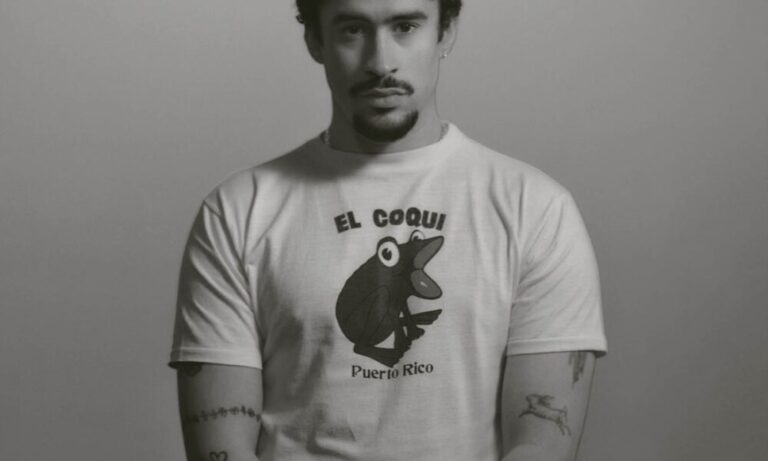
From a chart-topping album to a groundbreaking residency to fearless advocacy for Latinos, the Puerto Rican artist has proven that his talent has no ceiling — and his love for his native land has no limits.
Every year, Bad Bunny is getting bigger, breaking new records and gaining more ground — and yet his career in 2025 feels like a massively historic moment, even for him. The Puerto Rican star, born Benito Antonio Martinez Ocasiolaunched hostilities in January with the release of Debí Tirar More Photos. A deeply felt collection, filled with memories, love and nostalgia for his island home, which also traces political issues like population displacement and gentrification. His masterful use of sonic traditions, blending Puerto Rican bomba and plena with pop creations, not only helped the album ricochet toward the top of the charts (it spent more than 20 weeks in the Top 10 of the Billboard 200) — it charted a new road map for the future of Latin music.
A residence in the heart of Puerto Rico
It also set the scene for a revolutionary concept: No Me Quiero Ir de Aquí (“I don't want to leave here”), the residence of 31 dates of Bad Bunnydesigned to bring listeners to the heart of Puerto Rico. Every evening, he filled the largest indoor hall on the island, the José Miguel Agrelot Coliseumwith nearly 20,000 people. Celebrities ranging from Penelope Cruz has Mbappé passing through Darren Aronofsky filled “La Casita,” a replica of a traditional single-story house on the island that served as the VIP area and B-stage. The entire residence made sure all eyes were on Puerto Rico, with constant headlines and intrigue built around surprise guests. The first weekends were open only to locals, and it was not uncommon to see teary-eyed Puerto Ricans in the crowd. The residency provided a boost to the island's economy, to the tune of at least $400 million, and helped Bad Bunny to remain faithful to what is close to his heart: his people.
The Super Bowl and political controversy
In September, another major milestone was announced: he will headline the Super Bowl in 2026, marking the first halftime performance predominantly in Spanish. The decision provoked an immediate reaction; conservatives lambasted the choice, cringing at the androgynous sartorial choices of Bad Bunnyhis defense of trans rights, and his past comments on Trump and immigration. (Earlier this year, he told the magazine iD that he had avoided an American tour so that his Latino fans would not be harassed by ICE (migrant police)). Newsmax host Greg Kelly called for a boycott of the NFL, insisting that Bad Bunny “hate America, hate President Trump, hate ICE, hate the English language!” He's just a terrible person. » Even the president weighed in, insisting he has no idea who is Bad Bunny and calling the NFL's choice“absolutely ridiculous”.
Yet, Bad Bunny remained firm, joking lightly about the controversy as he presented the SNL in October. His monologue included a winking clip of Fox hosts and commentators edited together to make it appear as if they were saying: “Bad Bunny.” East. My musician. Favorite. And he should be next. President. » Then the artist switched to Spanish and bragged about his fans' excitement about the Super Bowl, “especially all the Latinos and Latinas around the world, and here in the United States, all the people who have worked to open doors, more than what I have accomplished, who have accomplished everything, demonstrating that the way we do things, the way we carry this country, no one can ever take it away or erase it. » Other than that, he remained silent on the subject, simply preparing for his historic set and handling the hateful rhetoric with class and aplomb.
Triumph at the Latin Grammys
And just when he seemed to be completing a year-long victory lap — which also included major roles in Happy Gilmore 2 And Caught Stealing ofAronofsky — Bad Bunny won further accolades, earning five Latin Grammysincluding Album of the Year, in November. His acceptance speech was a subtle repudiation of anti-Latino rhetoric in the United States and an empowering moment for children in the community, Bad Bunny dedicating the prize to “all children and young people in Latin America, and particularly those in Puerto Rico”.