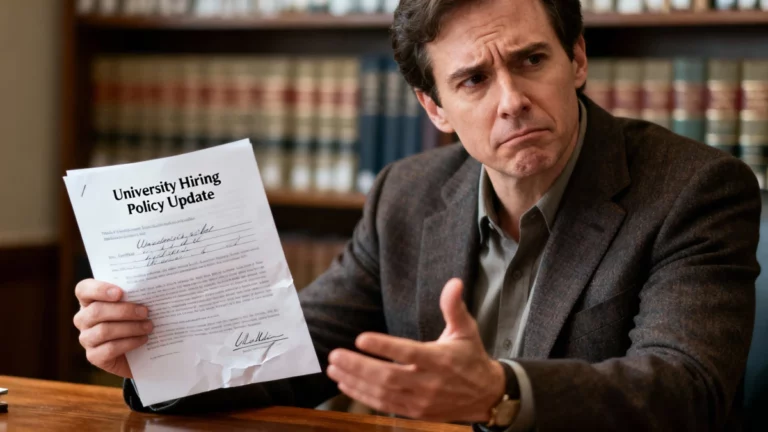
Governor DeSantis Calls for H-1B Visa Ban in Florida Universities
Inspired by Donald Trump’s familiar slogan, “Make America Great Again,” Ron DeSantis has taken a page from his predecessor’s playbook. On Wednesday, October 29th, the Governor ordered Florida’s education officials to “put an end” to the use of H-1B visas for hiring foreign professionals in the state’s public universities. Originally established to attract highly skilled, specialized workers to the United States, H-1B visas have long been a vital tool in recruiting global talent for research and teaching roles.
DeSantis made his point in a press conference at the University of South Florida in Tampa, specifically highlighting positions he believes should be filled by Americans. According to The New York Times, he listed examples such as a Spanish assistant swim coach, a Chinese professor of public policy, and a Canadian graphic designer. Then, with a rhetorical flourish, he asked:
“Are you kidding me? We can’t train an assistant swim coach in this country?”
A Policy Echoing Trump’s Moves—and Their Costs
This step by DeSantis is the latest in a series of measures following the federal policy direction initiated by Donald Trump. Last September 19th, the cost for employers to sponsor H-1B visas saw a dramatic hike—from roughly $2,000 up to $100,000 per person. The intent was crystal clear: slow the hiring of foreign workers and push companies to prioritize American talent.
Commerce Secretary Howard Lutnick, standing alongside the President in the Oval Office last September, encapsulated this approach:
“If you want to train someone, train a young graduate from a top American university, train Americans, and stop bringing in foreigners to take our jobs. All the major companies support this approach.”
Backlash from Academia: Risks for Excellence
For many experts, DeSantis’ decision rings alarm bells. Limiting access to the H-1B visa, they argue, could undermine both the quality of teaching and research. As The New York Times reports, Lynn Pasquerella—President of the American Association of Colleges and Universities—stressed that restricting these visas in Florida would threaten the public mission of higher education in the state by reducing the ability to recruit and retain top international faculty, researchers, and students:
“Restricting these visas in Florida would endanger the public goal of higher education in the state, by reducing the capacity to recruit and retain the best professors, researchers, and international students.”
Charles Lee Isbell Jr., Chancellor of the University of Illinois at Urbana-Champaign, echoed the concern:
“Hiring less qualified candidates would weaken merit-based selection and compromise academic excellence.”
It sets the stage for a blunt choice, as one observer put it: You can either recruit the best, regardless of nationality, or you can favor citizens for ideological reasons—which, like it or not, will lower standards.
Legal Realities and the Numbers Behind the Debate
DeSantis’ authority is not without limits: H-1B visas are issued by the federal government, and as Pasquerella points out, the Florida board cannot revoke or abolish them. What the state can do is adjust its own policies—for example, by refusing to sponsor such visas for university positions or programs. That, she suggested, is a move likely to be challenged in court.
This year alone, about 400 H-1B visa applications have been approved for Florida’s twelve state university system institutions through June—156 of those for the University of Florida itself, according to the Department of Homeland Security. For perspective, Washington University in St. Louis—with its prominent research and hospital operations—reports that more than 700 of its employees hold H-1B visas, “making an essential contribution to teaching, advanced research, and patient care,” as cited in The New York Times.
The debate over whether to restrict or promote global talent in American universities is far from settled. Behind the political showmanship, stakeholders on all sides have a packed agenda: securing opportunities for U.S. citizens, upholding the world-class reputation of American higher education, and, ultimately, grappling with what it really means to compete on the world stage.