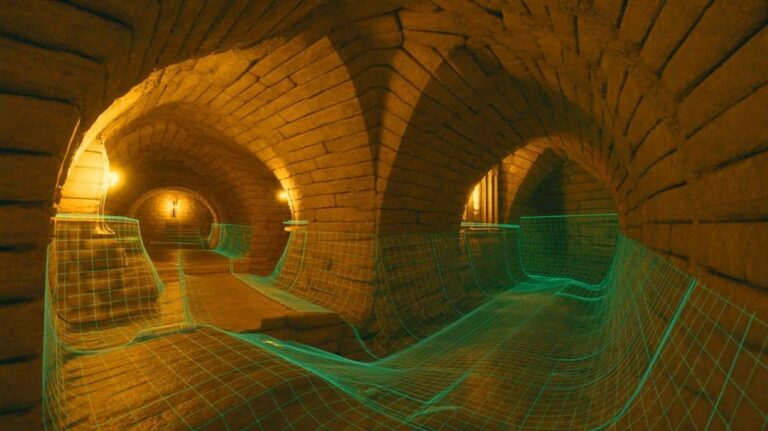
There are moments in history when the past clears its throat and politely asks us to pay attention again. This is one of them. Beneath one of Milan’s most visited landmarks, a long suspected secret has finally stepped out of the shadows, thanks to a few quiet sketches left behind by Leonardo da Vinci and a lot of modern patience.
A castle that never stopped changing
Castello Sforzesco has never been a static monument. Built and rebuilt through the fifteenth century, it evolved alongside Milan itself, shaped by politics, power struggles and artistic ambition. When Francesco Sforza transformed the site into a formidable fortress, it became both a symbol of authority and a practical military stronghold.
Later, his successor Ludovico Sforza brought Leonardo da Vinci into the picture. The artist was commissioned not just to decorate walls, but to observe, design and record. Among his lesser known works are detailed drawings that hint at something beneath the castle’s surface – a network of underground tunnels that, for centuries, remained theoretical.
Those sketches, tucked away in Leonardo’s notebooks, have intrigued historians for generations. Now, they have been quietly vindicated.
Leonardo’s clues beneath the surface
In his Codex Forster I, Leonardo sketched passages that seemed to snake under the castle grounds. At the time, they were largely dismissed as conceptual or symbolic. After all, no one had physically found them.
That changed when researchers turned to ground penetrating radar and laser scanning. These tools, often used in civil engineering and archaeology, allow scientists to see through stone and soil without lifting a single paving slab. Slowly, unmistakable shapes emerged beneath Castello Sforzesco.
According to researchers involved in the project, the tunnels match Leonardo’s drawings with striking accuracy. One passage appears to link the castle to Santa Maria delle Grazie, the basilica that houses The Last Supper. The idea that the Sforza family could move discreetly between political power and sacred space feels very Renaissance indeed.
Why these tunnels mattered
The immediate assumption is military use, and that is almost certainly true. Hidden routes allowed for swift movement, surprise attacks or discreet escapes. But there is something more personal here too.
One tunnel may have offered access to family tombs, creating a private link between life, power and legacy. It is a reminder that architecture in this era was never just functional. It was emotional, symbolic and deeply human.
Standing in Milan today, surrounded by trams and cafés, it is oddly grounding to imagine dukes slipping through candlelit corridors beneath our feet.
Technology lending history a hand
This discovery would not have been possible even twenty years ago. Francesca Biolo, a researcher at the Polytechnic University of Milan, has spoken about how modern scanning technologies allow access to spaces that are physically unreachable.
Laser scans and radar data are now being combined into detailed digital models. These reveal not only what still exists underground, but also what has been lost over time. It is history without guesswork, reconstructed layer by layer.
As someone who once queued in the rain to visit Castello Sforzesco, I cannot help thinking how different that experience might be if you knew what lay below.
The rise of the digital twin
The next phase of the project is ambitious. Researchers plan to create a full digital twin of the castle, mapping its present form alongside its historical transformations. Franco Guzzetti, professor of geomatics at the Polytechnic University of Milan, describes it as a way to visualise centuries of change in one living model.
For visitors, this could mean augmented reality tours that reveal hidden corridors and vanished rooms. Museums are increasingly embracing this approach, and cultural organisations such as UNESCO have long argued that digital preservation is essential for protecting heritage sites.
Here, it also adds a layer of wonder.
A boost for culture and curiosity
Castello Sforzesco already houses several museums, but this discovery adds a new dimension. Virtual access to the tunnels could transform how people engage with Milan’s history, drawing in both scholars and casual visitors.
More than anything, it is a reminder that even the most familiar landmarks still hold secrets. Sometimes, all it takes is a forgotten drawing, a bit of technology and the willingness to look beneath the surface.
And perhaps that is exactly what Leonardo intended.