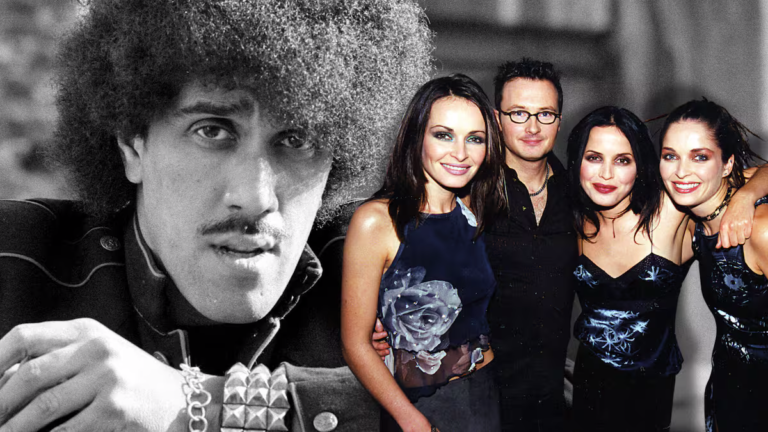
On January 4, 1986 he died Phil Lynottand with him went more than just the leader of a band with sharp guitars: one of the great storytellers of Irish rock disappeared. Forty years later, his name still speaks volumes in Dublin—where It has its own statue on Grafton Street— and perhaps less so in Spain, despite the fact that one of his songs would end up becoming a hit thanks to his other compatriots. Lynott was a singer, bassist, urban poet and charismatic frontman of Thin Lizzya key group to understand the hard rock of the seventies and the transition to the eighties.
Born in Birmingham and raised in Ireland, the son of an Irish mother and a Guyanese father, he made his mestizo identity a flag in a country that did not always have an easy time accepting differences. On stage it was pure magnetism; outside of him, a brilliant and fragile man in equal parts. His death, at only 36 years old, It was the result of a chain of excesses and health problems —infections, pneumonia, heart failure—that abruptly closed a career marked by talent and self-destruction.
Lynott's importance is not measured only in records sold, but in influence. He was one of the first European rockers to place the bass as the main instrument and to write lyrics that mixed mythology, social realism and pub humor. Thin Lizzy was never exactly heavy metal or blues or classic rock: it was all of those at once, with twin guitar harmonies that would later be copied by everyone from Iron Maiden to Metallica. In Ireland, furthermore, Lynott is a cultural symbol. Not only for his music, but for having brought the accent, the stories and the imagination of the country to the international charts without falling into cliché. Hence the statue, the murals and the almost civic veneration.
WECB Classic
WECB Classic
And that's also why a song of his, written outside of the Thin Lizzy umbrella, found a second life many years later in the hands of a globally successful pop group.

That song is “Old Town”, originally published in 1982 on the solo album The Philip Lynott Album. Unlike the muscle rock of Thin Lizzy, “Old Town” showed a more melancholic and nocturnal Lynott: an urban postcard with the aroma of farewell, written at a time of personal and artistic transition, when the group was on hiatus and its author began to sense that time was against him. It was not a great success upon its release, but it remained one of those cult songs that musicians remember and the general public rediscovers later. And that rediscovery came at the end of the nineties.
In 1999, The Corrs recorded their version of “Old Town” for the album Unpluggedpublished in 1999 and becoming one of the biggest hits of his career. The album reached number one in the United Kingdom.went multi-platinum in several European countries and sold more than two million copies internationally. Within that context, “Old Town” functioned as a bridge between generations: a song written by a cursed rocker from the seventies reinterpreted by a family band, elegant and omnipresent on radios and televisions. The version respected the original melancholy—and maintained the wink of the word “Hello” before the final trumpet solo—but wrapped it in acoustic arrangements, Celtic violin, and a neat production that made it accessible to a mass audience.

Commercially, the song had a notable impact as part of the Unplugged: It was one of the most recognizable cuts on the album, with strong radio rotation in Europe and a constant presence at the band's concerts during those years. For many listeners – especially outside Ireland – “Old town” became “a song by The Corrs”, without knowing that Phil Lynott's pen was behind it. And therein lies the paradox: an author associated with excess, the night and hard rock finding new life in a luminous and serene, almost domestic reading, without losing its emotional foundation.
Forty years after his death, the story of “Old Town” sums up Phil Lynott's legacy well. He was not only the charismatic leader of Thin Lizzy nor the bronze icon in Dublin, but a songwriter capable of writing songs that survive changes in style, era and performer. That a ballad of his has traveled from the urban rock of the eighties to the acoustic pop of the nineties without losing identity is, perhaps, the clearest proof that his talent was far above his time—and his demons.