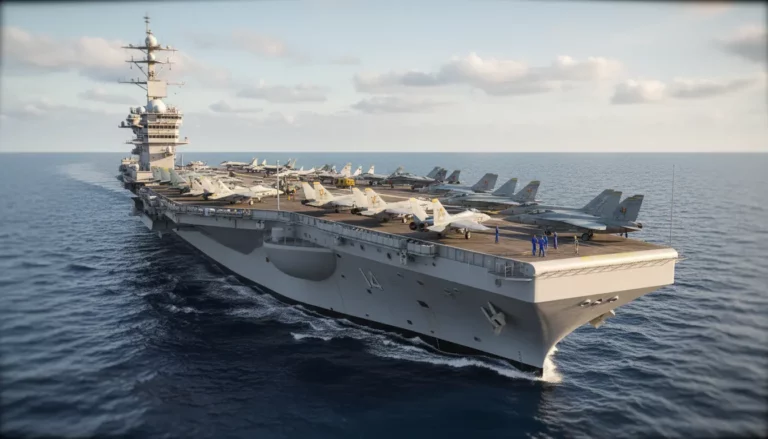
A Giant Takes Shape on the Atlantic Coast
The PA-NG stands as a decisive chapter in the evolution of the French Navy. Envisioned as not only the largest warship in Europe but also one of the most imposing globally, this carrier is scheduled to enter service in 2038. It’s being developed through a partnership between Naval Group, holding 65% of the project, and Chantiers de l’Atlantique with 35%. The construction site? None other than Saint-Nazaire on France’s Atlantic coast—a place that’s practically synonymous with shipbuilding on this side of the Channel. For the all-important nuclear boiler rooms, TechnicAtome plays a key role as lead contractor, reinforcing the project’s high-tech credentials.
Deadline Driven: From Blueprint to Battleship
The order for the PA-NG is expected to be placed by the end of 2025, with delivery penciled in for 2038. This tight schedule isn’t arbitrary; it highlights just how strategic this project is for France, on both economic and military fronts. Delays? Let’s just say they’re not on the agenda—everyone involved is keen to stick to the plan.
Numbers That Stun: Dimensions and Performance
The PA-NG’s scale is genuinely jaw-dropping. At 1,017 feet (310 meters) long and a flight deck that spans 279 feet (85 meters) wide, this warship more than earns its title as a sea giant. When fully loaded, it weighs in at 78,000 metric tons (that’s more than 171 million pounds for those using American weights). Onboard, the crew will number 1,100, with:
- 600 personnel operating the embarked air group,
- 100 staff officers,
- plus 200 additional specialists.
The PA-NG’s propulsion is provided by two K22 nuclear reactors, each with a power output of 220 megawatts. That’s enough juice to push the ship to a top speed of around 31 miles per hour (50 km/h)—not too shabby for something that weighs as much as a small town!
Advanced Arsenal and Aviation: Why Rivals Are Watching
This floating fortress is ready for serious action, boasting the capacity to carry around 40 aircraft. The line-up includes Rafale Marine fighter jets (and their successors), three E-2D Advanced Hawkeye airborne early warning planes, as well as NH90 Caïman Marine and H160 Guépard Marine helicopters—quite an air wing for any would-be adversary to reckon with.
When it comes to defense, the PA-NG means business. It will be armed with vertical launchers for Aster surface-to-air missiles, split between three eight-cell launchers on the port side. Four 40 mm Bofors cannons secure close-range protection, while Simbad-RC air defense systems loaded with Mistral 3 missiles provide an additional umbrella against aerial threats.
Among the ship’s most impressive innovations is the integration of EMALS (Electromagnetic Aircraft Launch System) catapults. Unlike traditional steam catapults, EMALS can launch aircraft weighing up to 77,000 pounds (35 metric tons) with a longer launch stroke—an extension of 344 feet (105 meters) compared to classic C13-3 catapults. Surveillance and threat detection are beefed up by the Sea Fire active antenna radar from Thales, sporting four fixed panels offering advanced tracking capabilities.
Seamless Transition: From Charles de Gaulle to the Future
The new carrier won’t simply replace the iconic Charles de Gaulle overnight. Instead, the transition will unfold gradually. The PA-NG is scheduled to arrive at Toulon (the French Navy’s main Mediterranean base) in 2035 to be loaded with nuclear fuel, with sea trials planned for 2036. Meanwhile, upgrades will be implemented on the Charles de Gaulle to ensure uninterrupted French naval operations throughout the changeover—because, as every admiral knows, you never want your flagship out of commission.