Until 26 April 2026, the Extra Space of the MAXXI National Museum of 21st Century Arts hosts “Franco Battiato. Another life”, the exhibition-event dedicated to one of the greatest protagonists of contemporary Italian culture, five years after his death.
Through memories, unpublished materials and rare documents, the exhibition itinerary returns an intimate and layered portrait of the artist, recounting his capacity for continuous reinvention, resilience and cultural heritage. An intense and immersive journey emerges that goes beyond music and crosses time, exploring every dimension of his research.
Co-produced by the Ministry of Culture and the MAXXI National Museum of 21st Century Arts, the exhibition is curated by Giorgio Calcara with Grazia Cristina Battiato and is organized by COR Creare Organize Realize by Alessandro Nicosia, in collaboration with the Franco Battiato ETS Foundation.
Singer-songwriter, musician, poet, philosopher and intellectual, Franco Battiato has been able to cross different genres and languages: from avant-garde to pop, from electronic to mystic. A tireless and progressive researcher, he profoundly transformed Italian song, combining charisma, cultural rigor and an unmistakable mystery.
THE EXHIBITION ROUTE
The exhibition is divided into seven thematic sections that trace his life and work.
The beginning (from Sicily to Milan) tells of his beginnings in the Sixties, his move to Milan and his debut as a pop singer-songwriter, supported by Giorgio Gaber. The first television appearances and the songs influenced by the beat climate lay the foundations of his future originality.
With Experimentare (from acoustics to electronics) we enter the Seventies, when Battiato abandons light song to dedicate himself to avant-garde and electronic research, inspired by figures such as John Cage and Karlheinz Stockhausen. Albums such as Fetus, Pollution and Sulle Corde di Aries establish him as a pioneer of musical experimentation in Italy.
The section Success (from avant-garde to pop) documents its arrival at the general public between the end of the Seventies and the Eighties. With The Era of the White Boar and above all The Master's Voice, Battiato fuses high culture, spirituality and accessible electronics, becoming a mass phenomenon without sacrificing artistic depth. At the same time, he wrote memorable songs for Alice, Milva and Giuni Russo.
Mysticism (between East and West) delves into the growing interest in spirituality, esotericism and eastern philosophies, influenced by Gurdjieff's thought and Sufism. This tension finds fulfillment in mystical songs and great learned works such as Genesis, Archaic Mass and Gilgamesh.
In L'uomo (return to origins) the choice to leave Milan to return to Milo, on Etna, emerges. Here Battiato leads a secluded life, dedicated to meditation, reading, painting and composition: a return to his origins experienced as a fully conscious act.
The section The Master (like a diamond) recounts the consolidation of his figure as a cultural and moral guide, recognized for his generosity, rigor and irony, despite his rejection of the label of guru. Central is the partnership with the philosopher Manlio Sgalambro, which began in 1994 and lasted almost twenty years, from which some of the densest pages of contemporary Italian culture were born.
Finally, From sound to image (Battiato's cinema) explores the cinematographic activity of recent decades, with films such as Perduto amor and Musikanten, as well as documentaries and soundtracks. A true “Franco Battiato cinema”, as recognized by Elisabetta Sgarbi, deeply intertwined with his thought and his perspective.
The beating heart of the exhibition is an octagonal space, a symbolic echo of the musical octave, where a Dolby Atmos listening system and the projection of five video clips envelop the visitor in a multisensory and synaesthetic experience.
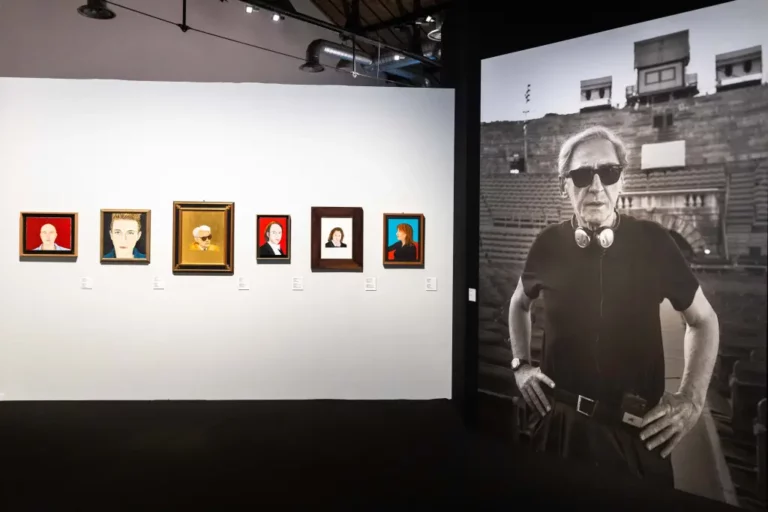
The itinerary is enriched by album covers, historical posters, photographs and rare memorabilia, which convey the versatility of an artist capable of spanning over fifty years of career as an innovator and precursor.
Alongside the musical universe, the original pictorial side emerges: a silent and contemplative painting, characterized by golden backgrounds, symbols and archetypes of Middle Eastern ancestry.
In the last decades of his activity, the cinematographic dimension joins the musical one, giving life to feature films and documentaries that tell of his artistic and spiritual research in dialogue with contemporaneity.
The exhibition is accompanied by moments of in-depth analysis and by a catalog published by Silvana Editoriale, which collects images, texts and a rich repertoire of testimonies.
GALLERY
©-Franco-Battiato-Foundation
INFO
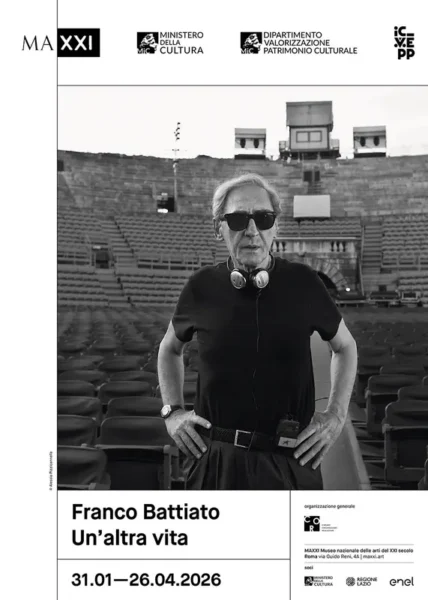
Franco Battiato. Another life
Until April 26, 2026
MAXXI National Museum of 21st Century Arts – Rome