After three years of recording silence, Tutti Fenomeni returns with “Monedì”, an album that marks a clear but not pacified discontinuity in its journey.
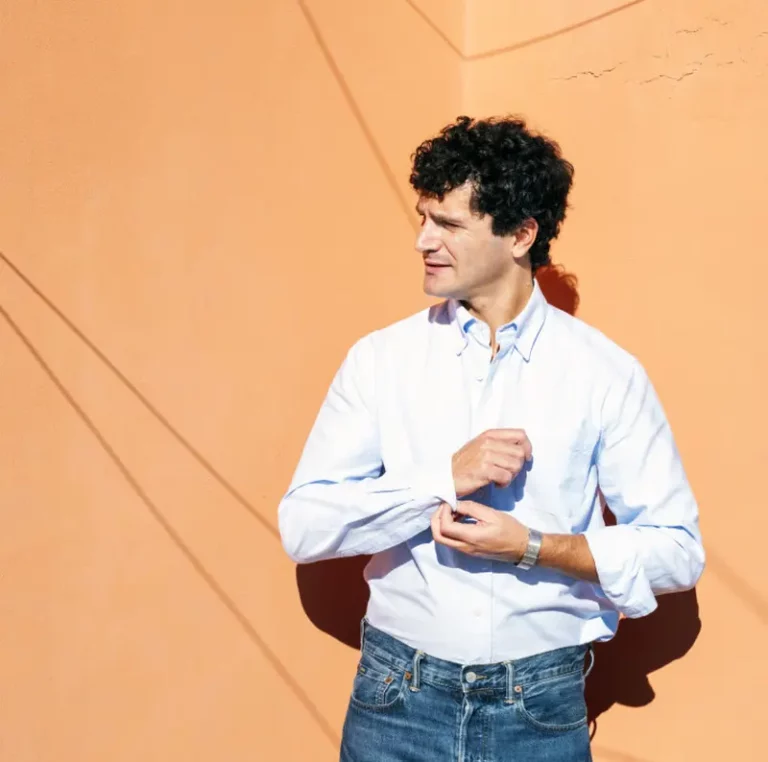
Giorgio Quarzo Guarascio – Roman, born in 1994 – re-emerges from a zone of suspension that was not inactivity but decantation: two albums (Merce Funebre and Privilegio Raro) which quickly became underground cults of the Italian indie and a cinematic foray that was anything but ornamental in the film Enea by Pietro Castellitto contributed to redefining the contours of an artistic figure who has always been resistant to labels and allergic to the comfort zone.
Anticipated by individuals Heroes' Square, Vittorio's girlfriend and Vanagloria“Monedì” is produced, played and recorded by Giorgio Poi: a meeting that does not smooth out friction but transforms it into structure. The sound becomes clearer, airy, sometimes orchestral, closer to the song form without ever abjuring the rap and verbal roots of the debut. It is a music that renounces demonstrative urgency to gain time, breathing space, discipline.
Ten tracks in which Tutti Fenomeni's writing continues to move through short circuits: high and low quotations, semantic gaps, proper names used as unstable symbols of a schizophrenic present (Mozart and Berlusconi, Nico and Elon Musk, Mao and D'Annunzio). But something changes. For the first time, irony is no longer just a defense or a mask: an emotional fissure opens. Death remains a central theme, but it is crossed over, lightened, almost reversed. Alongside it emerge love, nostalgia, the melancholy of an age that stops being promised and becomes responsibility.
“Monedì” is a record that doesn't proclaim maturity: it puts it to the test. It is not a triumphal rebirth, but a cautious, imperfect, daily restart. Like making your bed in the morning knowing that it won't change the world, but perhaps the way you stay in it. This is where Tutti Phenomeni starts again. From the most hated day of the week. From the first step to the end.
THE INTERVIEW
Why “Monday?” What does this title really represent?
Monday is a word that already contains a contradiction. It's the day of good resolutions and at the same time the day we lie to ourselves. “From Monday I change”, “from Monday I do”, “from Monday I become”.
It is the illusion of change, but also its staging.
Monday is routine, and routine, as it grows, stops being a prison and becomes a form of salvation. A dictatorship that, if accepted, can even be satisfying.
It is the first day of creation: God said “let there be light” and it was Monday.
It is resurrection, resistance, beginning. But it is also the awareness that often nothing changes.
This album was born within this ambiguity: starting with good intentions knowing that I could prove myself wrong immediately.
Listening to this record it seems like you take yourself more seriously. Is it really like that?
Yes, at least in music. I have long defended the right to be irreverent, self-destructive, ironic to the point of sabotage. It was a form of autonomy that however could not last indefinitely. At a certain point the joke ends. The registry comes into play, but not as a fetish of age: as a need for responsibility.
On Monday there's more you and me. Before I pointed the finger at an abstract world, now there is a more intimate dialectic. There is a story that begins, there is a showing. The cover is my house, the photos are almost all taken there, my face is there. I removed layers of protection. It's a record that respects music more, also because you can't remain “the promising young woman” forever.
In the album a tension seems to emerge between loneliness and the need for others.
I realized that solipsism is no longer enough for me. I'd rather go to the gallows with someone else than alone.
The search for others has become a concrete necessity, no longer an idea. This is also why I wanted to have live meetings, physical presentations, see people.
Places are no longer symbolic spaces: they are the encounters, the special relationships that you manage to build.
Love is never completely out of the show, but there are still moments that are not spectacularized, and they are the ones in which something real happens.
You often talk about awareness, about growing old, about routine. Was there a turning point?
Not a specific event. But a very clear fear: losing one's memory. I'm not interested in protecting identity, understanding who I am. I'm interested in protecting memories.
The idea of becoming old without memory terrifies me.
Before, I was looking for experiences that would make me escape from the present. Now I feel the opposite need: to protect the past.
It is a radical change that also enters the music.
What is your relationship with “youth” and the digital present?
I have always fed myself on outdated things, which perhaps made me look older.
But I feel in phase with my age.
I don't chase youth, I'm not interested.
I recently happened to compare myself with people ten years younger and there I felt a real distance.
Not as a conflict, but as a given.
The album is crossed by a criticism of the spectacularization of everything, even love.
Yes, but not in an ideological way. Places of love are not “pure” spaces: they are relationships.
Relationships that endure. Football, for example, is an enormous symbolic universe: spectacle, ritual, belonging, ideology.
I no longer believe in pristine places. I believe in meetings.
What are your real cultural sources today?
The sources have run out. For years I have plundered negative, suicidal, subversive authors and disturbing cinema.
Now I'm going from memory. And it's a problem: I have to go back to reading, listening, watching.
If I have to mention records: Battiato's The Master's Voice, Mascagni's Cavalleria rusticana, Disordini dei Cani, Achille Lauro's first mixtape (Barabba), the Dark Polo Gang.
Not out of aesthetic affinity, but because they shaped me in different ways.
The cinematic language runs through the entire album. Is it a conscious choice?
I collect sentences. Always done. Many of these would be better in a film than in a song.
The experience in cinema hasn't changed me as an author, but it has confirmed one thing for me: it's always better to make a song than a film.
Cinema is continuous mediation, money, compromises.
Music remains the freest place for what I do.
In this album love seems to become a response to death.
Before, talking about death was a way to talk about love without exposing myself. Now it's the opposite: talking about love is an advertisement against death.
I still talk about the end, about closures, about exhaustion. But love has become the main language. It is an illusion of hope, perhaps, but a necessary one.
How was working with Giorgio Poi compared to previous records?
With Giorgio the work was on form, on melodies, on tones, on becoming a singer. It's a metaphor for adulthood.
Before, I was the kid who talked loudly. Here: chin high, make the bed, respect the song form.
It was tiring but liberating. Once we found the musical coherence, the lyrics came more easily. It's a record made with time, breath, trust.
TOURS
Tutti Fenomeni has also announced two live events: April 9th at the Alleanza in Rome and May 22nd at the Mi Ami Festival in Milan.
WEB & SOCIAL
@tutti.phenomeni