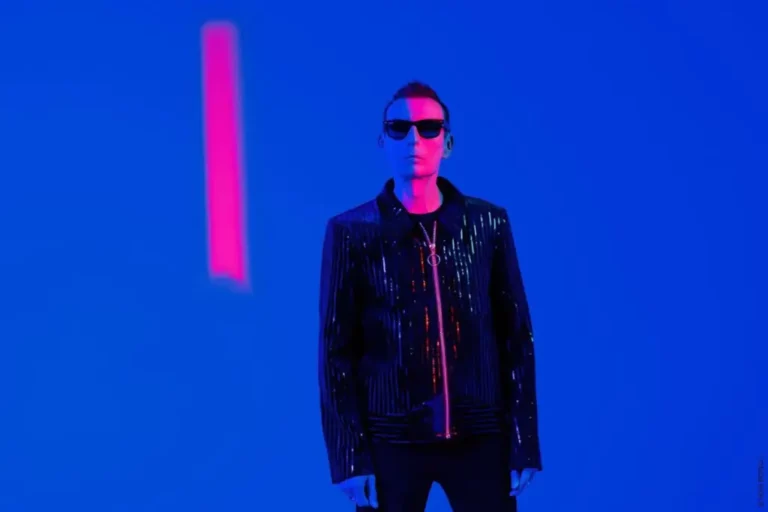
Mauro Ermanno Giovanardi's new album is not born from an urgency, but from a long sedimentation.
“And then carefully choose the words”, released on March 20, is a work thought over time, crossed by pauses, deviations and returns, which claims the centrality of the word and a song-form capable of dialogue with the present without chasing it.
Before revealing itself in its entirety, the album began to be heard through “At all costs”, a four-track mini EP that includes Fast, the single released last December. A preview that introduces a thoughtful and profoundly existentialist path, however crossed by a conscious, never decorative lightness.
Built on essential electronic architectures and on a voice that always remains at the center of the story, the album moves away from any nostalgia or rock reflex, choosing a measured and coherent expressive terrain.
We talked about it with Giò, who in this conversation gives an intimate story of the project and a broader reflection on making music today, reminding us – as the title itself suggests – of the importance of choosing words carefully!
THE INTERVIEW
Let's start from the structure of the project. First the single, then the EP, finally the actual album. A not so obvious choice. How did this scan come about?
It's a choice born from the fact that I hadn't released my own album for a long time. I wanted to build a path, not just “throw out” an album.
Releasing a single first, then an EP, meant revealing the record little by little, allowing the songs to breathe, to have a longer life.
Also for a very concrete question: between mid-February and mid-March Sanremo swallows up everything. Releasing a single in December, an EP at the end of January and arriving at the complete album in March seemed like an intelligent way to accompany the listener towards the final step.
And today I can say it: I am really, really happy with the result.
In the press notes you talk about this work as your most thoughtful, most troubled, most awaited album. Listening to the first songs, this feeling is very clear.
Look, a lot of people are telling me this. More than one person has told me: “Maybe it's your best album”. Even those who work with me.
It's a record that has a very long history: I started writing it in 2018, between 2019 and the beginning of 2020 half of the material was already ready. To Sing Louder, the song written with Colapesce, is almost identical to how you hear it today. I remember going to his house in the fall to play it for him and he played me a preview of Very light music.
Then the album ended up on standby because I dedicated myself to the La Crus project. At that point I started working on this album again and completed it.Inside, among its folds, there is my whole way of being and my approach to music: made of discipline, constancy, sacrifice and, at the same time, of love, respect, ethical, moral and existential sense. A record that sounds contemporary.
In what contemporary sense?
There's no guitar, there's no drums played, there's no traditional bass. Everything comes from the piano: electronic rhythms, Moog for the bass, synths, samples. Then real strings and wind instruments, many voices to build the themes. We have overturned the canons of electronics: usually the beats are in the foreground, but here they are behind. They have to be there, but they must never bother the voice.
I was very inspired by Leonard Cohen's records from the 80s and 90s: the word always in focus, always central.
And then the collaborations: Colapesce, Kaballà, Bianconi. A true “collective of the word”.
Yes, and it's something I've wanted for a long time. Colapesce and I have known each other since before he started playing: I met him in Syracuse when he was a DJ, we still called him Lorenzino. I pissed him off for years by telling him he had to sing in Italian.
With Pippo Kaballà we have been friends for life, with Bianconi the same: I discovered that he was a huge fan of La Crus, he came to see us in Perugia on the tour of the first album. The idea was to build a collective, but with a clear direction: the last word is up to me, because I put my face to it. But working with friends you respect makes the meeting truly meaningful.
The result is a dense, existentialist, but never heavy album.
Exact. It's probably my most existentialist album, but without ever falling into moralism or heaviness. In the press release I mention Calvino's American Lessons, thoughtful lightness. It's all there. Even the title is a statement: You can choose your words carefully. It's already inside the essence of the record.
This tension is also reflected in the cover image: you balancing on a pink beam.
It's our condition. Always being on the edge, always on the verge of falling, but trying to stay upright. That shot is totally real, nothing is constructed. It was born by chance during a very long photo session: the photographer was arranging the lighthouse, that bright line was created on the ground and I tried to walk on it like a tightrope walker.
At a certain point I said: “This is contemporary man”. Fragile, precarious, but stubbornly standing.
And it's very hard to stay standing.
This album will inevitably have a live life. How do you imagine him on stage?
I thought from the beginning that it was far from any rock idea. I'm fascinated by a minimal formation, almost from the 1980s. I have in mind my first concert seen live, in '79 at the Palalido in Milan: Iggy Pop with the Human League who opened as a duo.
We are rehearsing as a trio, with two keyboard stations: a pianist and a producer-keyboardist who plays synths and does backing vocals. A formation with an Anglo-Saxon flavour, new to me too. You always have to challenge yourself, raise the bar with every record.
You often talk about challenge. But in your opinion has the bar of Italian music really been raised today?
I believe that making a record like this, which seeks a balance between experimentation, poetry and melody, is already an enormous challenge. Music is always the mirror of society. We live in a “disposable” society, with a concentration span of seven seconds.
A twelve or thirteen year old boy grew up with TikTok: for him that is the world. We have a different experience and everything seems poorer to us, but I'm not judging. It's a fact. If the majors sign artists with a target audience between 11 and 18 years old, this already says a lot.
TRACK BY TRACK
1 Fast
(Giovanardi – Kaballà – Bitossi – Pastorino)
“Veloce” is a hymn to the paradox of modernity: always finding yourself running, in the throes of frenzy, without even knowing where. With philosophical irony and a fast pace, the piece fuses social criticism and urban poetry: Kierkegaard meets the algorithm, “either/or” is measured against perpetual connection. Speed becomes a metaphor for a world that mistakes urgency for meaning, and movement for freedom, while “the future is a drug dealer” where anxieties and loneliness are consumed. Musically pulsating and textually sharp and disenchanted, the song tells of the short circuit between heart and profit, between the need for peace and the cult of performance. A manifesto on time that devours, which talks about the contemporary human being who tries to keep up with technology, to “go faster than machines” but which produces an existential disorientation without comparison with the past and without any real points of reference.
2 Zero Years
(Bianconi – Kaballà)
“Anni Zero” is the meeting point of two eras, a poetic journey between two worlds linked by the same musical beat: a mother who listened to the transgressive rock of the Velvet Underground (translated in the text to “Il Velluto Sotterraneo”) and a daughter who, in digital earphones, rediscovers that same rebellion. The song intertwines memory and current events, showing how music follows a circular motion: it restores youth, identity, disorientation. With a lyrical and cinematic language he tells how each era resonates within the other, in a continuous return of emotions, illusions and imaginaries. “Blue skies will return between astonished walls”, sings the chorus, like a subtle omen. A ballad about the passing of time and the ephemeral eternity of pop songs, and their power to become – once again – a small generational “placebo.”
3 To Sing Louder
(Giovanardi – Colapesce – Rescigno)
How can we overcome death? The first spark, the idea for the text was born while I was walking. I wanted to talk about immortality, and how, precisely, to be able to defeat it, death. I have always thought that we, who do this job, are incredibly lucky and privileged compared to others. That of being able to leave a very small sign of our passage on this earth. And we can do this with our art. Leaving works, or in this case songs, reflections, words, that resemble us as much as possible. May they truly adhere to what we are and what we think. To be able to describe our inner universe in all its facets. Therefore, from an ethical point of view, this fortune cannot and must not be wasted. Never. And that's why at the end of every new album I'm exhausted. Because this sense of ethics leads me to always give 110%. Because once a new job is released, you can no longer change it. It stays forever. “I want to open my arms, to sing louder, to cheat death, and feel more alive.” In these verses, the need to want to leave a trace so as not to disappear and dilute into oblivion. To succeed at least once, in overcoming death.
4 An Error
The song reflects on the theme of identity starting from a deviation. Not the error as a fault to be corrected, but as a necessary fracture, as a space of freedom in a world that asks for adhesion and coherence. His words suggest that imperfection itself allows a more authentic look at reality, a personal form of judgment and creation. Accepting that you don't always work becomes an act of loyalty to yourself. A determined song, which claims the right to waste as the origin of a recognizable voice.
THE TRACKLIST
The EP
1 Fast
(Giovanardi – Kaballà – Bitossi – Pastorino)
2 Zero Years
(Bianconi – Kaballà)
3 To Sing Louder
(Giovanardi – Colapesce – Rescigno)
4 An Error
(Giovanardi – Cremonesi)
The album
1 The Darkness in the Skin
2 Fast
(Giovanardi – Kaballà – Bitossi – Pastorino)
3 The Conscience of My Generation
4 Zero Years
(Bianconi Kaballà)
5 Love Judas
6 Of Heartbreaking Love
7 Stop me
8 To Sing Louder
(Giovanardi – Colapesce – Rescigno)
9 The Number That Comes After
10 An Error
(Giovanardi – Cremonesi)
11 I don't believe in miracles
12 Every desire of the two of us
13 Schopenhauer is right
WEB & SOCIAL
@mauroermannogiovanardi