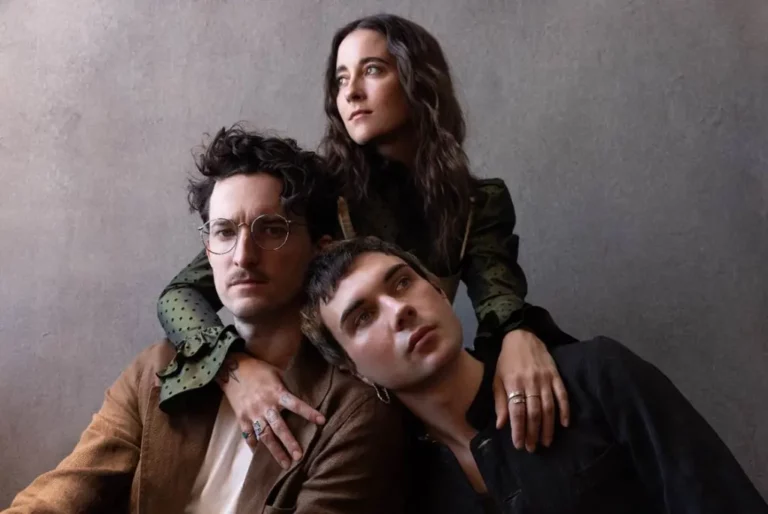
Synthpop, minimal wave, electronic, post-punk, goth, new romantic, the Nation of Language live in that liminal space where labels and genres stop being categories and become simple hypotheses.
Their music, led by the voice of Ian Richard Devaney, does not seek nostalgia but crosses it, deconstructs it, reinterprets it to the point of transforming electronic synthesis into a surprisingly human, almost epidermal gesture.
With “Dance Called Memory” Devaney, their latest album, returns to a primordial urgency, writing on the guitar and letting vulnerability become the driving force and material of the album.
We met them during their recent appearance at the Magazzini Generali in Milan, to talk about vulnerability, identity, technology and that thin emotional thread that continues to hold their music together.
THE INTERVIEW
“Dance Called Memory”, your latest album, seems constructed like a filigree diary, written between melancholy and lucidity. What inspired you to let vulnerability become the driving force behind the record?
I guess, in a way, there wasn't much choice: melancholy was the only thing my mind could focus on, and music was the only real outlet I had. Many of our fans have been vulnerable with me, telling me what our music has meant to them, so I felt that, going through my own crisis, I had a safe place to be vulnerable — maybe even a responsibility to be. In so many aspects of life I have had to wear a mask over my emotions, and it was important to me that music wasn't one of those places.
Ian, you said you wrote the new songs “to distract yourself from depression.” How much of that process was therapeutic, and how much remained an almost clinical act of self-observation?
I'd say it was more or less a 50/50. There's a deep satisfaction in feeling like you've created something that really captures how you feel, and it's incredibly therapeutic. But it also involves sitting with your misery, without looking away. In the long run, hopefully, this brings growth, but in the moment it can be extremely unpleasant.
You have always inhabited a constellation of labels: synthpop, minimal wave, post-punk, goth, new romantic. How much do you really care about how critics try to define you? And is there a label that irritates you more than others?
No label really bothers us — I think we were lucky: most people who use these terms usually make it clear that our music doesn't sound like a simple retro tribute. There are so many elements that inspire us, and all those genres play a role, but what we do has to feel like the work of a contemporary band, not a copy of past styles for the sake of style. In the beginning I was really trying to stick to the synthpop language in a precise way, but since then things have grown and evolved. In the end, I hope it's the songs that stay at the center.
“I'm Not Ready for the Change” is a meditation on letting go. What are you not ready to let go of today, as individuals and as a band?
I believe that, as a band and as people, we resist “professionalization”. We still like to do things ourselves and know every step of the process. As the band grows, it's tempting to simplify and streamline everything, but the more you do it, the more every day risks feeling the same — in the wrong way. A small example: every evening, on tour, we set up the synth station from scratch. For some it could be a waste of time; for us it is a way to start the working day by building something together and preparing the stage for the show.
The contemporary synth scene is changing — ever more digital, ever more algorithmic. Where does Nation of Language fit into this transition?
I believe there is nothing wrong with using digital tools such as software synths and effects to create art, but I don't like the idea of AI and algorithms having a bigger role in the world of music. As a band we are definitely outside of that transition. Here we say “work harder, not smarter”, because we think there is great value in effort, in friction, in having to solve unexpected problems. The band should be a vehicle for personal growth, not a song factory.
Your music constantly walks the line between electronic coolness and emotional warmth. What is the key to ensuring that technology amplifies the human instead of filtering it?
In a way it comes naturally, because the music, in most cases, exists primarily to support the lyrics and vocal melodies. At every stage of the process we try to make sure that the human soul of the song is always at the center.
The Italian public welcomed you with growing affection. Is there anything that surprises or fascinates you in particular about the Italian public?
I wouldn't say it surprises me, but I love seeing how much passion the fans have. Italians are known everywhere as a passionate people, and it's incredible to see that energy and enthusiasm aimed at us and our music. It's a great honor.
Do you know any Italian singers? If yes, which ones?
Aidan made me a mix CD at the beginning of our relationship with the Italian band Soviet Soviet in it, so they have a special meaning for us.
What are you listening to these days? Is there an artist or band that you just can't get out of your head?
There is an artist called Avalon Emerson, who is mostly known as a dance music DJ, but who also has a project called Avalon Emerson and The Charmin which he explores a more singer-songwriter approach, while remaining in the synth field. He just released a single from Charm's upcoming second album, so I'm listening to it a lot and also rediscovering the first album.
LISTEN TO THE RECORD
VIDEO
WEB & SOCIAL
@nationoflanguage