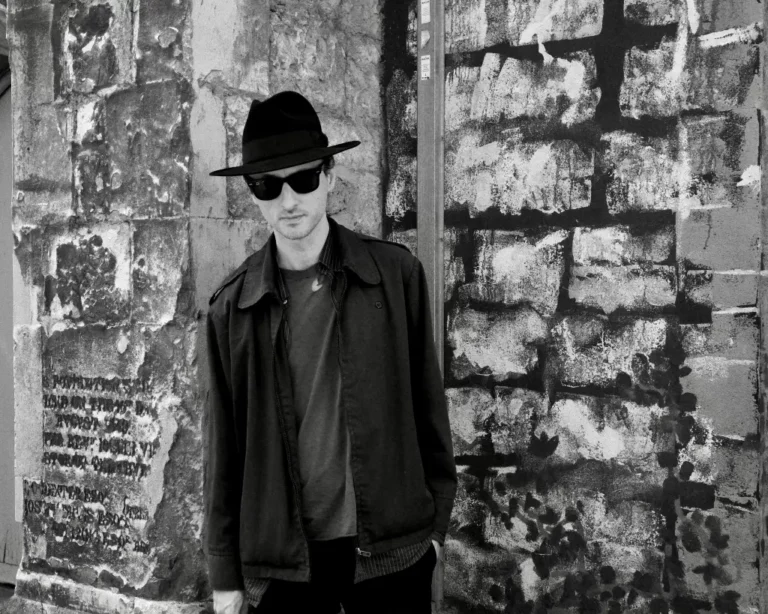
I have never been to Essex, one of the seven kingdoms of the so-called Anglo-Saxon heptarchy. A historical definition that today sounds almost archaeological, yet still useful for imagining a margin: the one in which the brothers Jack and George Barnett move.
Their origin is not only geographical, but perceptive. A liminal area, close to London and yet secluded enough to produce an idea of distance, of operational isolation, of necessary autonomy.
The trajectory of These New Puritans has long abandoned any linearity. From the first post-punk impulses to the current configurations, their music has progressively abandoned the song form to move closer to a sound architecture made of minimal gaps, of subtle tensions, of matter reduced to essential vibration.
“Crooked Wing”, the band's fifth studio album, represents a further shift in this sense: a light yet rigorous construction, where the sound is organized in fragments, details and well-defined acoustic angles.
In “Crooked Wing” external presences also appear which further broaden the field: Caroline Polachek, in a duet with Jack in the song Industrial Love Song, and the actor Alexander Skarsgård, involved in the video for A Season in Hell. Interferences that do not break the identity of the project, but multiply its surfaces.
We met Jack Barnett while waiting for their live at the XXI edition of Sexto 'Nplugged, where they will perform on July 2nd.
THE INTERVIEW
“Crooked Wing” let's start from here, your latest album was released precisely one year ago. What happened to your relationship with that record in the meantime? Is there anything you would change today or does an album, once released, definitively cease to belong to you?
I haven't listened to it much, but I'm happy with the version that exists in my head.
I think I last listened to it when we did a surround mix for an event at the ICA. In that case, however, there was the possibility of changing things, of experimenting. It was something alive, constantly changing. I care less when it's no longer malleable.
But the music itself is still very much alive for me, because I still work on it with the live band, so it's still changing. I'm sure that if I listened to the album again, there would be hundreds of things I would change.
One of your most obvious characteristics is continuous change. Jazz, industrial, sacred music, electronics and minimalism coexist in your music. Can sound research turn into a form of obsession?
Yes, it's an obsession. Obsession can also be destructive, but how do you work without obsession? It's what you need to not get distracted. I was reading about Alberto Giacometti who for six years destroyed everything he did. There was a part of me that admired that dedication.
Before this interview I went back to listening to your early works, Colours And Numerology. Inside those songs there was still an almost post-punk, nervous, instinctive impulse. Looking back after almost twenty years, what do you see in those records today?
It seems like a million miles away and I suppose it is!
It's strange how records are such vivid documents of a specific moment. We were very determined. We listened to J Dilla, dancehall, Benjamin Britten, Béla Bartók, and sometimes it seemed like people thought: “if you dropped all that you could be a decent garage rock band”.It always seemed like a running gag when we went to play in London in our dad's work van.
I feel closer to the music I recorded as a child, before all this: it still resonates with me and I understand that person in a strange way.
Perhaps you are born, then you become something else, and then you gradually return to what you were.
In your works, spirituality often coexists with something physical, metallic, brutal. Are you interested in continually challenging the separation between the sacred and the industrial?
It's like a pendulum, we move between those poles. I'm interested in beauty in unexpected places, it's more powerful that way. When I wrote “Crooked Wing” I lived in an industrial area, opposite an African evangelical church: so these two things can absolutely coexist.
You have defined the liturgical organ as “an instrument of love and fear”. What kind of emotional power were you looking for within that sound?
The pipe organ can be many things. It's like a DAW (acronym for Digital Audio Workstation), you can do whatever you want with it. Somehow I already listened to it as a sound, it couldn't be anything else.
In a present dominated by digital hyperproduction, your approach maintains something ritual and almost artisanal. Is it a form of resistance to the dematerialization of music?
That's an interesting way to think about it. Gradually everything is being taken away from us. We are completely free to have absolutely nothing.
In your arrangements silence often has the same weight as sound. How important is what you decide to leave out?
It's very important. You have to have a certain amount of contempt for your work, to be willing to cut, dismantle, improve it or take it elsewhere.
Essex continually returns in your music, even when it isn't explicitly evoked. Is it a real place or a mental state?
It's both, of course, like everywhere else. I'm proud to be from Essex. It's not a postcard picture of England, but that's not what interests me. It's something else. There is a lot of beauty there, if you know where to look.
Someone said that Essex people don't hold grudges because, if they don't agree, they'll tell you to your face.
There is also a mentality of self-sufficiency, of “making it on our own”, that belongs to us. It gave us space to reinvent ourselves, or simply invent ourselves.
I realize that I am truly a sea person.
It's my element. For the last three days I have been swimming in the estuary and I couldn't be happier. Everything becomes simple.
If “Crooked Wing” were it to become a physical space, what place would it be? A cathedral, a construction site, an industrial wreck, an empty room?
A combination of all this sounds perfect.
The visual component has always been central to your artistic universe. What relationship do you have with aesthetics? For you, does the image accompany the music or is it an integral part of it?
It has always been very important. I'm also very lucky to have George, who creates amazing images for music.
It's always seemed inconceivable to me to work hard on a record, pour everything into it, and then hand the artwork over to someone you've never met and say, “here, you do it.”
Very often the images are born together with the music as I write it. For Crooked Wingfor example, the image of the white arches with very white trees in the night was very vivid in my mind, so it seemed natural to paint it for the cover. I hadn't painted in years, so I had a few weeks to relearn how to do it, but it was beautiful.
This summer you will be back live. What form will the concerts take?
We have a great band. The best we've ever had. Otto Hashmi and Toril Azzalini bring a lot to the project. On stage we have many metal instruments: vibraphone, chains, tubular bells.
Last question. What are you listening to these days? Do you know any Italian artists?
The last Italian artist I listened to is Lucio Dalla. Maria Chiara Argirò played live piano with us for a long time, and also participated in Crooked Wing.
The last non-Italian was a composer and organist called Jehan Alain. He died very young during the Second World War; he was a military motorcyclist, I believe he was intercepted by German troops and killed after refusing to surrender.
THE VIDEOS
THE FESTIVAL
SEXTO 'NPLUGGED XXI edition
From 2 to 5 July 2026 in Sesto al Reghena (PN)
WU LYF + These New Puritans
Thursday 2 July 2026
CLICK TO BUY TICKETS
Altın Gün + The Ice Cream Wizard
Friday 3 July 2026
Equipment + JoyCut
Saturday 4 July 2026
The Dogs
Sunday 5 July 2026