10 years of Highspeeds and the memory of an eternal debut.
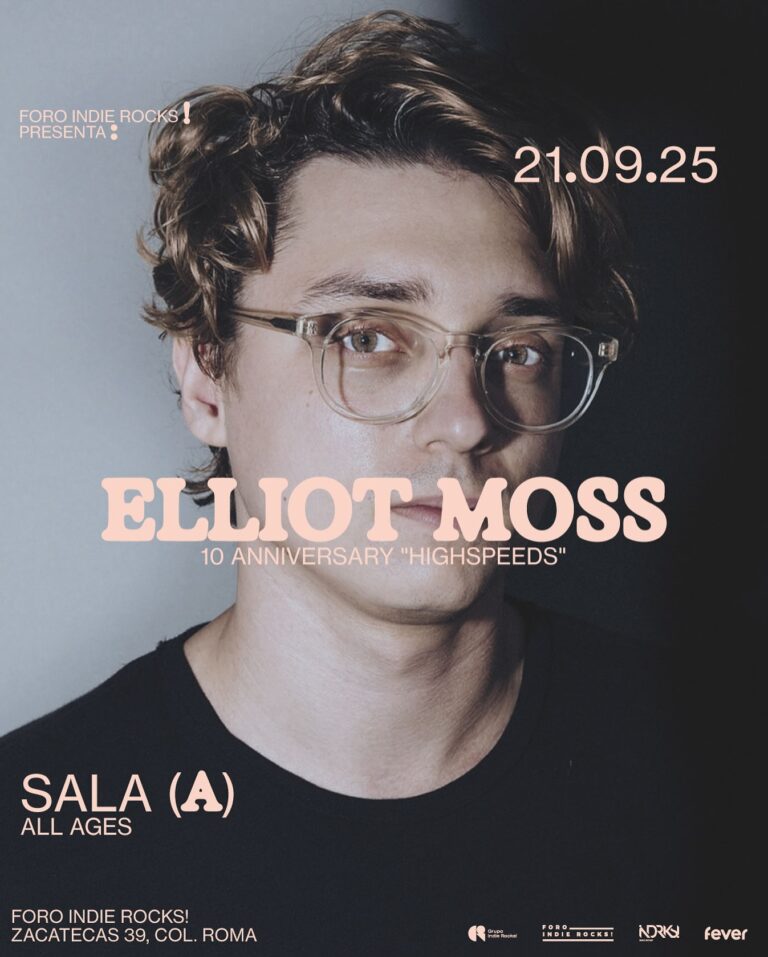
It's been 10 years since Elliot Moss burst onto the alt-pop scene with Highspeedsan album conceived almost alone from his home studio and which, with its luminous melancholy, became a cult work. Today, moss celebrates a decade of this debut with a special edition and a tour that will bring it back to the Indie Rocks Forum!where he reflects on the origin of those songs, the evolution of his sound and what it means to revisit the starting point of a career marked by introspection and experimentation.
Indie Rocks!: This year you celebrate the tenth anniversary of Highspeeds with a special edition and a series of concerts. Looking back, what does this album mean to you and where does it fit in your career?
Elliot Moss: For me, Highspeeds at the time I wrote it was towards the end of high school, when most of the songs came together. I was immersed in music, trying to learn how to create something that reflected what was in my head, although I didn't know exactly how to do it. I felt like I was far behind compared to others who had bright futures, who were going to college or getting jobs. I was in my attic experimenting with guitar sounds, feeling alone in that search. It was my choice, but many times I felt like I had made the wrong decision and that was scary, like the world was moving fast and I was left in slow motion and alone. Many songs were born from that feeling.
Now, for me, it represents the beginning of my career. Looking back, some songs I still identify and others have remained in the background. I liked seeing how themes like “Slip”, “Great Things” either “Best Light” They have evolved live, always present and accompanying me all this time.
GO!: In general, where does inspiration come from for you? Does it come from life itself or do you start with a specific theme and build from there?
EM: Many times I'm already thinking about something and I start making music as a way to process or understand that thing. This is how I organize my thoughts, putting them into a song that has a beginning and an end, a structure that is much more useful to me than having scattered thoughts that come and go. That helps me see it more objectively. Most of my songs come from trying to understand something that's really happening.
GO!: Highspeeds was an album you created almost entirely in your home studio, maintaining complete artistic control. How do you remember that process? DIY And how much does it still influence the way you work today?
EM: Equipment and peripherals are secondary or tertiary to me. For example, a 1960s analog compressor with a broken meter can become an almost obsessive pursuit. It's like putting together a puzzle or building a ship in a bottle rather than part of the creative process. When I write music, I focus on what I want to achieve and say, the rest comes later, especially in production. The writing is basically the same, only now I have more tools cool to create sounds or soundscapes, but the essence of everything remains the same.
GO!: This new edition of Highspeeds includes reinterpretations made by yourself. What was it like to reconnect with those songs from the perspective and maturity you have now?
EM: The big difference between when I did Highspeeds and now it's just that back then I had never played in a shownor did I really understand what a live performance was. It was very interesting to choose two songs that I never finished and add them together, thinking that I would soon play them live. I chose “Bad Neighbors” and “Floats” of between seven or eight incomplete songs by Highspeeds. I tried to preserve what happened in those sessions years ago and finished what was missing without undoing anything. It was like opening a time capsule, not doing something new.
Now that we've started rehearsing these two songs with the originals, they fit together well. In it Indie Rocks! On the 21st we will play these new songs and several songs that we had never played live. It's fun that the live performance part is now part of Highspeedsbecause it didn't start that way.
GO!: The album has often been described as a contrast between the dark and the hopeful. How did you achieve that emotional balance and how do you see it today, 10 years later?
EM: Definitely different. For example, the title song “Highspeeds” It is simple and easy to reinterpret to apply it to what is happening today. “Even Great Things” is a good example of a theme that is metaphorical enough that I can relate to it at different times, thinking about how long something will last, something I didn't have in mind when I wrote it. The more personal and specific songs are harder to connect with because they're talking about something from 10 years ago.
GO!: You will interpret Highspeeds complete in concerts in New York, Los Angeles and Mexico City. What are your expectations for these concerts and how different is it for you to play these songs now?
EM: In Mexico City we will play five or six songs for the first time, songs from the album that we had never played live and, obviously, the two new songs. There will be a lot of new music to try out in front of the audience. There's also a lot of excitement about getting back to playing live, something we don't do all the time, and we really value those moments.
I look forward to the energy and that connection with the music that we always feel when playing at the Indie Rocks Forum! It is very pleasant to support this album after 10 years and have the opportunity to see how the songs have evolved and transformed into something different live. I feel like it's an important moment in my career, a milestone to celebrate with touring and not just let time pass. I am very grateful for that.
GO!: Finally, describe the Elliot Moss of 10 years ago in three words.
EM: Probably quiet, a little obsessive or tangential.