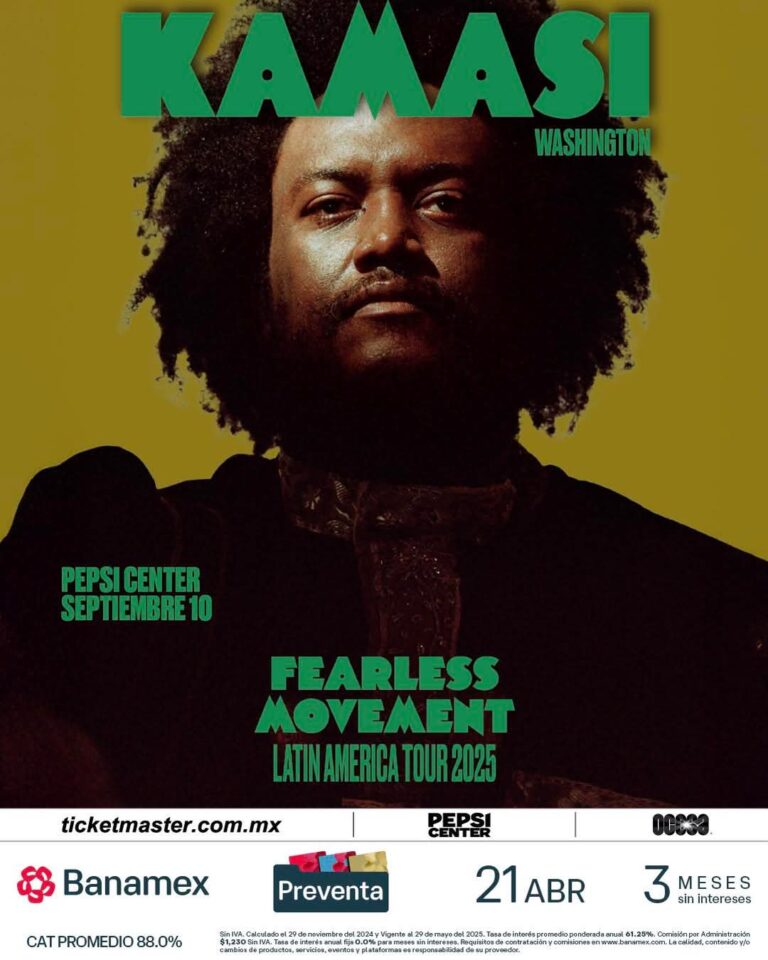
Fearless sounds, infinite paths.
Few contemporary musicians embody the spirit of exploration like Kamasi Washington. Before his long-awaited return to Mexico City, the saxophonist and composer spoke with us about Fearless Movementfatherhood, collaboration, improvisation and the sacred role that music plays in our collective lives. With honesty and vision, Washington reflects on his evolution and the inexhaustible energy that continues to shape his art.
GO!: First, you return to Mexico City after a long wait since we last saw you. In general, and even in terms of inspiration, what does Mexico City mean to you and how are you preparing this concert? Does the city serve as inspiration in some way?
KW: Yes, I love Mexico City. It is one of my favorite cities in the world. Being from Los Angeles, I grew up surrounded by a lot of Mexican people and it feels like home, but like a different version of home. It is a beautiful city, with an incredible combination of history, art, music and its people. The pyramids are not that far away, the architecture is impressive. Every city has an energy, and musicians connect with that energy when we go.
GO!: You have described your latest album, Fearless Movementlike a dance album, but not in the literal sense. What do you want people to feel when they hear it?
KW: This album was born from a big change in my life: I became a father. Fearless Movement It's a play on words: dancing is movement, but so is life. To live like this, you need courage. There is no state more free from fear than when music takes over you completely, when you just dance, enjoy and your fears disappear. That was the inspiration. I hope people connect with that feeling, that moment when a concert is so beautiful that it makes everything else fade away.
GO!:Many years passed between heaven and earth and Fearless Movement. What changed in that time?
KW: They are very different. The Epic It was music that we had been playing for a long time before recording it, and it even took two years to come out. During that time I wrote much of heaven and earthso we were already playing that material. With Fearless Movement It was different: it was completely new music that none of us had played before, not even me. That gave it a different energy, that of exploring the unknown, instead of polishing songs that we already knew.
GO!: This album also includes collaborations with Thundercat, George Clinton, André 3000. Was it difficult to add so many different voices to the album?
KW: Not at all. The music was new, my life was changing and I wanted it to take other paths. Many of these collaborations happened naturally. The theme with George ClintonFor example: Ronald Bruner he wrote it, but we didn't know what to do with it. Then I met him at an art exhibition and he said, “We should make music together.” At that moment I knew he would know how to solve it. With Andre 3000 It was different: he called me to record. I didn't know what he was up to, I was just a big fan of his. When we met I discovered that he was into very experimental things. That session, together with Carlos Niñotook us to an unexpected place. When you want the music to change, sometimes you have to let go of control a little and let others take the helm.
GO!: Speaking of new paths, you also worked on the anime's soundtrack Lazarus. How was that experience compared to making an album?
KW: I'm a big fan of Shin'ichirō Watanabe and anime in general. I grew up watching their series on VHS back in the nineties. So when they called me, I was very surprised. He gave me scenes from the series and asked me to compose as if I were making an album inspired by those moments. That freedom was incredible and took me in a new direction. In fact, some of my favorite music in recent years came from that project.
GO!: Your discography mixes jazz, soul, punk, hip hop, even progressive overtones. Are those decisions conscious or do you just flow in the studio? And in that sense, what is the difference between Kamasi in the studio and Kamasi live?
KW: In the studio I usually arrive with a vision: a song written, a goal. But if something better comes along, I'll go with the flow. Live it's different: I leave everything open. Every night there can be a brilliant discovery in a song, so I don't want to pigeonhole myself into one arrangement. We change tempos, tonalities, chords… music is infinite. And on stage we explore those infinite possibilities.
GO!: Improvisation is central to your shows. How do you balance it with maintaining the essence of the songs?
KW: That's the challenge: not to lose the spirit of the song. For me, the song is sacred. Improvisation opens infinite doors, but if I stay true to what I hear, the song remains. Music flows through me, through the universe, through everyone. My job is to channel it more than to manufacture it. If I try to force it too much, I run the risk of losing it. But if I listen, the song is still there, in the center. For me it is a ritual, a celebration. Music is one of the most sacred things in life.
GO!: For those who still don't know your work, what would be the best song to start with?
KW: It's difficult. My music is very varied, and no song encompasses everything. But if I had to choose one that gives a good idea of what I do, it would probably be “Fists of Fury”.
GO!: Describe Kamasi Washington in three words.
KW: Right now, I'd probably say—and it's more of a description of what I'm doing—but I guess it would be: searching for the truth.