Ideas fly. Albums sleep on hard drives.
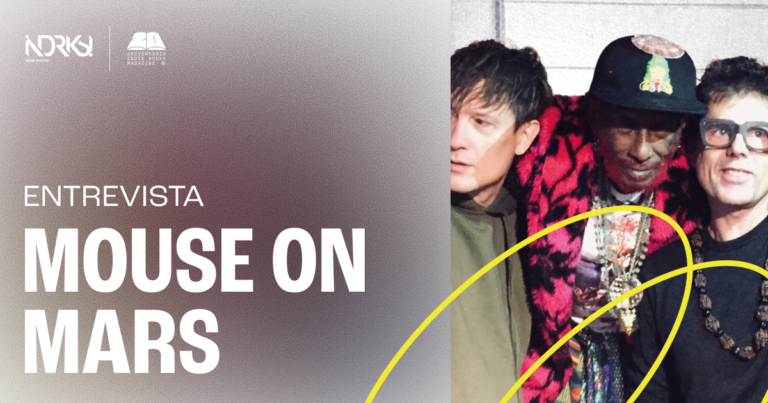
Jan St. Werner and Andi Tom They talk about the record they made with Lee “Scratch” Perry in 2019, about COVID that froze him and why a can of food can sound the same as an expensive synthesizer.
Mouse on Mars For more than three decades they have been building one of the most unclassifiable catalogs of experimental electronic music. Jan St. Werner and Andy Tomoriginally from Cologne, Germany, have turned sound discomfort into their own language: layers of noise, rhythm and texture that do not ask permission to coexist. But his collaboration with Lee “Scratch” Perry —the Jamaican producer who invented dub as we know it, creator of the legendary Black Ark and titanic figure of 20th century music— was something different. It was a community. A kitchen full of people recording. A UFO moving slowly over a stage.
Recorded in 2019, frozen by COVID and finally given over to silence when Perry died in August 2021 at the age of 85, the album came into the world with the certainty that some things improve with time, like wine. Jan St. Werner and Andi Tom They speak without haste and with the conceptual precision that characterizes everything they touch. Mouse on Mars. Talk about collagesof Dada, of a lamp that looked like a UFO and why nothing in the world is really separate.
Indie Rocks!: This morning I was listening to their next album and I think it is an incredible work. I'm very excited to talk about it. I want to start by asking you about the process of making this album. I was reading about the history of the collaboration with Lee “Scratch” Perry. Does either of you want to tell me a little more about the details of this new album that you're going to release in about a week?
Mouse on Mars: Yes, what was the question exactly? I want to know a little more about the details behind this new album that you are going to release.
In some way, I think it had to happen that we met, because it seemed that the energies from both sides—that of Lee and ours—converged without any expectation of what was going to happen. The only expectation was that the process would be free. No pressure, no egos.
Many friends also joined the recording sessions. People were arriving and it became a community. The studio was full of people and we had several recording possibilities: we set one up in our studio, there was also a fairly large room where we set up equipment, and even in the kitchen, while we were cooking, we were recording something. It was necessary, because something was constantly happening.
Lee He felt very comfortable with the situation and was constantly active. He never got tired. I was permanently involved in the recording process.
GO!: You are telling me that you recorded even while you were cooking, that new material emerged all the time. So I want to ask you: how do you know when an album is finished? If you're recording all the time and something new comes out all the time, at what point do you realize you have a record ready?
MOM: I think this is the only album we thought was finished. All the rest we could have continued working indefinitely.
GO!: It's the musician's paradox: you never feel like the album is finished. At what point did you say “this is ready”?
MOM: The main reason was that Lee died.
We knew we couldn't do any live performances. We couldn't mix it with him. That was also the reason why the album was not finished. We recorded it in 2019, at the end of 2019. Then COVID hit. The album was left sleeping on the hard drive.
GO!: Like wine. Getting better with each year. I love that idea. I want to ask you how you are going to translate this music to live format without Lee. I think it's going to be complicated, but that's just my impression. Do you have anything in mind for the shows?
MOM: So that? For the live show?
GO!: Yeah.
MOM: Let's play with dodo. We thought for a long time if this album could be performed live. But Andy wasn't sure, because without Lee it didn't make sense. Nor did he feel he had the authority to do so. I felt the same, until I realized that dub is actually about making versions of something that already exists.
We discussed it. Was dodo who saw it clearly: he sees no problem in presenting this without Lee.
dodo was as valuable as Louis, Louis Chude-Sokei. They were both very important in bringing this forward. Because Andy and I reached moments where we looked at each other and said: we cannot make this decision alone. We have no authority to do so. dodo He said, “I can play this and you can join in.” We approached it little by little.
Now I think we found a way to present this material as if they were remixes or dub versions of the original tracks. A dub version can live very well without the original lyrics. This is how we are going to present this album.
Maybe at some point we throw out a processed version of Leeor just a fragment. But I think the tracks can live very well without it. They can grow. We can add other musicians or play just the three of us. We are quite flexible with the live set. It's going to be something slow and relaxed. We don't have to meet any expectations. We can just do what we think is right.
GO!: I think it's going to be very interesting to see this album live. Do you have plans to come to Mexico?
MOM: No, you have to make the plans. They have to invite us.
GO!: I need to make some calls, right?
MOM: Yes please. Now.
GO!: Talking a little more about other things that caught my attention about the album: I was looking at the cover, the photo they used and the colors. I liked it a lot. Can you tell me the story behind that image?
MOM: The idea of the album in its entirety translates the idea of a collage. And that was a very real practice of Lee's. It was many years ago collages. He was also a very serious visual artist. He produced sculptures. His way of putting elements together is very Dadaist. It looks very Dada.
And Dada is an art form that was born in Zurich, in the Cabaret Voltairewhich was the epicenter of the movement. Lee had a great posthumous exhibition in the Cabaret Voltaire about two years ago. I coincidentally went to see that exhibition in Zurich and thought: this is what album art should be like. It should be a collage. It should bring together all the elements of the recording sessions and the collages that Andy and I do.
Because our study, in a certain way, is also a collage. We put things next to each other. Andy He has a special talent for sticking a sticker on a machine and suddenly changing its entire meaning. You take the sticker off a vacuum cleaner and stick it on a Moog synthesizer, and that transforms the meaning of the entire Moog. I love cutting out and working with paper. I identify a lot with the practice of Lee to do collages.
So we thought that's what the album should be like. It should transcend the liveliness of the record, the different practices of working with the visual. It should be something spontaneous and dirty, something that could come from the trash and still have meaning. You find something that seems disposable, but can still mean something. Similar to how we produce music on record.
It could be a can of food. You hit it and it creates a sound. It could have been a very expensive synthesizer. All of those things coexist on this album, and we wanted the cover to translate that coexistence.
The photo that appears on the cover was taken Konstantin Karstenthe engineer who helped us record everything. He is also a great friend. He took some photos during the sessions and there was this image where it was just that moment. It's made in a kitchen and Lee was among us.
There is also another photo where he is holding a lamp that looks like a UFO, from an old factory. Well, it was actually a speaker: it had several speakers distributed around that circular shape. Andy replaced the speakers with lights. We took it on tour with us and that UFO always moved slowly over the stage, from one side to the other. We have it in the studio. And it was that perfect moment when Lee saw that UFO and it made all the sense in the world. Of course there was a UFO there. And Lee was coming to visit us.
I think the cover contains all those moments. He booklet also. And along with the text of Louis Chude-Sokeiall of that brings a complete story to life.
The practice of collage —bringing disparate elements together and relating them—is also a special practice in itself. Special in a non-problematic way: you can put anything in relation to anything else if you want. It all depends on your mind and your perspective.
The world out there: nothing is separate. Everything belongs together, it can speak with the other, it can enter into dialogue. Nothing in this world is separate. Separation is a human construct. It's politics. They are nationalities, cultures, religions, genders, beliefs, consumerism, capitalism. It is making things into a product and then separating them. Ideas are not products. Ideas fly. Ideas continue to change and communicate with everything. And we wanted to make that the story. I think that's exactly what happened when we met Lee.
GO!: If you were wrestlers entering the ring, what song would you enter with?
MOM: Good question. I know that wrestling is something very important in Mexico, I have a lot of respect for it. Maybe something quite soft and light. I don't know. AndyDo you have a favorite song to enter the ring?
GO!: They can choose what they want.
MOM: What song could be a fight song? I think it would be very good to enter with a free jazz song. Some Peter Brötzmannsome of Machine Gun.
GO!: I love it. And finally, if you had to describe Mouse on Mars in just three words, what would they be?
MOM: Mouse on Mars.
GO!: They are cheating. They're cheating, but I'll let them. Thank you so much.
MOM: Everything is possible. Everything is possible.
GO!: I love it. Thank you very much to both of you. It was a huge pleasure.